Public liability insurance in South Africa can cost from R200 to R500 a month for small businesses and from R600 to R2,500+ for medium to large enterprises. Your final premium depends on your business's actual risk, not just the name of your industry.
If you're reading this, there's a good chance a client, landlord, venue, or municipality has asked for proof of insurance and you need to know what it's going to cost before you commit. That's usually when business owners discover that there isn't one neat price list for public liability insurance.
The reason is simple. Insurers don't price a label. They price exposure. A one-person consultant who rarely sees clients in person doesn't present the same risk as a retailer with daily foot traffic, an event organiser hiring venues, or a contractor working on someone else's property.
That's why the smartest way to think about public liability insurance cost isn't “What's the price?” It's “What are insurers looking at, and which parts of that can I control?”
Why Is There No Simple Answer to Public Liability Insurance Cost
You ask for a public liability price on Monday morning. Your friend who runs a small design studio tells you what they pay. Then a broker asks you six more questions before giving you even a rough estimate. That can feel frustrating, but there is a good reason for it.
Public liability insurance is priced more like a risk assessment than a shelf product. Two businesses can ask for the same type of cover and get very different premiums because the insurer is not pricing the label. It is pricing the chance of a claim, the size of that claim, and how often the public comes into contact with your work.
A simple comparison helps. There are clear differences between building and home insurance, even though people often treat them as if they are the same thing. Public liability works in a similar way. Two owners may both say, “I need liability cover,” but a bookkeeper working from a quiet office and a contractor working on client sites do not bring the same level of risk.
That is why there is no single price list that means much on its own.
What matters more is knowing which details push the premium up or down. If you understand those levers, the quote stops looking random. You can see why one insurer wants more detail, why one SME pays less than another, and why small changes in how your business is described can affect what lands on your monthly budget.
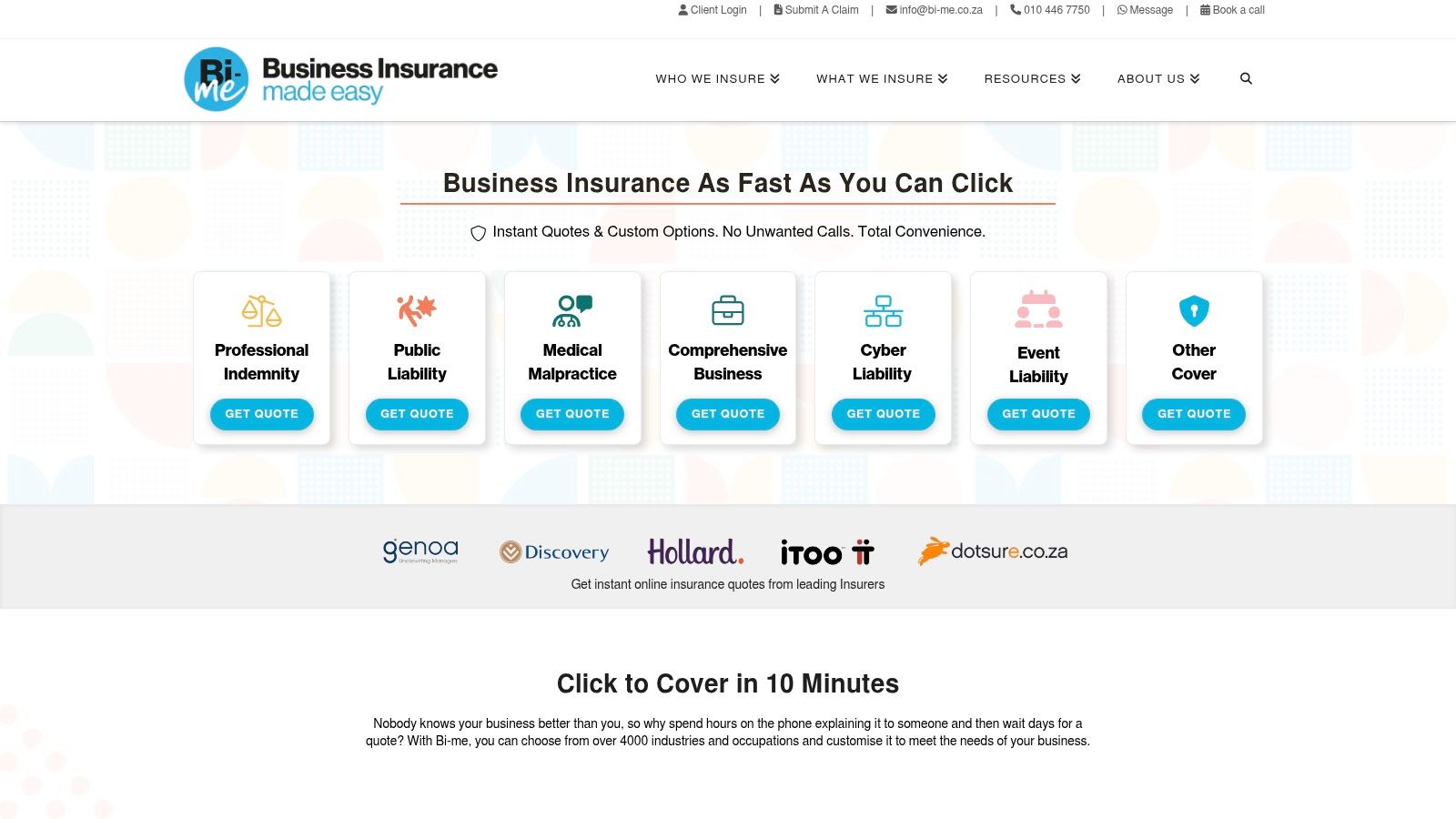
This is also where a digital platform like Bi-me becomes useful. Instead of guessing why one quote looks higher than another, you get a clearer view of the information behind the number. For an SME owner, that transparency matters because it helps you ask better questions, compare like for like, and spot practical ways to control cost before you buy.
Understanding Your Premium The Basics of Risk Pricing
An insurance premium is the price you pay for an insurer to take on a defined risk. In public liability, that risk is the chance that a third party says your business caused bodily injury or property damage and then seeks compensation.
A simple analogy helps. Car insurance doesn't charge every driver the same amount because not every driver presents the same level of risk. Age, driving history, vehicle type, and where the car is used all matter. Public liability insurance works the same way, except the “driver profile” is your business.
What public liability insurance actually covers
In practical terms, public liability insurance is a financial shield for claims brought by members of the public. That could be a customer slipping in your shop, a contractor damaging a client's property while working on site, or a visitor being injured because of your operations.
The key phrase is third party. It isn't there to cover your own damaged tools, your own stock, or your own employees' injuries under every circumstance. It's there for liability you may owe to someone outside your business.
That's why insurers want a clear picture of how your business operates. They're trying to estimate where third-party harm could realistically happen. The more public contact, physical activity, site work, or moving parts involved, the more carefully they'll price.
Why insurers price risk and not products
Insurers aren't selling a standard box off a shelf. They're accepting uncertainty. That's why there's no universal rate card that applies neatly to every SME.
Imagine lending someone your car. You'd feel very different about lending it to a cautious family member who drives short local trips than to someone who drives long distances in unfamiliar areas every day. The object is the same. The exposure changes.
Public liability premiums make more sense when you stop treating them like a product price and start treating them like a risk fee.
This is also why two businesses in the same broad category can receive very different quotes. One retail business may operate from a small, tidy premises with controlled foot traffic. Another may sell products, host promotions, and see heavy customer movement. Same sector. Different profile.
The premium becomes easier to understand when you look at the insurer's main question: How likely is a third-party claim, and how expensive could that claim be?
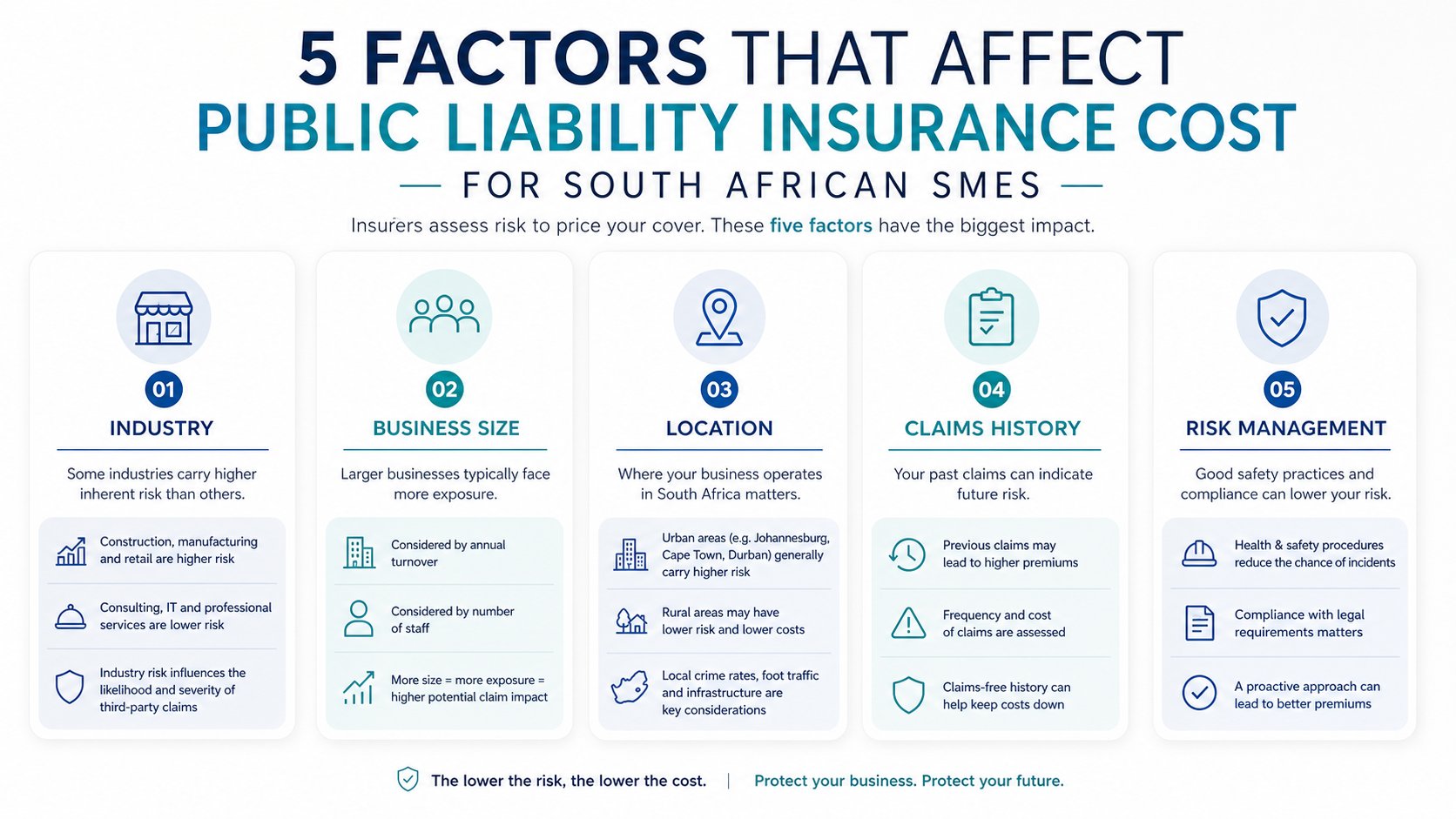
The 5 Key Factors That Determine Your Premium
The broad idea of “risk” only becomes useful when you know what insurers look at. In day-to-day underwriting, a handful of variables do most of the heavy lifting.
Industry and business activity
This is usually the first filter. A quiet office-based consultancy and a construction contractor don't create the same chance of third-party injury or property damage.
If you work in a trade that involves tools, site access, installations, food, crowds, or physical products, insurers generally expect more opportunities for something to go wrong. If your work is desk-based with limited public contact, the pricing pressure is usually lower.
That's why your business description must be accurate. “Consulting” and “project management on client sites” can sound close to a business owner, but they won't be assessed the same way by an underwriter.
Turnover and business size
Turnover often acts as a rough signal of business activity. More jobs, more customers, more staff, or more locations can mean more chances for a claim to arise.
Insurers commonly ask for turnover, employee count, and operational details when calculating a premium. For businesses seeking cover, this practical guide to public liability insurance options gives a good sense of how cover is matched to business activities and exposures.
A larger business doesn't automatically mean unsafe. It does mean the insurer sees a wider operating footprint.
Limit of indemnity
This is the maximum amount the policy will pay for covered liability claims, subject to the wording. The higher the limit, the more risk the insurer is taking on.
Public liability insurance in South Africa is most commonly purchased with coverage limits between R5 million and R10 million, which is the standard benchmark for many venues, municipalities, and client contracts requiring proof of insurance, as explained in this overview of event liability insurance limits in South Africa.
If a contract requires a certain limit, that requirement can set your minimum spend. You may not be choosing purely on budget. You may be choosing based on compliance.
How often the public interacts with your business
A business can be low hazard in theory and still carry meaningful liability exposure because of foot traffic. A small office that rarely sees visitors is one thing. A beauty salon, shop, restaurant, venue operator, or business that regularly visits client premises is another.
Consider the difference:
Low interaction: An architect who mostly works remotely and only occasionally meets clients.
Moderate interaction: A retailer with daily walk-in traffic.
Higher interaction: A mobile contractor entering multiple client premises each week.
The insurer isn't just pricing what you do. They're pricing how often other people come into contact with what you do.
Claims history and risk controls
Past claims matter because they show whether losses have already happened under similar conditions. A clean history won't guarantee the cheapest premium, but repeated claims can make insurers more cautious.
Risk controls matter too. A business that keeps incident records, trains staff, manages walkways, documents procedures, and supervises on-site work gives underwriters more comfort than a business that runs informally.
The cheapest premium often goes to the business that looks easiest to insure, not just the business that asks for the smallest quote.
Typical Public Liability Insurance Costs in South Africa
Once you understand the pricing levers, benchmark numbers become far more useful. They stop being random ranges and start acting like signposts.
In South Africa, small low-risk businesses with turnover under R1 million typically pay between R3,000 and R6,000 annually, medium product-based businesses face annual costs of R5,000 to R10,000, and high-risk sectors like construction can incur premiums exceeding R25,000 per year, according to historical quote data
Benchmarks by business profile
These figures are best read as examples, not promises. They help you place your business on the map.
| Business Type | Risk Level | Example Annual Premium | Example Monthly Premium |
|---|---|---|---|
| Small low-risk business with turnover under R1 million | Low | R2,800 to R6,000 | About R240 to R500 |
| Medium product-based business | Medium | R5,000 to R10,000 | About R417 to R833 |
| High-risk contractor such as construction | High | Exceeding R25,000 | Exceeding about R2,083 |
The monthly figures in the table are simple conversions from the annual benchmarks above. Real billing terms can differ between insurers, and the quote may still move based on your own details.
How to read these numbers properly
A common mistake is to match yourself only by industry label. That can lead you astray. A small contractor doing low-complexity work won't necessarily resemble a large contractor working on multiple third-party sites. A retailer with limited customer movement won't always resemble one with heavy daily traffic.
Use the benchmarks like this:
Start with your activity: Are you office-based, product-based, event-based, or site-based?
Then look at exposure: How many people interact with your business? Where does that interaction happen?
Then check contract requirements: Your client or landlord may require a cover limit that changes the price.
If your quote looks “too high” or “too low”, check whether the declared business activity and required cover limit actually match your operations.
Another point that trips people up is mixing annual and monthly thinking. Many owners focus on the monthly debit order because that's what affects cash flow. Insurers, however, are still pricing an annual risk profile in the background. That's why accurate annual turnover and operating details matter so much.
The public liability insurance cost that makes sense for your neighbour's business may be wrong for yours, even if both of you are classified as SMEs.
How to Get an Accurate Quote and Lower Your Premium
You fill in a quote form in five minutes, pick the cheapest number, and move on. A month later, a client asks for proof of cover with a higher limit, or a claim comes up and the insurer spots that your business description was too broad. The problem was not only the price. It was the quality of the information behind it.
That is why quote accuracy matters so much. Public liability insurance works a lot like pricing delivery fees. If the courier thinks you are sending a small parcel across town, but it turns out to be a fragile pallet going cross-country, the first price was never going to hold. Insurance works the same way. The more precisely your business is described, the more usable the quote becomes.
What information you need before you ask for a quote
An insurer is trying to build a factual picture of your day-to-day public exposure. That usually starts with a small set of details:
Annual turnover: This gives a sense of business scale and transaction volume.
Number of employees: More staff can mean more activity, more movement, and more chances for something to go wrong.
Nature of business activities: This should explain what you do in practice, not just your company registration wording.
Previous claims history: Past incidents help the insurer judge whether your risk has been quiet, recurring, or changing.
For some businesses, that basic snapshot is enough. For others, the questions go deeper. A business that works at client premises, handles products used by the public, or manages events will usually need to describe those exposures more clearly. The practical lesson is simple. Extra questions usually mean the insurer is trying to price your business more accurately, not trying to make the process harder.
How to improve price accuracy
Clear wording changes the quality of a quote.
“Maintenance services” leaves too much room for guesswork. “Interior painting, ceiling patching, and minor drywall repairs at client premises” gives the underwriter something concrete to assess. “Event services” is also too broad. “Indoor corporate networking events with temporary signage and hired furniture” is far more useful.
A digital quote process can help because it forces this clarity early. If you want a faster way to compare options, you can get small business insurance quotes instantly online using structured questions that reduce vague descriptions and make pricing easier to compare.
Before you submit, check these points carefully:
List every activity that creates contact with the public. Include site visits, deliveries, installations, product use, and events.
Use your best turnover figure. A rough guess can distort the quote from the start.
Check contract requirements. A landlord, venue, or client may require a specific cover limit.
Declare past claims consistently. Small differences between forms can create delays later.
Keep your business description aligned across documents. If your website, quote form, and proposal all describe different activities, an insurer will treat that as uncertainty.
This is one of the easiest cost levers to control. You cannot change your industry overnight, but you can remove avoidable uncertainty.
Practical ways to keep costs under control
Lower premiums usually come from lower uncertainty, better risk habits, or both.
Start with the basics. Good housekeeping, visible signage, staff instructions, maintenance records, and incident logs all help show that your business is being run with care. From an insurer's point of view, that matters because a managed business often presents fewer avoidable third-party risks than one that operates informally.
Then check the cover limit. A higher limit can be necessary if a contract requires it, but buying more than you realistically need can increase cost without adding much practical value. The right limit is the one that fits your exposure and your contracts.
One more point catches many SME owners. The cheapest quote is only cheap if it still works when you need it. If the insurer priced you as a low-footfall office business, but your real operation includes regular site work, product demonstrations, or public events, the saving on premium may cost you far more later.
Good insurance buying is really cost control through clarity. When you understand the levers, activity, turnover, claims history, cover limit, and how clearly you describe your work, you are in a much stronger position to compare quotes with confidence instead of guessing.
Making a Smart and Affordable Insurance Decision
The lesson behind public liability insurance cost is that the premium isn't random. It's built from identifiable facts about your business. Once you understand those facts, you stop shopping blindly.
That matters because insurance decisions often get reduced to one question. “What's the cheapest monthly premium?” A better question is, “Which policy gives my business the right protection at a price that matches my actual exposure?”
For SMEs that run events, pop-ups, activations, or public-facing functions, it also helps to think beyond the policy schedule. Operational planning changes risk.
If you want broader context on choosing coverage appropriate for a small business, this SME survival guide to tailored insurance is worth reading before you compare options.
A smart decision usually comes down to three things:
Know your risk profile
Declare your activities clearly
Compare cover on value, not premium alone
Do that, and the cost becomes easier to explain, easier to budget for, and easier to manage.
Bi-me helps South African SMEs compare business insurance options online, customise cover for their industry, and manage documents digitally in one place. If you want a simpler way to assess public liability insurance cost and compare suitable cover, explore Bi-me.
This is general information only and does not take into account your financial situation, needs, or specific objectives. As with any insurance, the cover will be subject to the terms, conditions, and exclusions contained in the policy wording.