
You've booked the golf day, lined up sponsors, and decided a headline prize will get people talking. A cash prize or vehicle for a hole-in-one can absolutely lift interest in the event. It can also create a nasty problem for a small business if someone sinks the shot and you have to fund the prize yourself.
That's where Hole in One Insurance – Prize Indemnity comes in. In simple terms, it lets an event organiser offer a major prize without setting aside the full prize amount in cash. But in South Africa, there's a detail many organisers miss. This cover usually works on indemnity, not on the basis of an automatic prize payment. If you misunderstand that point, you can run a polished event, have a player hit the shot, and still end up in a dispute.
Offering Big Prizes Without the Big Financial Risk
A golf day prize has one job. It must be exciting enough to make players stop, look, and talk about your event before tee-off. A small novelty prize rarely does that. A serious prize does.
The trouble starts when the marketing idea becomes a real financial exposure. If you promise a large cash amount, a vehicle, or another high-value reward and a player qualifies, your business has to honour that commitment. Most SMEs don't want to hold that level of prize money on standby for a single day's promotion.
Why organisers use prize indemnity
Prize indemnity shifts that risk to an insurer. You pay a premium upfront. In return, the insurer takes on the financial exposure attached to the prize, subject to the policy wording and the event meeting the agreed conditions.
That makes the event easier to budget. It also lets you promote a meaningful prize without tying up working capital that should be used elsewhere in the business.
Practical rule: If paying the prize yourself would hurt cash flow, you shouldn't offer it without checking whether prize indemnity is available first.
Where this fits in the bigger event risk picture
Hole-in-one cover only solves one problem. It doesn't replace the rest of your event risk planning. If you're hosting a corporate day, you should also think about public liability, venue requirements, suppliers, and participant-related exposures. A broader essential guide for event organizers is useful because prize indemnity works best when it sits inside a properly organised event plan.
The same applies if you're reviewing your wider liability exposure for the day. Event organisers often focus on the glamour of the prize and ignore the legal side of the event itself. This practical overview of how event liability insurance can save the day is worth reading alongside any prize discussion.
What works and what doesn't
What works is straightforward. You define the prize clearly, confirm the event format, identify the qualifying hole, and make sure your competition rules line up with the insurance wording.
What doesn't work is vague promotion. “Win something big if you ace this hole” may sound good on a poster, but it's useless if the prize terms, player eligibility, and proof requirements aren't documented properly.
How Prize Indemnity Insurance Actually Works
This is a risk transfer product. You're taking a low-frequency but potentially painful financial obligation and handing it to an insurer in exchange for a known premium.
The structure is simple enough to explain without jargon. You decide on a prize. The insurer evaluates the chance of that prize being won under the stated event conditions. If both sides agree, the policy is issued and the insurer assumes the defined prize exposure for that event.
The mechanics in plain language
Think of it this way:
You choose the prize and the competition format.
The insurer prices the risk based on the details of that event.
You pay the premium before the event.
The event takes place under the agreed rules.
If the qualifying feat happens and the conditions are met, the insurer settles the covered prize liability.
This is why prize indemnity is useful for businesses that want attention without volatility. Your cost becomes predictable. The possible payout remains large, but it's no longer sitting on your own balance sheet.
It's not only for golf
Prize indemnity isn't a niche golf trick. It's a broader South African risk-transfer tool used for promotions where a participant must achieve a difficult sporting feat. As noted in this overview of prize indemnity insurance, event promoters use it to avoid holding large cash reserves for major prizes, and the same model is used locally for challenges such as rugby kick-for-posts contests and score predictions.
That matters for SMEs because the logic is the same across formats. If your promotion depends on a measurable, rule-based outcome, there may be an indemnity structure for it.
A well-structured prize promotion should create excitement for guests, certainty for the organiser, and no confusion for the insurer.
What underwriters care about
Underwriters don't price this on enthusiasm. They price it on defined event risk. In practice, they look at matters such as the event setup, the qualifying feat, and participant profile. If the information is incomplete or inconsistent, the quote process slows down and the chance of claim friction rises.
The organisers who get this right do the boring work early. They confirm who may play, which hole applies, how the prize is described, who witnesses the shot, and what records the club will keep.
Calculating the Cost of Your Cover
This is usually the first commercial question. “What will it cost me to insure the prize?”
In the South African market, hole-in-one insurance typically costs about 2.5% of the total prize value, with examples showing R50,000 for a premium of R1,250, R100,000 for R2,500, and R150,000 for R3,750, according to FAnews on SHA's hole-in-one product.
A simple way to think about premium pricing
The practical takeaway is that the premium is usually a small, known cost compared with the size of the prize exposure. That gives you room to decide whether the promotional value of the prize justifies the insurance spend.
Insurers don't pull the premium out of thin air. The underwriting approach considers the probability of the feat and the size of the potential payout. In practice, organisers should expect the final price to depend on details such as the number of players, the hole being used, event duration, and participant profile.
If you've ever looked at other marketing cost models, the logic is familiar. A budgeting framework such as the YouTube creator CPM formula is different in purpose, but it shows the same planning discipline: know the exposure, know the spend, and decide whether the campaign return makes sense.
Estimated Hole-in-One Insurance Premiums (2026)
| Prize Value | Estimated Premium |
|---|---|
| R50,000 | R1,250 |
| R100,000 | R2,500 |
| R150,000 | R3,750 |
Budgeting decisions that help
The best organisers start with the total event budget, then test where the prize sits within it. That approach is more useful than choosing a flashy prize first and hoping the maths works later.
A few practical checks help:
Match the prize to your audience: A corporate client day and a charity golf day don't always need the same type of prize.
Check the full event insurance picture: If you're also buying liability cover, factor that into the total event cost. This guide on how much event liability insurance do you need in South Africa is a good companion piece when you're planning your overall budget.
Don't ignore admin requirements: A cheaper premium won't help if poor event setup causes claim trouble later.
Critical Policy Conditions You Must Meet
This is the section organisers need to read slowly. Most claim issues don't start on the green. They start in the planning phase, when someone assumes the insurer will “work it out later”.
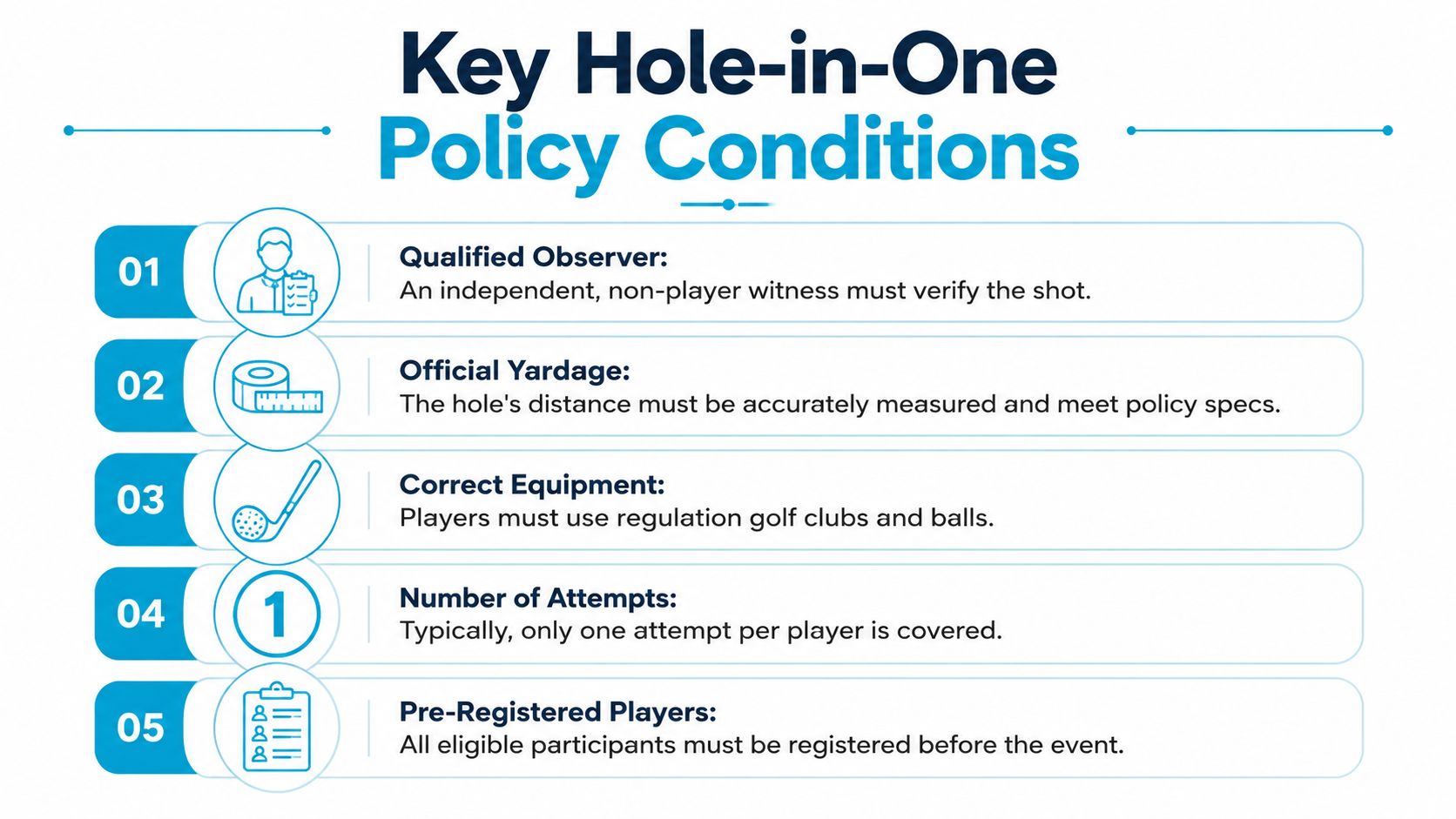
In South Africa, technical eligibility typically requires the hole-in-one to occur on a designated par-3 hole during a full 18-hole round, to be triggered by the first tee shot, and to involve amateur players only, as set out by policy wording of the relevant insurer.
The non-negotiables
Use this as a planning checklist before your event material goes out:
Amateur players only: If professionals are included where the wording excludes them, you've created a mismatch between the event and the policy.
Par-3 designation: The qualifying hole must be the specific type contemplated by the wording. Don't assume any short hole will do.
Complete 18-hole round: A shortened format or novelty setup may fall outside standard eligibility.
First tee shot only: If a player's second attempt goes in, that doesn't satisfy the normal trigger.
Registered course and official confirmation: Event documentation matters. In practice, clubs and officials must be able to confirm what happened.
Conditions that often catch organisers out
Some policies also operate with minimum yardage expectations. Standard prize indemnity mechanics usually require 150 yards for men and 130 yards for women for a qualifying shot, according to Western Financial Group's explainer on hole-in-one insurance. Even where your South African wording is the key document, it's still wise to check that the nominated hole's distance is properly measured and disclosed.
Another often-missed point is how liability is limited. Some South African wording works on a first-to-arrive basis, meaning the insurer settles the organiser's prize liability for the first participant who achieves the qualifying hole-in-one rather than every occurrence.
What to do before tee-off
A clean process protects everyone:
Set written competition rules before the day.
Name the qualifying hole in those rules.
Confirm player eligibility at registration.
Arrange independent witnesses or officials through the club.
Keep records immediately if a qualifying shot happens.
What doesn't work is fixing the rules after the fact. If the event team, sponsor, MC, and club manager all describe the prize differently on the day, that inconsistency can become a claims problem very quickly.
The Critical Misconception That Can Void Your Claim
The most dangerous misunderstanding in this area is simple. Many organisers think the policy is a prize fund that pays automatically if someone gets a hole-in-one.
It usually isn't.
South African hole-in-one policies generally operate on the indemnity principle. That means the insurance responds to your actual financial loss or legal liability to provide the prize, not to the sporting achievement in isolation. The point was tested in practice when the Ombudsman for Short-Term Insurance upheld a denial because the insured had not suffered a quantifiable financial loss or liability, as discussed in Moonstone's report on the hole-in-one insurance claim dispute.
Why this matters to an SME
If your event rules don't create a clear obligation to award the prize, you may have no indemnifiable loss. In plain terms, if you weren't on the hook to pay, the insurer may say there's nothing to reimburse.
That catches organisers because their marketing often sounds firmer than their legal position really is. A banner, social media post, or verbal announcement may create excitement. It doesn't automatically create a properly defined liability.
The practical test
Ask yourself these questions before the event:
Is the prize described clearly in writing?
Do the competition rules state exactly who qualifies and how?
Have you created a binding commitment to award the prize if the conditions are met?
Does that commitment match the insurance wording?
If the answer to any of those is “not sure”, the problem isn't the golfer. The problem is the event structure.
The safest approach is to treat the prize wording like a contract, not like advertising copy.
What works and what fails
What works is alignment. Your promotional material, entry terms, sponsor commitment, and policy wording should all point to the same promise.
What fails is assumption. Organisers often assume that once the premium is paid, the insurer has effectively bought the prize and will pay it no matter what. That's not how indemnity works. The policy protects a defined loss. It doesn't rescue a loosely drafted promotion.
This is the point most online guides skip, and it's the one most likely to matter if a player hits the shot.
Get Your Hole in One Cover Online with Bi-me
Many SMEs still run into the same operational problem when arranging specialised event cover. The insurance itself is manageable. The process around it is what causes delays. Phone calls, back-and-forth emails, missing forms, and late document requests can turn a simple event decision into an admin project.
Bi-me is built for South African SMEs that want a faster digital route into business insurance. It operates as a licensed financial services provider, not as the insurer itself, and gives businesses a structured way to compare cover options from local insurers, buy online, and manage documents through a self-service portal.
Why the digital route makes sense
For event organisers, speed matters because event planning rarely happens in a neat, linear sequence. Venues change. Sponsor decisions move late. Prize details are confirmed after invitations go out. A digital process helps because it reduces the lag between “we need cover” and “the policy is in place”.
The value isn't only convenience. It's visibility. When you can compare insurer options side by side, you're less likely to buy on premium alone and more likely to notice wording differences that matter.
What SMEs usually need from the platform
Bi-me's practical strengths are clear for time-pressed businesses:
Online quote access: Suitable for SMEs that don't want to wait for office-hours callbacks.
Side-by-side comparison: Useful when different insurers approach event-related risks differently.
Immediate documentation: Important when a venue, sponsor, or partner asks for proof of cover.
Self-service policy management: Helpful for retrieving schedules, certificates, and related documents in one place.
If your event also needs broader protection beyond the prize itself, Bi-me's event liability insurance solution is the logical place to review the liability side of the day.
Where this helps most
This works particularly well for SMEs that want a paper-light process and still need broker-backed guidance when the risk gets more specific. A standard office event is one thing. A sponsored golf day with a headline prize and multiple stakeholders is another.
For that kind of event, the best outcome is simple. The organiser understands the prize rules, the insurance is arranged properly, and there's no scrambling for paperwork when the event date arrives.
If you're planning a golf day or promotional event and want a simpler way to arrange business cover, Bi-me gives South African SMEs a digital route to compare quotes, purchase cover online, and manage policy documents through one platform.
This is general information only and does not take into account your financial situation, needs, or specific objectives. As with any insurance, the cover will be subject to the terms, conditions, and exclusions contained in the policy wording.