
Official metrics released by South African Banking Risk Information Centre (SABRIC) reported that South Africa suffered financial crime and fraud losses amounting to approximately R3.3 billion for the 2023 period, and around R2.7 billion for 2024. For one person, that can start with a fake bank message, then move to a stolen password, then end with a drained account and a credit record that takes months to untangle. A home policy won’t fix a hijacked Netflix login, and life cover won’t pay for identity restoration after someone opens accounts in your name. That gap is exactly where personal cyber insurance becomes relevant.
Introduction to Personal Cyber Insurance
A digital incident often starts in ordinary places, an email inbox, a banking app, a social platform, or a cloud folder, and then turns into identity theft, account takeover, or fraudulent transfers. A consumer may not notice anything is wrong until a bank declines a transaction or a lender flags unusual activity. By then, the hardest part is often not the money alone, it is the cleanup.
Personal cyber insurance is built for that cleanup. It focuses on the support and costs that follow digital fraud, identity abuse, or data compromise, rather than only the final payout. In South Africa, POPIA’s breach-notification duty makes this particularly relevant, because a compromised data subject has a legal notification right under section 22.
Traditional personal insurance is designed for physical loss, not a stolen password, a spoofed bank message, or a compromised online profile. Cyber cover fills that gap and helps people respond faster when their digital life is the thing under attack. It works a bit like a repair kit for a damaged car after a crash. The car may still be there, but it needs specific help before it can be used safely again.
A useful way to judge any policy is to read the wording closely. By Design Law’s cyber insurance guide is a helpful reference for seeing how cover is described in plain legal language, and that kind of wording check matters because hidden exclusions often sit in the details. One policy may cover account recovery but exclude certain fraud claims, while another may help with liability yet leave the policyholder to handle their own recovery costs. Bi-me’s platform is valuable here because it shows those wording differences side by side, making it easier to spot what is covered, what is excluded, and where two policies look similar but behave very differently in practice.
Understanding Personal Cyber Insurance Concepts
Think of a house. Home insurance protects the walls, roof, and contents if someone breaks in. Personal cyber insurance protects the digital version of that household, your identity, accounts, devices, and online activity when they’re tampered with or abused.
First-party and third-party cover
The most useful split is between first-party cover and third-party cyber liability. First-party cover is for your own loss, things like identity restoration, fraud recovery, incident response, and costs tied to fixing the mess. Third-party cover is different, it responds when someone says you caused harm through electronic-data activity or a rights breach.
That distinction matters because many buyers expect one policy to do everything. It doesn’t work that way. A policy that pays for your own account recovery may still exclude liability claims, and a liability-focused policy may not help much when your bank account has already been hit.
Practical rule: If the main fear is “I need help after my account is hijacked”, start by checking the first-party section of the wording, not the liability section.
A useful reference point is By Design Law’s cyber insurance guide, which is helpful for seeing how cover is usually described in plain legal language. That kind of wording check matters because the claims trigger often sits in the details, not the headline.
Why the risk has become more visible
Verified data shows total financial crime losses dropping to R2.7 billion in the 2024 reporting period, alongside digital banking fraud incidents climbing to roughly 64,000 cases totaling over R1.4 billion according to the SABRIC Crime Statistics Report. That doesn’t mean every consumer needs the same cover, but it does show why first-party cyber protection is no longer a niche concept. The risk is now closely tied to everyday behaviour, like logging in on a phone, paying online, or storing sensitive files in the cloud.
Who Needs This Cover and Policy Differences
Anyone who lives through a screen needs to think about cyber risk, but some people sit closer to the impact. Online shoppers, remote workers, people who use mobile banking daily, and households that keep passwords, documents, or photos in shared cloud storage have more exposure than someone who barely goes online. The same applies if your social profiles are public, because impersonation can move quickly from nuisance to financial harm.
The mistake is assuming other personal lines already handle this. Home insurance usually won’t respond to a phishing-driven bank loss. Travel insurance won’t help with a hacked inbox or a stolen online identity. Antivirus software helps prevent some problems, but it doesn’t reimburse fraud recovery costs or provide legal and forensic support after a breach.
A good rule of thumb is this, if the loss starts in your digital identity rather than in your physical possessions, you need to read a cyber policy, not a household policy.
The strongest buyers are often people with a lot of digital touchpoints, not just wealth. Frequent card-not-present purchases, cloud backups, and online account links create more ways for a scam to spread. South Africa’s payment environment also makes this more relevant, because remote payment channels remain a meaningful part of everyday activity, which increases exposure to phishing and unauthorised online transactions.
For a broader comparison of how digital protection is packaged in practice, it can help to look at Bi-me’s cyber insurance for small and medium South African businesses. The business setting isn’t the same as a household, but the comparison is useful because it shows how insurers separate digital risk from standard property risk.
Policy Types Underwriting and Required Documents
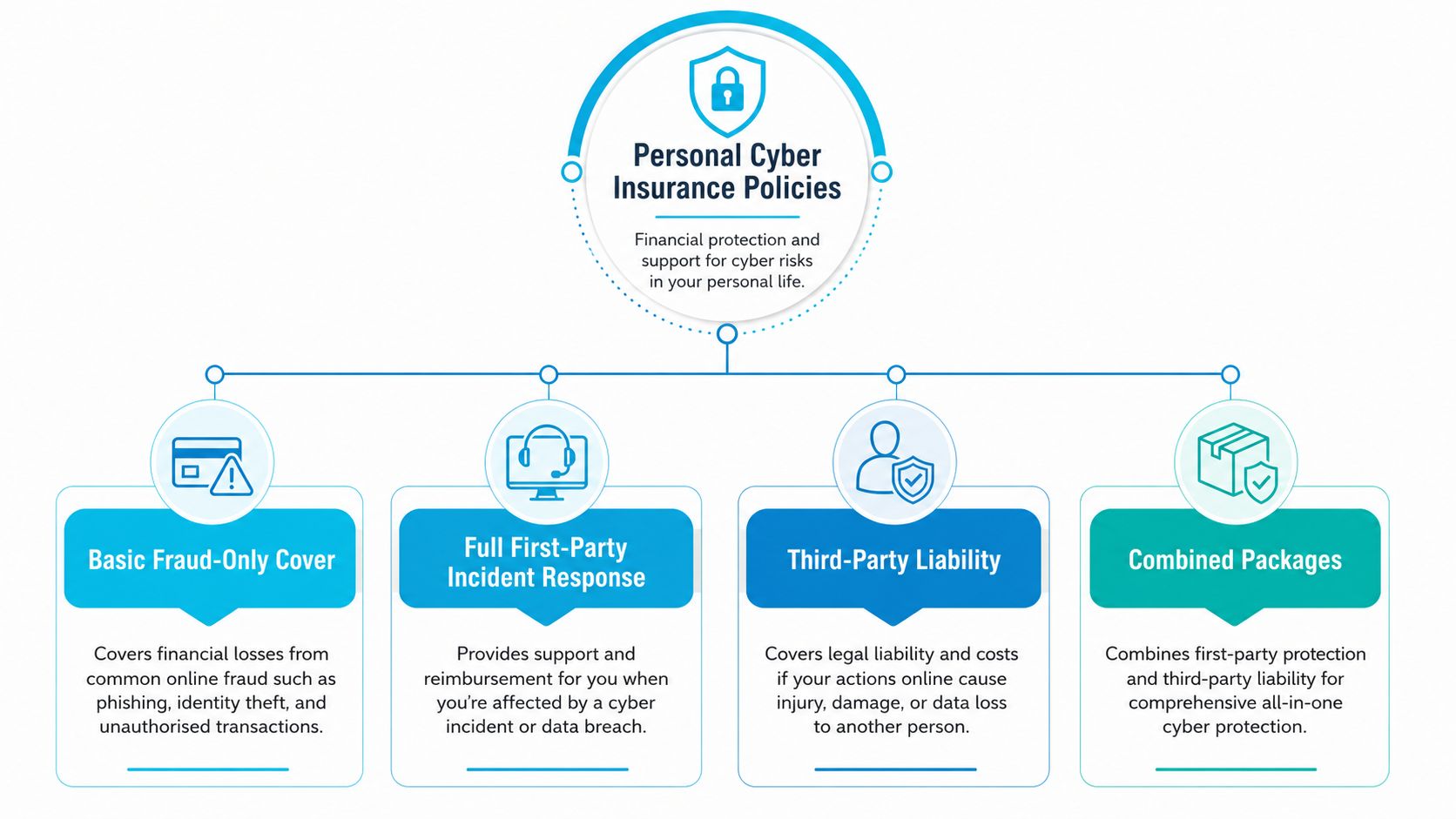
Personal cyber policies in South Africa generally fall into four broad buckets. Basic fraud-only cover focuses on direct financial loss and recovery support. Full first-party incident response goes wider, adding identity restoration, forensic help, and related response costs. Third-party liability is for claims made against you after a data-handling mistake or similar cyber incident. Combined packages bring those pieces together, but the wording still decides what’s included.
What insurers look at
Underwriting is no longer just a box-tick exercise. Insurers increasingly want evidence of the policyholder’s security posture, because baseline controls can affect eligibility, premium, and limits. Common checks include multi-factor authentication, endpoint protection, a documented incident response process, and proof that the setup has been tested. The technical reason is simple, a weaker account and a looser device environment usually create a more expensive claim path.
For higher limits, underwriters may ask for more than declarations. In practice, that can mean proof of security controls, recent testing, or evidence that serious findings were remediated. The point isn’t to punish users, it’s to make sure the cover matches the risk being accepted.
Documents commonly requested
A buyer should expect to gather a few practical items before applying:
- Proof of residence, because insurers still need to verify the policyholder’s address.
- Device inventory, so the insurer knows what computers, phones, and tablets the cover is meant to protect.
- Recent bank statements, especially where fraud or unauthorised payments are part of the risk picture.
- Evidence of security controls, such as screenshots showing MFA is switched on or records showing security settings have been enabled.
That documentation helps the insurer match the application to the actual risk. It also makes claims smoother later, because there’s less room for arguments about whether the policyholder had the controls they said they had.
A clear technical split is worth repeating once: first-party policies pay for identity restoration and fraud recovery, while third-party policies respond when you’re sued for data mishandling. That’s why the wording matters so much. Two policies can sound similar and still behave very differently when a claim lands.
The best policy isn’t always the broadest headline. It’s the one whose exclusions, triggers, and document requirements match your actual digital habits.
For people comparing different personal and equipment-related protections, Bi-me’s electronic equipment cover page is a useful reminder of how specific protection types are separated in practice. Cyber cover and equipment cover are not the same thing, and the distinction matters when you’re buying.
Step-By-Step Buying Checklist
Buying cyber cover works best when you slow down enough to check the wording before you click through. The shopping journey should feel like comparing bank accounts, not grabbing the first policy that looks cheap. Price matters, but the exclusions and response services matter more when fraud hits.
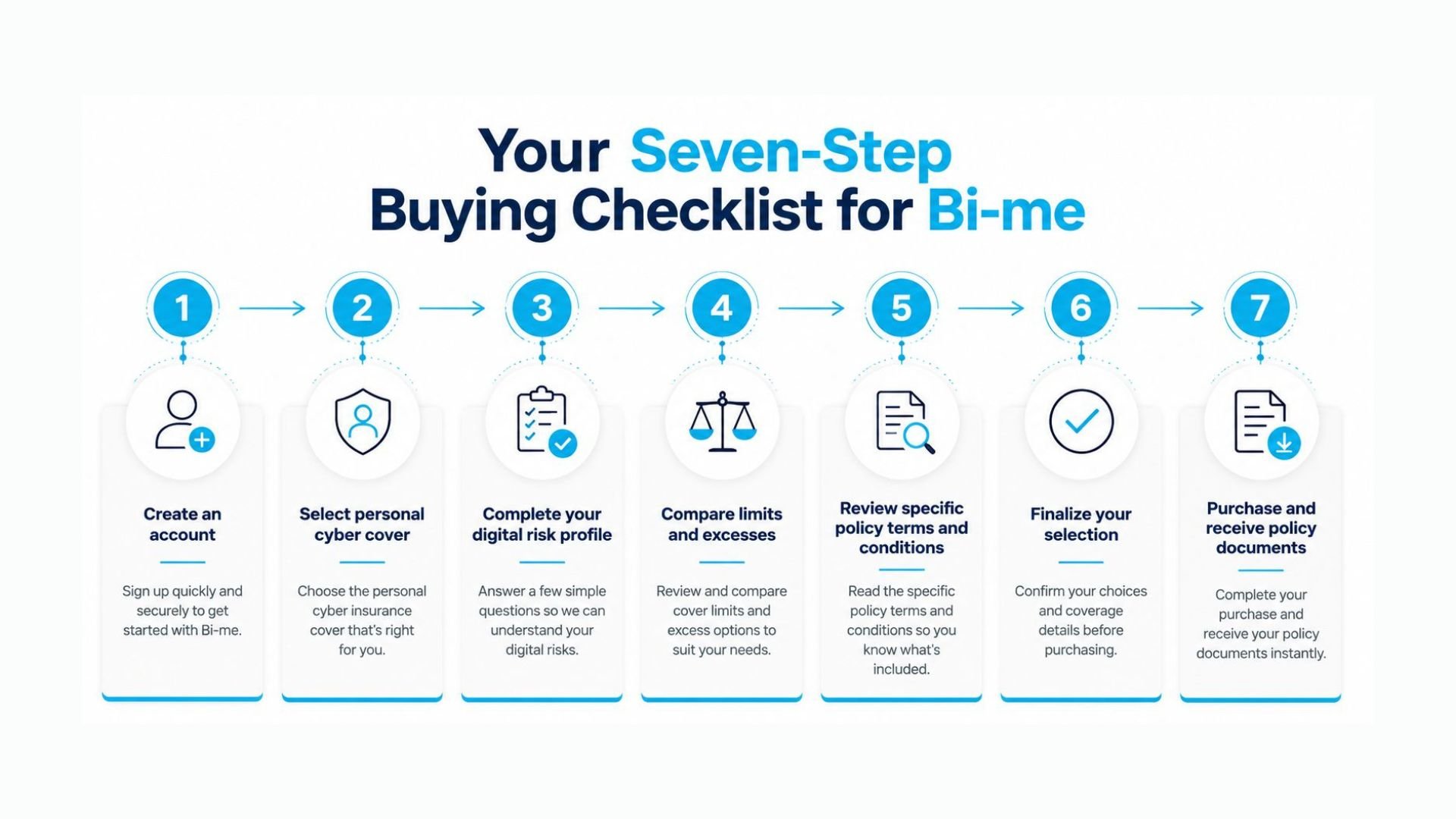
A practical seven-step sequence
- Start quote journey. Use accurate contact details so quotes, policy documents, and claim messages reach you without delay.
- Select personal cyber cover. Choose the product type that matches your risk, not just the lowest premium.
- Complete your digital risk profile. Be honest about the accounts, devices, and payment habits that matter.
- Compare limits and excesses. A low premium can hide a high excess or a narrow cap on recovery costs.
- Review the terms and conditions. Pay close attention to what counts as fraud, restoration, legal help, and device loss.
- Finalise your selection. Check the declaration carefully before purchase.
- Purchase and save the documents. Keep the policy schedule and wording in a safe, easy-to-reach folder.
The big habit to build is annual review. Security settings change, devices change, and account usage changes. A policy bought when you used one bank account and one phone may no longer fit after you add cloud storage, shared family devices, or a second payment app.
The practical companion to the buying process is security discipline. A policy can be priced more fairly when your controls are visible, documented, and maintained. For general digital-risk hygiene, Bi-me’s online threat protection guide is a useful reference point, even though the audience there is business-focused.
Keep the renewal date in the same calendar as your password review, MFA audit, and device backup check. That makes the policy part of your security routine instead of a once-off purchase.
How to Compare Quotes and Handle Claims
A quote table should do more than show price. It should put limits, excesses, exclusions, and sub-limits side by side so you can see which wording gives real protection and which wording only looks generous on the brochure. A policy that covers fraud recovery, for example, may still leave gaps in device restoration or legal support, while another policy may only respond to certain payment types. The cheaper quote can become the expensive one once a real incident starts.
What to compare first
Start with the trigger wording. Check whether the policy responds to identity theft, account takeover, unauthorised online payments, cyber extortion, or social-media impersonation. Then look at family-device loss or cyberbullying, because insurers often treat those items separately and sometimes place them in a narrow part of the wording.
Hidden exclusions are where many buyers get caught. A policy can advertise broad cyber protection and still limit recovery support, legal help, or device restoration. That is why wording comparison matters more than the marketing headline.
Bi-me’s side-by-side presentation makes these gaps easier to spot, because you can see the wording differences without reading one policy at a time and trying to hold every condition in memory. That matters when two quotes look similar at first glance but behave very differently once the claim file is opened.
A simple claims workflow
When something goes wrong, handle it in order.
- Preserve evidence. Save emails, screenshots, bank alerts, chat logs, and any notes that show what changed and when.
- Notify your insurer quickly. Claim timing matters, especially where the wording expects prompt reporting.
- Meet legal notification duties. POPIA section 22 requires notification when personal information is compromised, and the insurer may ask for proof that you took that step.
- Record the incident with authorities where relevant. The Cybercrimes Act 19 of 2020 gives South African law a formal way to deal with unlawful access, unlawful interception, data interference, and cyber fraud, so a case reference can help when the incident is criminal in nature.
- Track the claim and upload documents. Keep the correspondence, evidence, and forms in one place so the assessor can follow the sequence without gaps.
A good claims file reads like a timeline. It should show what happened, when you noticed it, what you did next, and which documents support the loss. That kind of record makes it easier for the insurer to decide whether the event fits the policy wording and where any exclusion may apply.
FAQ on Regulatory and Contractual Considerations
A cyber claim can start with a data leak, but what your policy pays often depends on fine print that many people overlook. POPIA section 22 says people must be told when their personal information has been compromised, so the legal process and the insurance claim may need to happen together. In South Africa, this can lead to costs for legal advice, expert investigation, and help communicating with affected people. These details matter because an insurer may only pay if the incident matches the policy wording and is reported the right way.
The law also affects how an insurer sees the incident. The Cybercrimes Act explains how South African law deals with illegal access, spying on data, data tampering, and online fraud. Because of that, the same event could be treated as a technical issue, a privacy issue, or a crime, depending on the facts. That can change how the claim is assessed. When you review a policy, do not only look at the loss. Look at the exact wording that triggers cover.
Family cover needs a close look too. Check whether children or dependants are included, and whether the policy also offers counselling or legal help for family members. One policy may include this, while another may not. That is why side-by-side comparison matters before you buy. Bi-me’s platform helps make these differences easier to spot, so important exclusions do not stay hidden in the fine print.
Support services also need careful reading. If a policy says it offers recovery help, legal support, or other assistance, check when those benefits actually apply. Some services may be included automatically, while others only apply in specific situations. A benefit that looks broad in the summary can be much narrower in the full policy. The wording should clearly show who is covered, what starts the benefit, and what is excluded.
Conclusion
Personal cyber insurance makes sense when your life runs through email, banking apps, cloud storage, and social accounts. An important buying lesson is not to chase the flashiest headline, but to check the exclusions, the first-party versus third-party split, and the proof insurers want at application and renewal. Strong digital hygiene can make cover easier to buy and claims easier to manage.
This is general information only and does not take into account your financial situation, needs, or specific objectives. As with any insurance, the cover will be subject to the terms, conditions, and exclusions contained in the policy wording.
Ready to compare personal cyber insurance? Use Bi-me to review cover side by side, see what’s included and excluded, and buy with confidence.