

You've got stock on a truck, a customer is waiting, and the driver has just texted that the vehicle was delayed at a robot or pulled into an overnight yard. That's the moment many South African SME (Small and Medium-sized Enterprise) owners realise the risk isn't the delivery itself, it's what happens while the goods are moving, parked briefly, loaded, unloaded, or handed over. Goods in transit insurance is built for that gap, and the policy wording matters just as much as the premium you pay.
South African businesses rely heavily on road freight, so transit losses can turn into immediate cash-flow pressure rather than a line item for later. The practical question isn't only “is the load covered?”, it's “is it covered for the way my business moves stock, stores it temporarily, and hands it over?” That's the thread running through this guide, with the traps, the trade-offs, and the buying questions that matter most.
What Goods in Transit Insurance Actually Is
A small distributor loads a pallet of stock at 7 a.m., the driver makes two stops, and by lunchtime the load has vanished. The van may be insured, but the goods inside are a separate risk. Goods in transit insurance covers stock a business owns or is responsible for while that stock is being moved from one place to another.
The working definition
Goods in transit insurance is short-term cargo protection for the journey. It is not warehouse cover and it is not cover for stock already handed over at the customer's storeroom. In South African practice, the cover is usually tied to the period when the vehicle leaves point A and ends when the goods are delivered, with losses before loading or after unloading sitting outside that transit window (motor-transport practice guidance). That timing matters, because a policy can sound broad while still leaving the fragile parts of the trip outside the insured period.
For SMEs, the issue is often commercial rather than statutory. The party moving the goods can still face financial exposure through the contract of carriage even where there is no standalone legal rule forcing the purchase of transit cover (contract and liability context). In plain language, if your business is responsible for the stock while it is moving, the loss can still land on your balance sheet unless the policy responds.
The practical question is whether the policy covers the way your business moves stock, stores it temporarily, and hands it over. That is the gap many cheap policies miss, especially where goods are left in a vehicle, passed through a depot, or staged for cross-border movement. For a closer look at how transit cover fits with storage and movement risks, see transportation and storage cover options.
Practical rule: if the goods are in a vehicle, at a handover point, or in a temporary holding area linked to the transit, ask whether the policy still treats them as “in transit”.
The rest of the guide keeps one question in view, what the policy does when stock is stolen, damaged, delayed, mislaid, or left in a risky place for a few hours. That is where South African loss patterns matter. Hijackings, unattended-vehicle theft, and cross-border staging can expose gaps that are not obvious on a quote sheet, and those gaps are often where a cheap policy stops being a fit-for-purpose one.
The Main Types of Transit Cover Available
A quote for goods in transit insurance can look simple at first glance, then the wording starts to matter. For a South African SME, the key question is usually how the cover matches the way stock moves, because a business that sends the same load every week has different needs from one that only ships now and then. Some policies are built for a single journey, others are meant for repeated movement, and some are narrow enough that they only respond after a very specific loss event.
Restricted cover and broader cover
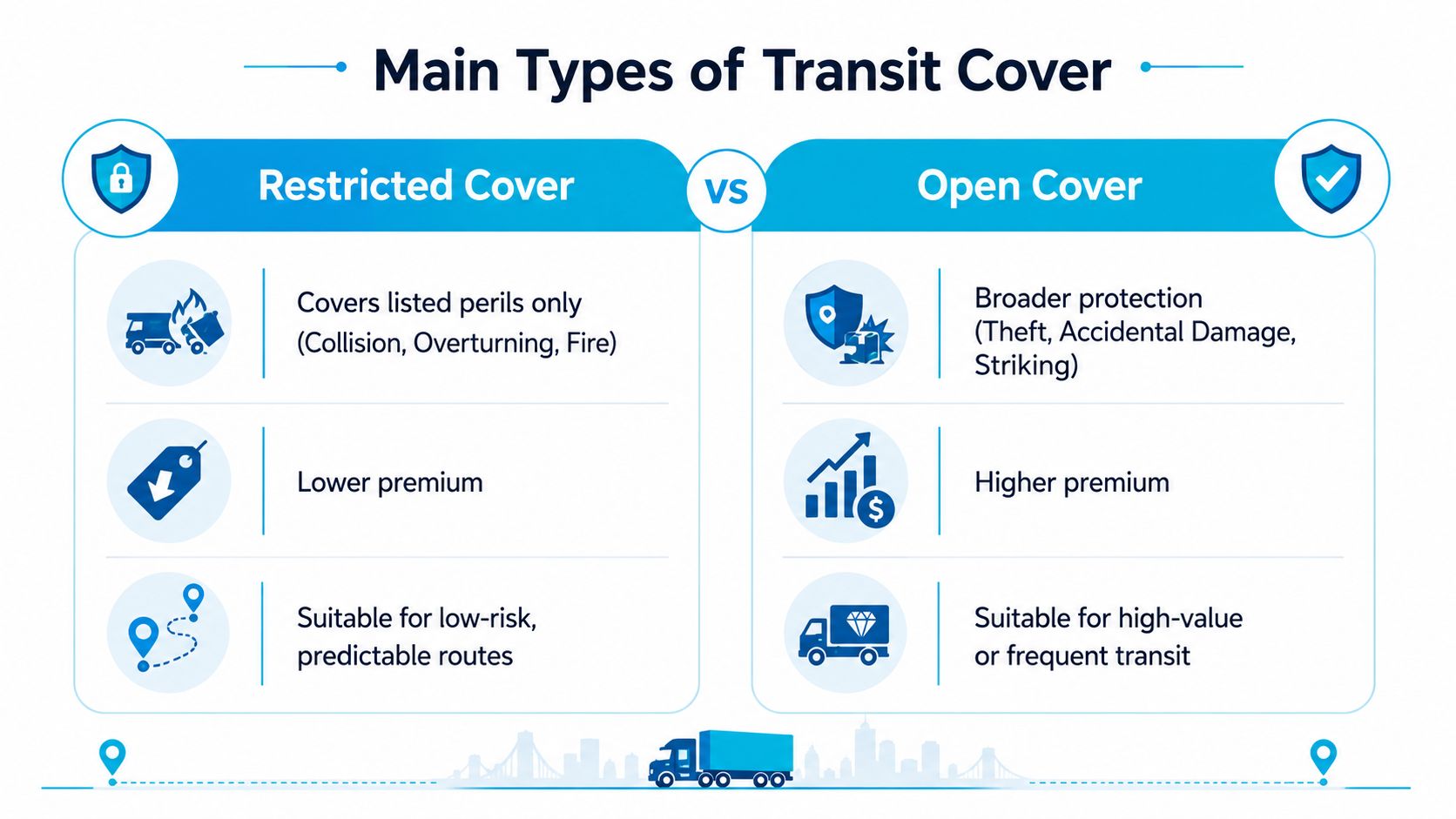
Restricted cover usually pays only for named events, such as collision or overturning, and sometimes a small number of other listed perils. That can suit a business with predictable routes and low exposure, where the main worry is a clear road incident. Broader cover goes further, because it can include theft, fire, pilferage, loading and unloading, and temporary garaging while goods are still part of the transit process. For a useful explanation of how transit wording can differ from one policy to another, see Bi-me's transportation and storage business insurance page.
The difference is often the same as buying a plain vehicle warranty versus a wider motor plan. The first one is cheaper because it protects against fewer situations. The second costs more because it is written for the awkward losses that happen between supplier, depot, customer, and border point. That matters in South Africa, where hijacking risk, unattended-vehicle theft, and temporary storage can sit right in the middle of a normal delivery run.
Single trip and annual cover
Some businesses only move stock from time to time. A once-off courier job, a seasonal shipment, or a one-off delivery to a customer can fit a single-trip approach, because the cover is tied to that specific movement. A wholesaler, retailer, or distributor that keeps sending goods out during the year usually gets a better fit from an annual open-cover style policy, since the admin is lighter and the insurance follows the business pattern instead of each booking.
The practical difference is simple. Single-trip cover is like buying a ticket for one ride. Annual cover is closer to a standing arrangement that keeps working as long as the policy stays active and the shipments fall within the terms. If your stock leaves the warehouse often, the second option usually makes more sense because you are not starting from scratch every time a truck leaves.
Road, rail, sea and air
Road freight carries most inland goods in South Africa, so many business owners assume transit cover is mainly about the truck. The mode still matters, though, because each one brings a different risk pattern and a different set of handover points. Rail, sea, and air all involve separate loading, storage, and transfer steps, and any inland leg linked to a port or terminal can change how the wording works.
A policy has to follow the route, not the short version on a sales quote. If a business mainly moves by road but sometimes adds cross-border or multi-modal legs, the wording should still make sense at the depot, at the border, and at the point where the goods change hands. That is where many cheaper policies become too narrow. They may look fine on the quote sheet, then leave gaps once the shipment leaves the truck and enters a holding point, a terminal, or a staging area.
What Is Typically Covered and What Is Not
A transit policy should read like the route itself. The goods leave the warehouse, move through the journey, may pause at a depot, border post, or staging point, and then change hands at delivery. The wording matters because the insured journey starts, pauses, and ends exactly where the policy says it does.
Common cover points
Most policies of this kind respond to collision, overturning, fire, theft, hijacking, and water damage. Some also include loading and unloading accidents, and some extend to temporary storage while the goods are still part of the transit chain. The wording in a goods in transit policy should make that clear, because many SMEs read “in transit” as only the hours the truck is moving, while the exposure often sits at the handover point.
The exclusions that catch people off guard
Claims disputes often begin in the fine print that the buyer did not slow down to read. Common trouble spots include unattended-vehicle theft, mysterious disappearance, inadequate packaging, wear and tear, and employee dishonesty. Losses outside the insured transit window create another trap, because the goods can still be physically on site and yet fall outside the policy once transit has ended.
A Johannesburg warehouse may have stock sitting on a truck overnight, or a delivery team may leave pallets in a yard while waiting for access. If a theft happens in that gap, the insurer will look closely at whether the policy still treated the load as being in transit and whether the security requirements were met. That kind of gap is also where businesses benefit from tools that optimize claims operations, because the claim file often decides how smoothly the loss is handled.
Cross-border and temporary storage
Border delays, overnight stops, and staging at depots create a grey area. A shipment may still feel active from the business side, but the policy can treat it as storage or as a completed leg, depending on the wording. Cross-border buyers need to examine the route carefully, especially where the journey includes ports, depots, border posts, or temporary warehousing. The question extends beyond what the brochure says to where the policy defines the insured journey's start, pause, and end points. If that wording is unclear, the highest-risk part of the trip may be the part that is least protected, and a business that expects help after a loss may need to start a claim with Bi-me sooner than planned.
The cheapest policy is often the one that excludes the exact loss pattern your business is most likely to face.
Real-World Claim Scenarios for South African SMEs
A Johannesburg-to-Durban load of branded stock gets hijacked on the corridor. The driver survives, the vehicle is recovered later, and the owner expects a straightforward payout. The claim turns on two things immediately, whether the loss happened during the insured transit window, and whether the policy wording is broad enough to deal with theft or hijacking rather than only collision or overturning.
That's where documentation and process matter. If the business can show the dispatch note, load schedule, driver details, and route controls, the claim file is much easier to defend. For firms that want to tighten up this side of the process, it's worth using a toolset that helps optimize claims operations, because the quality of the claim file often matters as much as the cover grant itself.
Rain at an overnight depot
An electronics wholesaler leaves cartons at an overnight storage point because the client can't receive the shipment after hours. Heavy rain gets into the holding area and damages several boxes. The policy response depends on whether the temporary storage was still part of the transit journey, whether the cover included water damage, and whether the storage arrangement met any security or packaging conditions.
This is the kind of loss many SMEs misread. They assume the goods were “just waiting”, but the insurer may treat the stop as a distinct exposure with its own wording rules. The outcome often hinges on the policy schedule and the supporting photos, transport documents, and damage records.
A shipment stuck at the border
A cross-border load is held at a border post for several days. The driver parks nearby, the goods are not yet delivered, and the business thinks the cover has paused. Depending on the wording, the policy may still treat the goods as in transit, or it may regard the extended stop as storage and trigger different conditions.
That's why border crossings and overnight staging are not minor admin details, they're part of the risk. If your business uses subcontractors, route planners, or customs agents, the practical question is who is responsible for the cargo at each handover point. The claims team on Bi-me's claims page will usually need the same story the insurer needs, what moved, where it stopped, who had custody, and what proof exists.
How Valuations, Limits and Premiums Work
Transit cover is easy to misprice because the quote can look simple while the valuation logic sits underneath it. A business can underinsure itself by declaring too little, or waste money by declaring too much. The right starting point is to match the insured amount to the actual commercial exposure, not just the invoice on a single day.
Valuation and insured amount
A common cargo-insurance practice is to insure at CIF value plus 10% (cargo valuation guidance). That approach reflects the goods themselves, plus a margin for incidental costs and expected profit. For importers and exporters, this matters because Incoterms affect when risk passes between seller and buyer, so the valuation basis has to match the trading terms, not just the invoice figure.
Limits and excesses
The policy limit is the maximum the insurer will pay for one vehicle or one shipment. The excess is the amount the business carries first. A higher excess can lower the premium, but it can also create pain if a smaller loss turns into a large out-of-pocket cost. If the load value regularly moves above the limit, the policy may look active while still leaving a shortfall on claim day.
| Typical Premium Drivers in Goods in Transit Cover | What it means for the business | Typical impact on premium |
|---|---|---|
| Declared value | Higher cargo values raise the insurer's exposure | Usually pushes the premium up |
| Type of goods | Fragile, high-risk, or theft-prone stock is harder to insure | Often increases cost or tightens wording |
| Mode of transport | Road, rail, sea, and air each carry different handling risks | Can change both price and exclusions |
| Route and geography | Long-haul, border routes, and known theft corridors matter | Higher-risk routes often cost more |
| Security controls | Tracking, vetted drivers, secure parking, and packaging help reduce risk | Better controls can improve terms |
| Claims history | Past losses tell the insurer how the risk behaves | Frequent claims can raise cost |
| Policy structure | Annual cover and single-trip cover work differently | Annual policies often suit regular movement |
Choosing the Right Cover for Your Business
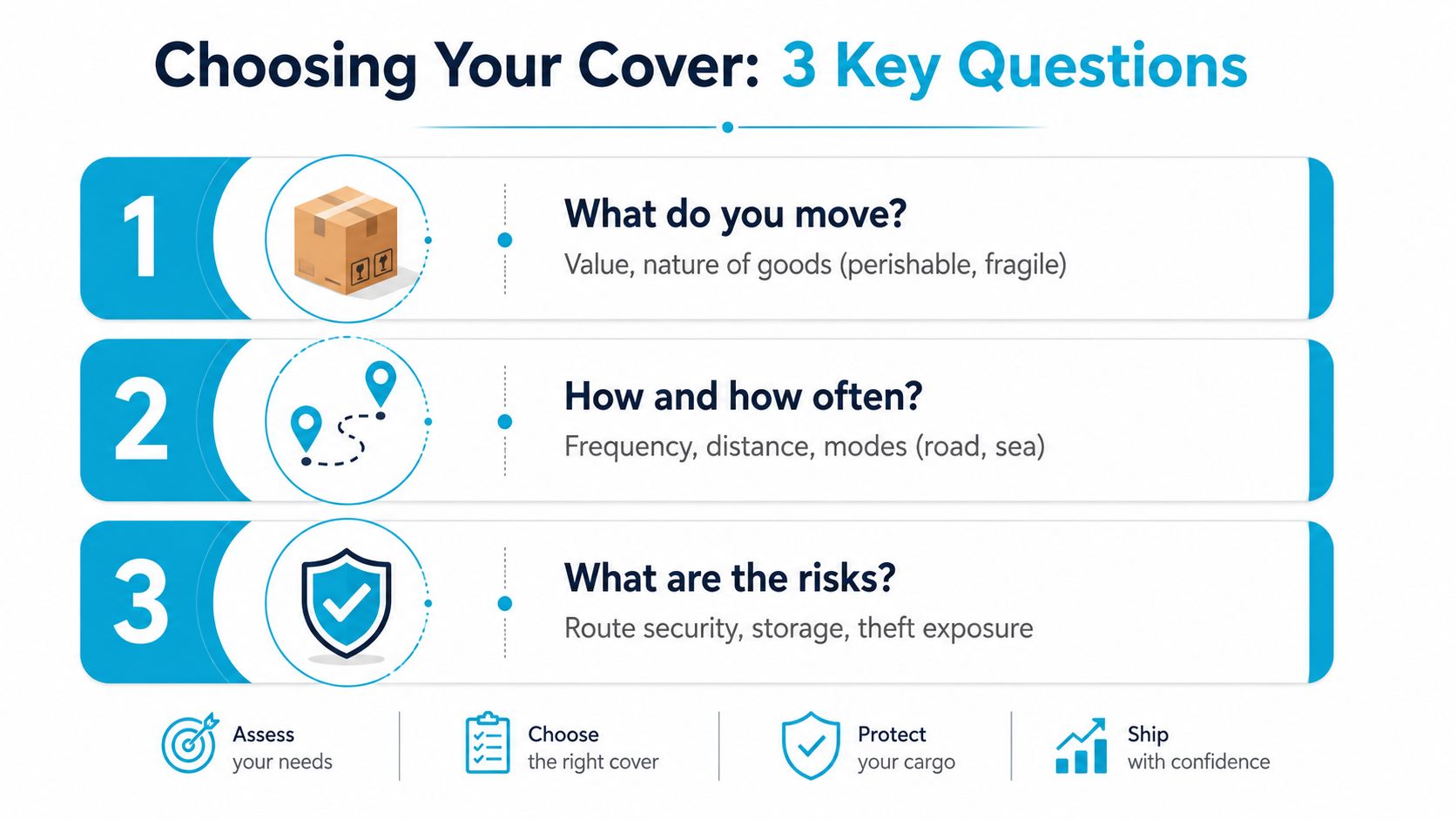
The right policy starts with three blunt questions. What do you move, how often do you move it, and how far does it travel? If the answer is “a few predictable local deliveries”, the cover brief looks very different from a business that sends mixed stock across provinces, across borders, or through multiple handover points each week.
Match the policy to the loss you can't absorb
A retailer carrying a modest weekly load may only need basic restricted cover if the route is simple and the security controls are tight. A wholesaler moving high-value electronics, or a manufacturer sending stock through depots and overnight parking, usually needs a broader wording that addresses theft, loading, unloading, and temporary storage. The right policy is the one that closes the gap between a single loss and a business-threatening cash hit.
Ask about the controls you already use
Insurers look at the business as it is run, not as it looks on a brochure. Vehicle tracking, driver vetting, route planning, secure parking, and packaging all affect how the risk lands. If your team already uses these controls, bring them up early, because they help the conversation move away from price alone.
Useful test: if you changed your route tomorrow, added a border stop, or moved into a higher-value product line, would the policy still fit without amendments?
A good broker conversation should sound practical, not abstract. Ask whether the wording handles hijacking, unattended-vehicle exposure, cross-border delays, and temporary storage. If the answer feels vague, the policy probably is.
How to Buy and Manage Cover Through a Digital Broker
A first-time buyer often starts with a simple question, how do I get transit cover without getting buried in forms and phone calls? Digital broker tools make that process easier to handle. They collect the business details, match them to suitable cover, and issue the paperwork online, so an SME can move from quote to policy without the usual delays. Bi-me's digital quote-and-buy flow is designed to provide cover in minutes for eligible products, replacing the slow, paperwork-heavy experience often associated with traditional business insurance.
What the online journey usually looks like
You begin by describing what the business does, what it carries, and how often those goods move. The quote engine then lines up that profile with relevant cover options, so you can compare premiums and wording side by side before you buy. That is a better starting point than choosing the cheapest number first and only reading exclusions later.
A useful way to judge the process is to ask whether the broker helps you understand the policy, not just purchase it. A goods in transit policy is a bit like a seatbelt in a vehicle. You want to know how it works before you need it, not after something has gone wrong.
Once the cover is active, the client portal matters just as much as the quote. Policy documents, renewals, changes, and certificates should be easy to access, because proof of cover is often needed by customers, subcontractors, and logistics partners. If a buyer, depot, or freight partner asks for evidence, you should not have to search through old emails to find it.
For that, the Bi-me certificates of insurance page is the sort of tool many SMEs end up using often, especially when they need quick proof of cover for a contract or dispatch requirement.
What to keep updated
If the business starts moving new goods, changes route patterns, or begins crossing borders, the policy should be reviewed before the first load leaves. The same applies if vehicle security, parking arrangements, or subcontractors change. Digital convenience helps, but the risk still needs to be described accurately, because a policy that matches last month's operation may leave gaps once the operation changes.
That is where South African loss patterns matter. Hijacking, theft from unattended vehicles, and losses linked to cross-border staging all raise different questions for wording and security controls. A cheap policy can look fine on the quote screen, then struggle to respond when the exposure sits in the route, the stopover, or the loading process.
Quick Reference and Common Questions
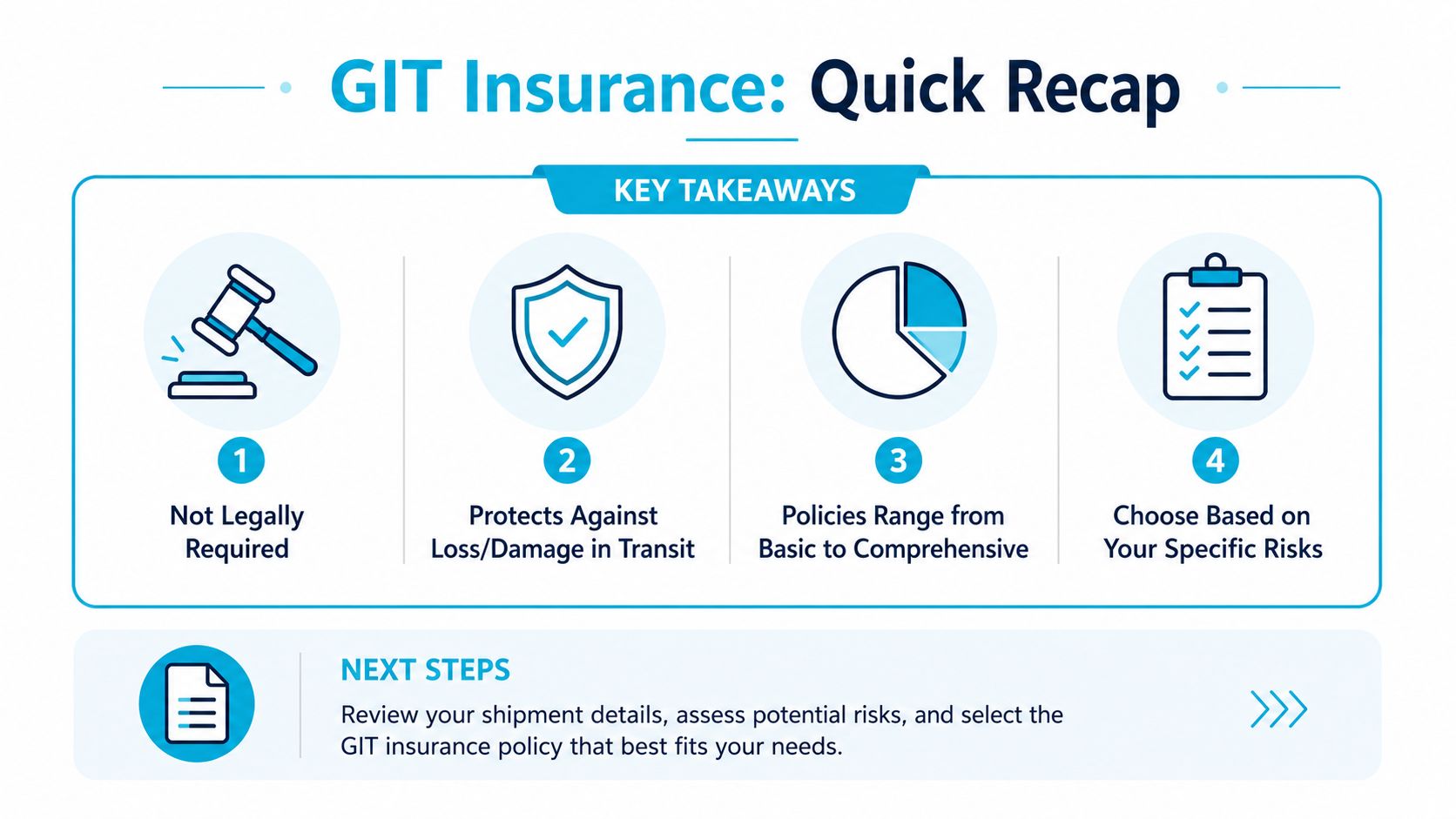
Quick recap. Goods in transit insurance is usually not a legal requirement, but it's commercially important for any SME that moves stock. The wording matters more than the cheapest quote, and the right cover should match the route, the goods, and the way the business operates.
Is goods in transit insurance mandatory in South Africa? Usually not by law, but contracts, customer requirements, and commercial exposure can make it essential.
Should I choose annual or single-trip cover? Use annual cover if you move stock regularly. Use single-trip cover if the movement is occasional and tightly defined.
What documents will I need for a claim? Expect to need the policy, transport documents, proof of value, and photos, with extra records if the cargo is perishable or sensitive.
How do I add cover when my business changes? Review the policy before you start moving different goods, using new routes, or adding cross-border legs.
If you're comparing transit cover for your SME, Bi-me lets you quote, compare wording, and manage cover online, with broker support when you need it. Visit Bi-me to find cover that fits how your stock moves.