You're waiting for a repair quote, a tow invoice, or a call from a driver, and then the real question lands. Was the vehicle properly insured for the work it was doing, or was it sitting on private motor cover that was never intended for deliveries, call-outs, stock runs, or client visits?
For many South African SMEs, car insurance for business vehicles only becomes clear after a claim. The vehicle may be registered in the business name, in a director's name, or in an employee's name, but the key issue is usually simpler. How was it being used when the loss happened, and what type of cover was actually in force?
In South Africa, that distinction matters. A vehicle used for paid work can fall outside the intended use of an ordinary private motor policy, especially where there are deliveries, tools, goods, site visits, staff transport, or regular business travel involved. With theft, hijacking, accident frequency, and repair costs all putting pressure on local businesses, the difference between private-style cover and commercial cover can decide whether the business recovers quickly or absorbs a major loss.
A sensible policy decision is rarely about chasing the cheapest monthly premium first. It is about matching the cover to the way the vehicle works in the business, then checking whether the policy deals properly with accidental damage, theft, hijacking, third-party property damage, excesses, replacement transport, salvage, and downtime.
When Your Business Car Is Suddenly Uninsured
Jabu runs a small electrical company. His van spends the week collecting fittings, travelling to jobs, and delivering urgent parts to clients. The van is written off in a collision, and he assumes the claim will be straightforward because the premium has always been paid on time.
Then the insurer or broker asks the question that changes everything. What was the vehicle doing at the time of the accident?
If the policy was written for private use, but the van was being used for business operations, the claim can become difficult very quickly. The problem is not the logo on the door. The problem is the declared use on the policy schedule and whether that use matches reality.
That is the gap many owners miss. A car, bakkie, or van becomes a business insurance issue because of the job it performs. Once it is used for deliveries, site visits, call-outs, carrying tools, carrying stock, or supporting paid work, the insurance question changes from "Do I have car insurance?" to "Does this policy respond to the way this vehicle is used?"
South African road and crime conditions make this even more important. A vehicle that is essential to revenue can be exposed to collision damage, theft, attempted theft, hijacking, malicious damage, and recovery complications. A policy that was cheap on paper can become expensive if the vehicle is off the road and the wording does not fit the actual risk.
Practical rule: if a vehicle earns income, supports paid work, carries work tools or goods, or is regularly driven for business purposes, treat it as a business vehicle risk unless your insurer confirms otherwise in writing.
For the owner standing at the roadside, the lesson is simple. A low premium means very little if the vehicle is outside the declared use category when the claim happens.
What Counts as a Business Vehicle
The simplest test is this. If the vehicle supports the business's operations, service delivery, sales activity, or income generation, it should be assessed as a business vehicle exposure.
That can include vehicles owned by the company, by a sole proprietor, by a director, or even by an employee who uses a private car for regular work duties.
Ownership and use are not the same thing
A company-owned bakkie is the obvious example. So is a courier van, a plumbing vehicle, a sales rep's sedan, or a panel van used for deliveries. Less obvious is the director who uses a personal SUV for client meetings, or the employee who uses a private hatchback for banking, collections, and supply runs.
In insurance terms, those scenarios can lead to different underwriting outcomes because ownership, regular use, and insurable interest do not always line up neatly. The registered owner, the policyholder, the main driver, and the person using the vehicle for work may all be different.
This is also where South African registration and entity details matter. If the vehicle is registered to a company, close corporation, trust, or other juristic person, the insurer will usually want the business's legal details as part of underwriting. If it is registered to a natural person but used mainly for business, that use must still be disclosed properly.
Usage changes the answer
Insurers focus on what the vehicle does day to day. A car used mainly for commuting with occasional business meetings is not the same risk as a van doing daily deliveries, and neither is the same as a bakkie carrying tools and materials between sites.
For South African SMEs, dual-use vehicles are often where the confusion starts. A double-cab bakkie may act as a family vehicle on weekends and a workhorse during the week. A personal car may be used by a staff member for both commuting and company errands. Those mixed-use patterns must be declared clearly, because the underwriting answer depends on the actual operating role of the vehicle.
If you want to see how this logic fits broader SME cover, the product page for business insurance for transport and storage gives a useful industry context.
A private motor policy and a commercial motor policy may insure the same vehicle, but they do not always respond to the same type of use.
The safest test is the daily-use test. If the vehicle is tied to revenue, field work, service delivery, stock movement, or client support, assume it needs business-use disclosure and commercial-appropriate cover unless the insurer confirms a different position in writing.
Core Cover Types and What They Actually Pay For
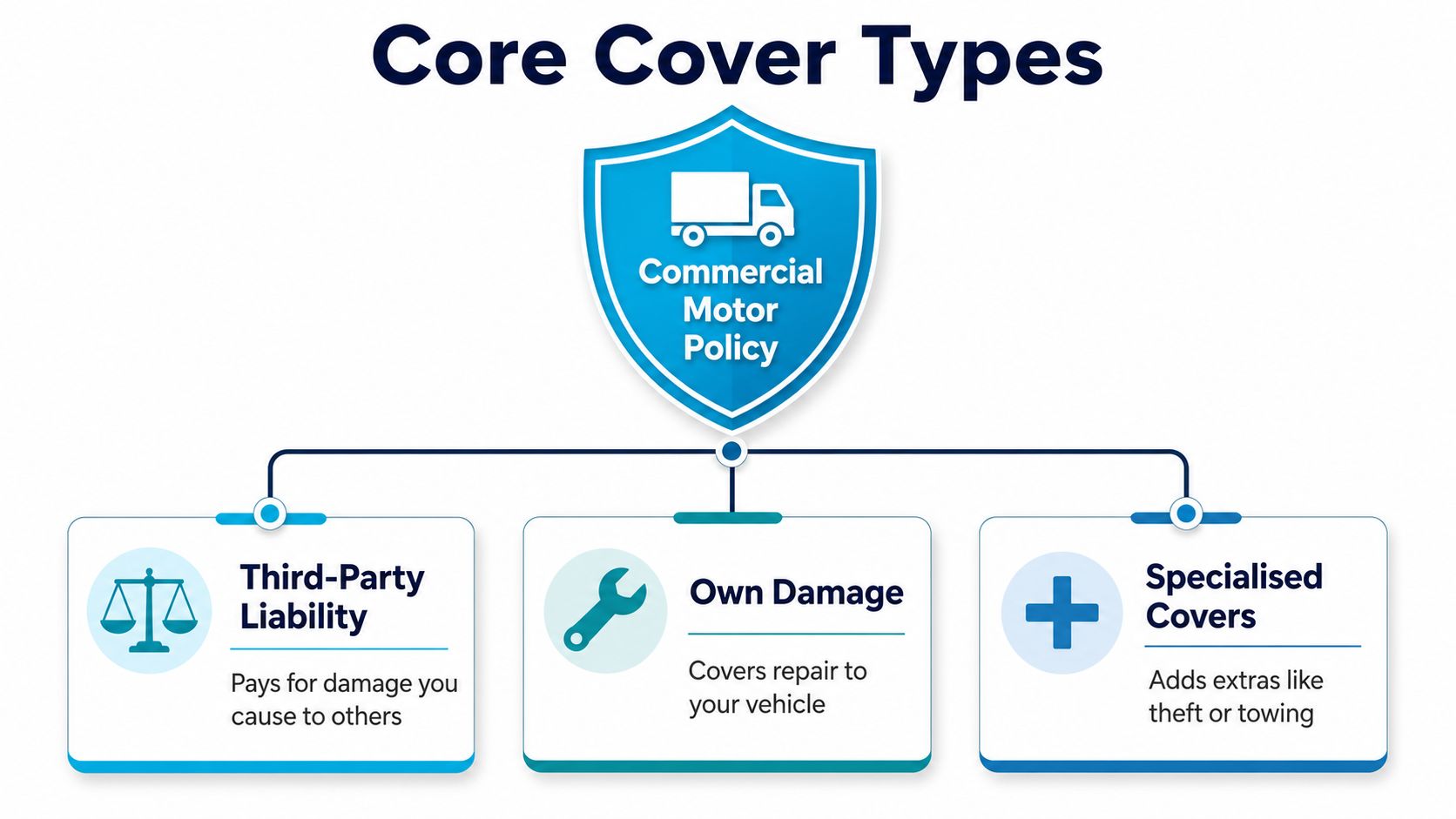
Commercial motor cover usually works in layers. One part protects you when your vehicle damages someone else's property. Another protects the insured vehicle itself. Additional sections may help with theft, hijacking, towing, car hire, or loss-of-use type costs.
Liability, own damage, and the Road Accident Fund
Third-party property damage cover is one of the most important parts of a South African business vehicle policy. If your driver crashes into another vehicle, a gate motor, a shopfront, warehouse doors, boundary walls, or expensive equipment, the business can face a substantial property damage claim.
For many SMEs, practical third-party property damage limits often start around R5 million and can extend to R10 million, R20 million, or more, depending on the insurer, the vehicle type, the business activity, and the risk appetite of the policyholder. The correct limit depends on exposure. A vehicle operating in dense urban areas, industrial premises, logistics yards, office parks, or customer sites can cause losses that are far higher than many owners expect.
The Road Accident Fund (RAF) sits in a separate legal space. In South Africa, the RAF is designed to compensate people for bodily injury or death arising from motor vehicle accidents, subject to the rules of the scheme. That does not repair your business vehicle, replace stolen assets, or pay for third-party property damage. It also does not solve the operational problem of a vehicle being off the road.
That is why commercial motor insurance remains essential even though the RAF exists. The RAF addresses bodily injury claims within its own framework, while motor insurance protects the vehicle asset, can respond to theft and hijacking losses, and helps cover damage you cause to other people's property.
Own-damage cover deals with the insured vehicle itself. If your bakkie is damaged in a collision, your panel van is stolen, or your work vehicle is hijacked and not recovered, this is the section that matters most to business continuity.
Optional extras can matter more than the brochure suggests
Many SMEs focus only on collision and theft, but the additional benefits often make the real operational difference after a claim. Depending on the insurer and product, useful options can include:
-
Car hire or replacement vehicle cover so staff can keep moving.
-
Towing and roadside assistance after breakdown or accident events.
-
Windscreen and glass cover with different excess structures.
-
Credit shortfall cover where the finance balance may exceed the insured value after a total loss.
-
Loss of keys or lock replacement in practical operating environments.
-
Goods in transit extensions where stock or customer goods are regularly carried.
-
Passenger liability or limited basis extensions in specialised cases.
Choose liability limits that reflect South African exposure
For local SMEs, the better benchmark is not a foreign liability guide. It is the realistic cost of property damage in South Africa.
A basic fender-bender may be manageable. A serious accident involving multiple vehicles, perimeter walls, automated gates, retail glass, loading bay structures, workshop equipment, or customer premises can become a multimillion-rand event. For that reason, many business owners compare policy options with third-party property damage limits from R5 million upward, and higher-risk operations often look for R10 million to R20 million or more where available.
The right number depends on where the vehicle travels, what areas it enters, how often it is on the road, and how costly the surrounding property could be if something goes wrong.
How Insurers Calculate Your Premium
Premiums for business vehicles start with risk, not with the monthly debit order. Insurers look at the vehicle, how it is used, who drives it, where it is kept, and what security conditions apply.
The vehicle itself comes first
Make, model, retail value, age, repair cost, parts availability, and theft profile all matter. A newer vehicle with expensive panels, lights, electronics, or scarce parts will generally cost more to insure than an older workhorse with simpler repairs.
In South Africa, vehicle type also interacts heavily with theft and hijacking patterns. Certain bakkies, SUVs, and light commercial vehicles may attract stricter underwriting because of claims history, recovery difficulty, cross-border theft risk, or demand for parts.
Use patterns move the number
Annual mileage, operating radius, overnight parking, who drives the vehicle, what is carried, and whether the routes run through higher-risk areas all affect the premium.
A van doing all-day urban deliveries is not priced like a car that mostly stays at one office park. A contractor's bakkie carrying tools to multiple sites is not the same risk as a director's sedan used occasionally for meetings. The same vehicle can be rated differently if it sleeps in a locked garage, a secured yard, staff housing, or on the street.
Underwriters also look closely at driver profile. Age, licence history, claims history, business use frequency, and the number of regular drivers all shape the rating outcome.
Useful comparison: two SMEs can own the same double-cab bakkie and still receive very different quotes because one uses it for occasional site visits and the other uses it for daily deliveries in higher-risk areas.
The article on goods in transit insurance for business cargo is relevant here because vehicle use and cargo risk often sit together in SME underwriting.
Policy choices change the final premium
Excess selection can move the premium materially. A higher voluntary excess will usually reduce the monthly cost, but it also means the business retains more of the first loss.
Named-driver restrictions, stricter overnight parking conditions, lower annual mileage assumptions, and choosing a narrower cover structure can all affect the price. But the main question is not only what the premium costs. It is what the business will have to fund itself after an accident, theft, or hijacking loss.
Documents Underwriters Ask For
Underwriters price what they can verify. Clean, accurate paperwork helps them quote properly and helps claims move faster later.
Single vehicles need clean identity and use details
For a one-vehicle SME, insurers commonly ask for:
-
vehicle registration details
-
the business registration documents if the policyholder is a company or other juristic person
-
identity details of the owner, members, or directors where relevant
-
driver licence details for regular drivers
-
the operating and garaging address
-
finance details if the vehicle is under hire purchase or instalment sale
-
a clear description of the vehicle's business use
This legal identity point matters in South Africa. Insurers often distinguish between natural persons and registered entities, and those details should align with the vehicle registration and policyholder information. In practice, businesses usually rely on CIPC registration details for companies and other registered entities, while private individuals insure in their own names as natural persons.
If the vehicle is used for work, describe that use plainly. "Occasional client visits" is different from "daily parts delivery", and "private use with some business travel" is different from "full-time field operations".
Fleets need pattern information, not just papers
For fleets, the underwriter wants more than basic ownership documents. They often want to understand behaviour across the book.
Useful supporting information can include:
-
driver lists and licence codes
-
recent claims experience
-
service and maintenance records
-
vehicle security details
-
route or territory information
-
overnight parking arrangements
-
what the vehicles typically carry
-
tracking and recovery arrangements
Plain answer: the insurer is not only checking that the vehicle exists. It is checking that the risk story, the paperwork, and the real operating pattern all match.
Quote delays usually happen for ordinary reasons. The wrong use category was selected, a regular driver was not disclosed, the registration details do not match the insured name, or a security requirement was left unclear.
Tracking Warranties and Security Conditions in South Africa
This is one of the most important local issues for business vehicles.
Because hijacking and theft risk is high in parts of South Africa, insurers often impose specific security requirements, especially for higher-value vehicles, frequently targeted models, bakkies, SUVs, and vehicles operating in logistics, field service, or delivery environments.
These requirements can include:
-
approved alarm and immobiliser systems
-
locked overnight garaging or yard security warranties
-
mandatory tracking or recovery devices from recognised providers such as Netstar, Tracker, or Beame
-
active subscription requirements for tracking services
-
special conditions for cross-border travel or high-risk operating zones
The policy wording matters here. Some insurers make tracking a condition of cover for theft and hijacking. If the device was required but not installed, not active, or not maintained under the warranty conditions, a theft-related claim can become problematic.
You may also hear about code 2 and code 3 vehicles in underwriting and licensing discussions. In everyday terms, code 2 usually refers to a standard passenger vehicle, while code 3 often refers to a rebuilt vehicle that has previously been deregistered and re-registered after being declared permanently unfit for use or uneconomical to repair. Insurers may underwrite these categories differently, and rebuilt or code 3 vehicles can face more restricted cover terms, higher excesses, or limited settlement approaches.
That is why businesses should confirm not only the monthly premium, but also the vehicle code, recovery requirements, theft conditions, and any tracking warranty written into the schedule.
Comparing Quotes the Smart Way
The fastest quote is not always the safest quote. If one insurer priced the vehicle as private use and another priced it correctly for delivery work, the cheaper option may simply be pricing the wrong risk.
Keep the comparison identical
When comparing quotes, keep the core facts the same:
-
same vehicle
-
same declared use
-
same drivers
-
same overnight address
-
same excess
-
same cover basis
-
same security and tracking assumptions
-
same liability limit
That is the only fair way to compare premiums.
Pricing also changes by business type, which is why an occupation-based comparison journey can help when the goal is to avoid apples-to-oranges quotes.
A digital quote process can make this easier because the business enters its information once and then compares options side by side. Bi-me's platform is built on that model, with online quote comparison from South African insurers and cover configured by occupation and industry across more than 4,000 profiles. It also supports online purchase, immediate cover issuance, and a self-service portal for endorsements, renewals, cancellations, and certificates of insurance.
Broker-led and digital journeys solve different problems
Traditional broker workflows can be helpful for unusual fleets, specialist vehicles, or layered risk placements. But they often take longer where the vehicle profile is straightforward and the buyer wants speed.
Digital quote-to-bind journeys reduce admin friction. The key is still clarity. Compare the actual policy structure, not only the premium. Check the use wording, the excess, the security requirements, the third-party property damage limit, whether theft and hijacking are included, and whether replacement vehicle support is available.
If the prices differ sharply, ask a simple question. Was the risk captured the same way on every quote?
Practical Ways to Lower Premiums and Manage Risk
The best cost-saving steps are the ones the business can actually enforce.
Real levers you can control
-
Choose an excess the business can afford: a higher excess can lower premium, but only if the company can absorb it after a loss.
-
Limit regular drivers: named or approved-driver structures can help create a cleaner underwriting profile.
-
Improve overnight security: secure garaging or locked yard arrangements can support a better risk story.
-
Install and maintain tracking: this helps with theft deterrence, recovery, and compliance with insurer warranties.
-
Keep vehicle use accurate: if the role of the vehicle changes, update the insurer quickly.
-
Manage tools and cargo separately: vehicles carrying stock, tools, or customer property may need additional cover sections beyond motor itself.
-
Bundle cover where it makes sense: combining motor with other commercial lines can sometimes improve the overall package.
Do not chase myths
Vehicle colour is not the issue. A smaller engine size also does not automatically create a better business premium. South African motor underwriting focuses much more on use, theft profile, driver pattern, security arrangements, area exposure, and loss severity.
One of the most overlooked costs is downtime. A cheap policy that does not help with towing, replacement transport, or theft recovery support can cost more than a slightly higher premium after a serious loss. For contractors, couriers, mobile technicians, installers, and field-service teams, the vehicle is part of the income engine.
Your Pre-Purchase Checklist and Common Questions
Before buying or renewing, check these points in plain language:
-
Is the vehicle use described correctly?
-
Are all regular drivers declared?
-
Is the third-party property damage limit suitable for the business's real exposure?
-
Are there tracking, immobiliser, or overnight parking warranties?
-
What excess applies to accident, theft, hijacking, windscreen, and driver-related claims?
-
How will the business operate if the vehicle is off the road tomorrow?
-
Do the registration and policyholder details match the true legal owner and insurable interest?
Keep policy schedules, registration papers, licence copies, claims records, tracking certificates, and finance details together in one secure place.
Quick answers to common questions
-
Does a personal car ever need business cover? Yes. If it is regularly used for client visits, work errands, deliveries, collections, or carrying tools, the insurer should be told and the use must be rated correctly.
-
Is RAF enough protection for a business vehicle? No. The RAF deals with bodily injury and death within its legal framework. It does not insure your vehicle asset or pay for third-party property damage.
-
Why do insurers ask about tracking devices? Because theft and hijacking risk is a major underwriting factor in South Africa, and tracking can be a policy condition for certain vehicles.
-
Can a company insure a vehicle in a director's name? Sometimes, but the insurer must understand the ownership, use, and insurable interest clearly. Do not assume the structure is acceptable without disclosure.
-
What should happen at renewal? Reconfirm use, mileage, drivers, overnight parking, security devices, and any business changes so the policy stays aligned with reality.
This is general information only and does not take into account your financial situation, needs, or specific objectives. As with any insurance, the cover will be subject to the terms, conditions, and exclusions contained in the policy wording.
Bi-me helps South African SMEs compare business insurance quotes online. Compare cover options by business type and vehicle use, then check that limits, excesses, and security rules match how your vehicles are actually used.