
You've probably got the email already. The venue wants proof of cover before they'll confirm the booking, the municipality wants the paperwork before it signs off the permit, and your client wants a certificate with the right name on it by close of business. That's the moment most organisers realise public liability insurance for events isn't a box-tick, it's the gatekeeper that decides whether the event happens at all.
The mistake I see all the time is simple. People assume their normal business policy will carry the whole load, then discover the venue wants separate event wording, a specific limit, and a certificate issued in the exact trading name on the contract. If you're staging anything off-site, temporary, public-facing, or contractor-heavy, treat liability cover as part of the event logistics, not an afterthought.
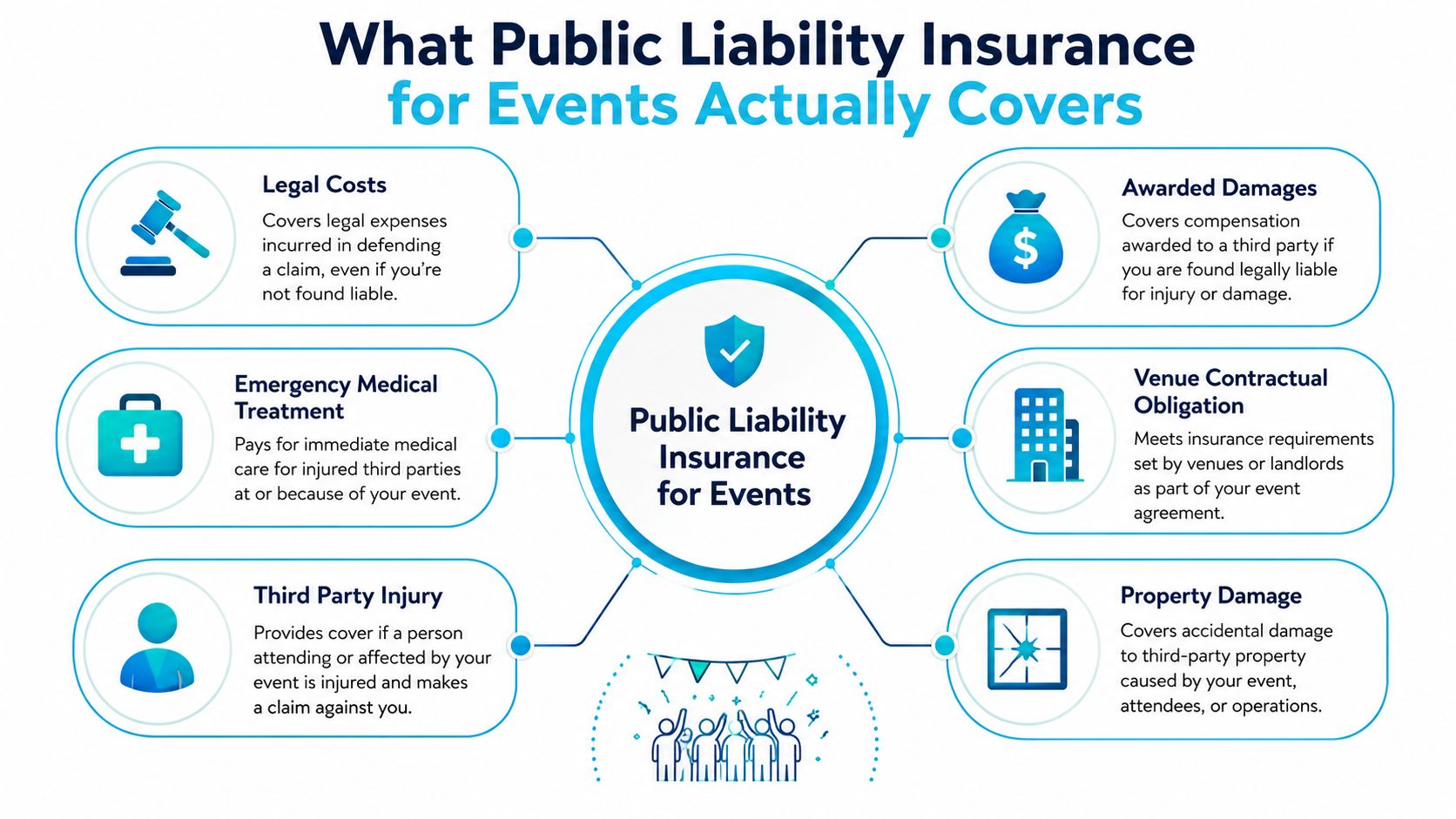
What Public Liability Insurance for Events Actually Covers
The cleanest way to think about public liability insurance for events is this, it protects you when someone outside your team says your event caused bodily injury or property damage. In South African event work, that third party is usually an attendee, supplier, venue owner, contractor, sponsor, or passer-by who wasn't part of your insured organisation but was affected by what happened at the event. The core exposure is third-party loss, not your own equipment, your own staff, or your own commercial disappointment.
A venue cares because liability claims attach to the organiser fast. If a guest trips over a cable, a contractor drops gear on a floor, or a structure damages a hired space, the venue will usually ask who is legally on the hook and whether a certificate exists before the doors open. That is why proof of cover is requested before the event, not after the incident. The policy is there to answer the question, “Who pays when a third party claims?”
Public-facing events in South Africa have to deal with more than just what the private venue wants. They also have to answer to the Safety at Sports and Recreational Events Act, or SASREA.
This law handles safety, security, and liability for public gatherings and events. It places heavy accountability directly on everyone involved, from organizers and venue owners to contractors and sponsors. If a safety failure leads to an injury or property damage, multiple parties can be held legally responsible. Because local municipalities and safety officers check this compliance before they will sign off on your event permit, having proper public liability insurance isn't just about ticking a box for the venue. It is a legal requirement you need to clear before the doors open.
What it is and what it isn't
This cover is not professional indemnity, which responds to advice and professional error. It is also not the venue's own insurance, which protects the venue's interests, not yours. If you're running a boma activation or a live-fire experience, read the practical setup guidance from use ABC Hire for boma fire pits and then check whether your liability wording and venue terms match the activity.
Practical rule: if your event creates the hazard, you should expect the claim to land on your paperwork first.
The operational takeaway is blunt. Buy the right limit, get the certificate issued in the right name, and make sure the policy wording matches what the venue expects. If those three things are wrong, the cover can exist on paper and still fail you in practice.
Typical Cover Exclusions and Optional Extensions
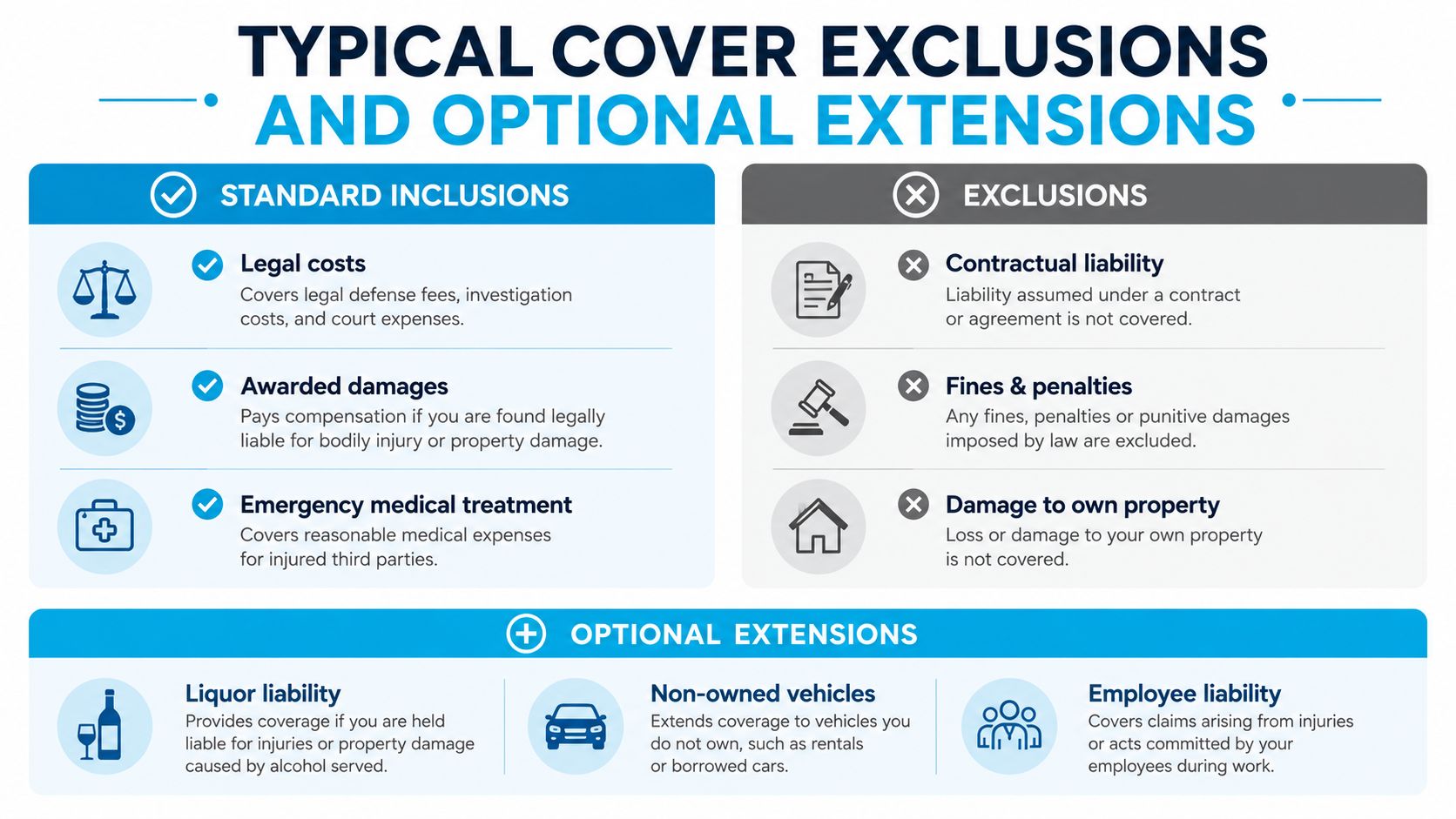
Most organisers only ask what the policy covers. They should ask what it leaves out, because that's where the ugly surprises hide. The standard event liability policy is built around legal costs, awarded damages, and emergency medical treatment flowing from a third-party claim. It can also be written to reflect the reality of volunteers or casual helpers acting under the organiser's direction, but the exact treatment depends on the wording, not the marketing summary.
The exclusions that bite hardest
The exclusions that cause the most pain are usually the ones an organiser thought belonged to someone else. Contractual liability assumed on behalf of a venue can fall outside the normal scope. So can claims for professional advice, motor liability on private roads, pollution, and losses linked to knowingly defective work. If a contractor knew a rig was unsafe and used it anyway, the insurer will look at that very differently from an accident that happened despite proper controls.
The other trap is assuming every live-event risk is automatically wrapped into one neat bundle. It usually isn't. A standard event liability policy is about negligence-based third-party claims, not every operational loss around the event.
Extensions that matter in the real world
A sensible organiser gets specific. If you're using hired kit, ask whether there's cover for hired equipment in your care. If multiple contractors are working together, cross-liability can matter when one party blames another. If the venue wants repair protection for accidental damage to its floor, wall, or fittings, that needs to be tested against the wording, not guessed. Some markets also offer adverse weather cancellation extensions, but that's a different risk conversation from third-party liability.
For a South African organiser trying to separate event cover from ordinary business cover, the difference is worth reading in plain language. The comparison at event liability vs public liability vs event cancellation in South Africa helps when you need to decide whether you're buying one-off event protection or relying on a standing policy.
Read the schedule like a contract, because that's what it is.
If you can't identify what's included, excluded, and extended within two minutes, your broker hasn't made the policy usable enough. That's a problem before the event, not after it.
How Insurers Underwrite an Event and What Drives the Price
Event liability pricing isn't pulled from a generic rate card. Insurers score the event from the details you give them, and they use those details to decide whether to quote, what wording to offer, and how tight the terms should be. A typical underwriting form asks for the policy type, period, sum insured, estimated attendance, ticket price, staging budget, whether the event is outdoors, and the start and finish times. That is not admin for the sake of admin, it is the insurer's exposure model.
Why two events of the same size can price differently
A 500-person dinner with controlled access, trained stewards, and a stable indoor venue is a very different risk from a 500-person outdoor activation with alcohol service, temporary structures, and contractors on ladders. The insurer is not just pricing the headcount. It is pricing the quality of control around the event. Better crowd management, better contractor governance, and cleaner documentation usually mean fewer follow-up questions and less friction at quote stage.
The reverse is also true. If you mention pyrotechnics, work at height, or other higher-risk elements without clear controls, expect scrutiny, exclusions, or a tougher excess. The organiser who sends a proper site plan, emergency arrangements, and contractor details usually gets a cleaner answer than the organiser who sends a one-line email and hopes for the best.
What you should have ready before you ask for a quote
Event format: one-off function, series of events, conference, market, exhibition, or live activation.
Risk features: outdoor setup, alcohol service, staging, temporary structures, hired equipment, and specialist contractors.
Operational controls: crowd flow, first aid, stewards, emergency routes, and breakdown procedures.
Commercial facts: attendance estimate, ticket price if relevant, and the venue's exact insurance wording.
The more complete the brief, the less time you spend chasing endorsements later.
If you need a cleaner South African buying workflow, a digital platform like Bi-me can compare insurer responses across declared activities, but the quality of the quote still depends on the quality of the event information. That's the part organisers often underestimate.
Limits That Venues Sponsors and Councils Commonly Require
The limit should reflect the scale of loss the event could realistically cause, not simply the lowest available option. One serious injury or a major property damage claim can exceed a token limit very quickly. In practice, minimum public liability cover commonly starts at R1 million, while many venues and authorities require R10 million to R50 million for higher-risk events. Availability and required limits also vary by duration, attendance, and venue type.
What contract wording usually drives
Venues, sponsors, and councils don't think in abstract insurance theory. They think in access conditions. If the lease says the organiser must carry a specific limit, that clause wins. If the municipality wants proof before a permit is released, the certificate must match the form they asked for. This is why I always tell organisers to get the venue wording first, then buy to that wording.
The practical mistake is shopping for a limit before you've read the contract. That usually leads to one of two problems, too little cover or the right cover in the wrong format. Both cause delay.
| Common Minimum Limits for Event Public Liability Cover | ||
|---|---|---|
| Event scale | Typical minimum limit | Why the level is set here |
| Small event | A lower starting limit | The exposure is tighter, with fewer third-party touchpoints |
| Mid-sized event | A higher limit | More people, more movement, more contractor interaction |
| Higher-risk event | A larger limit | Venues and authorities want stronger indemnity where the claim severity is greater |
The mechanics are similar across many jurisdictions. Smaller events can sit at lower limits, while larger or riskier events are pushed toward stronger proof of indemnity.
Use this rule. Match the limit to the worst credible third-party claim the venue could blame on your event, then check the certificate wording before the venue does. The buying note at how much event liability insurance you need in South Africa is worth keeping beside the contract while you decide.
Real Event Examples and What the Claims Look Like
A claims file is always duller than the fear that caused it, but it's still expensive. A guest slips in a corporate hospitality tent, needs emergency treatment, and the organiser gets a bodily injury claim from the injured person. That lands inside the liability policy if the policy responds and the event was properly disclosed. The same incident can also trigger legal defence costs, which is why organisers who focus only on the damage award miss part of the exposure.
Another common one is property damage during build or breakdown. A contractor's staging platform scrapes or cracks a venue floor, and the venue bills the organiser for repairs. That is where the contract wording matters, because the claim may sit comfortably within event liability cover or run straight into an exclusion if the organiser assumed liability that wasn't theirs to take on. The same logic applies whether the damage happens in a conference hall, a marquee, or a temporary venue fit-out.
The last scenario is the one people underestimate. A volunteer or casual helper gets injured during breakdown and the workers' compensation route doesn't respond the way the organiser expected. The liability question then turns on whether the policy wording and the actual role of the helper line up. If you haven't documented who was doing what, the claim gets messy fast.
For a broader South African view of how event claims get handled in practice, the discussion at how event liability insurance can save the day is useful because it keeps the focus on the organiser's real exposures rather than marketing language.
What makes a claim easier or harder
Induction records: prove who was briefed and when.
Contractor agreements: show which party was responsible for each task.
Incident logs: capture the facts while they're still fresh.
Site photos: help establish the condition of the venue and equipment.
If you can't document the event, you'll struggle to defend the story later.
That's the part organisers hate hearing, but it's true. The claim outcome often turns less on drama and more on whether your paperwork shows control.
A Practical Pre-Event Checklist for South African Organisers
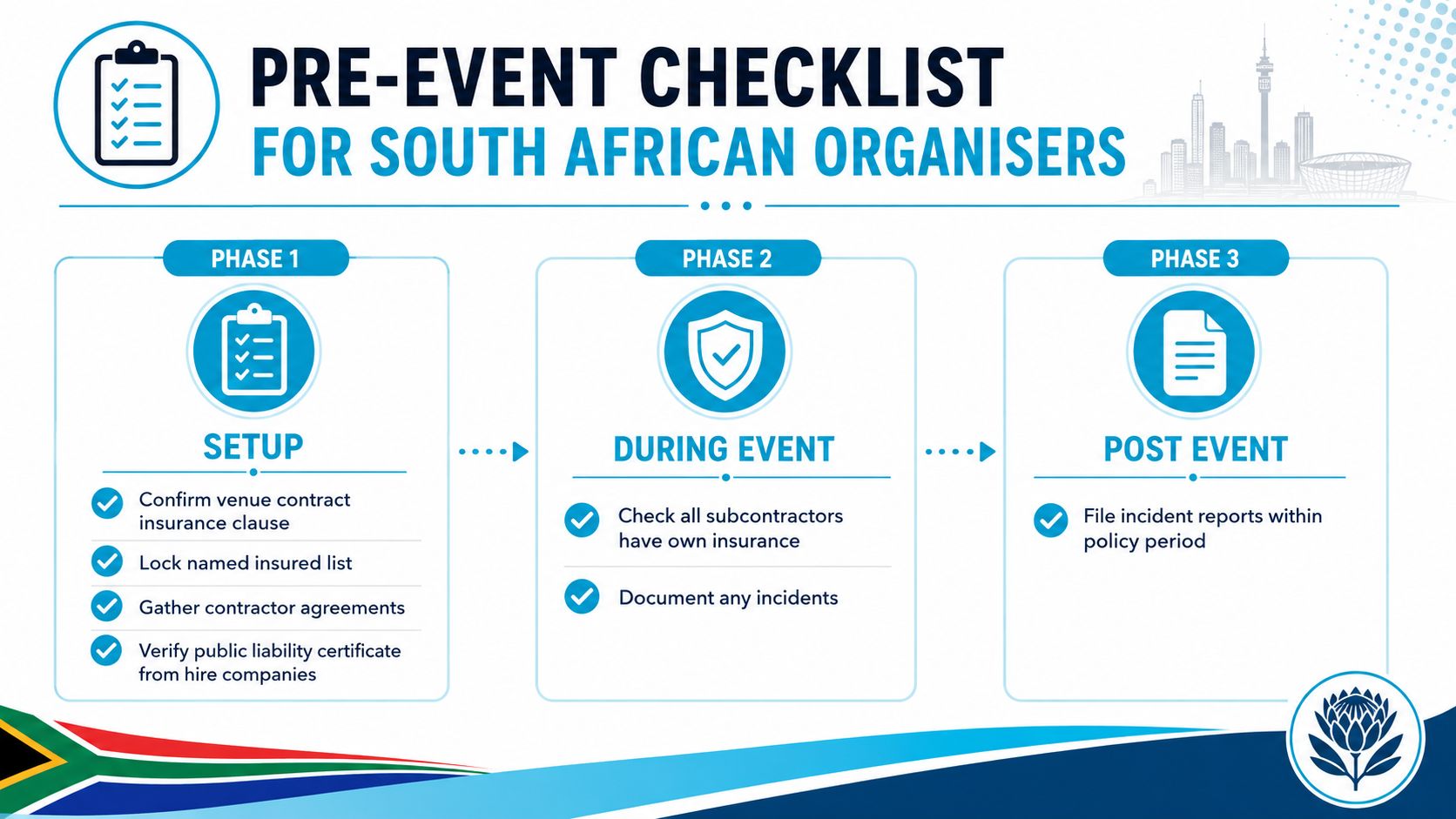
A good event checklist should do two jobs at once. It should keep the event moving, and it should build the evidence pack your insurer and venue will want if something goes wrong. I'd keep it on one page and hand it to the person who signs off the event file.
Setup phase
Start with the contract. Confirm the venue's insurance clause, the exact limit required, and the name that must appear on the certificate. Then lock down the named insured list, collect contractor agreements, and keep the site plan with crowd flow and emergency routes in the same folder.
Live event phase
During the event, keep first aid provision visible, use trained stewards, and manage alcohol properly if it's part of the format. Clear signage matters more than organisers think, because people move faster than they read once the venue gets busy. If anything unusual happens, log it immediately while the facts are still clean.
Breakdown phase
Breakdown is where a lot of avoidable losses happen. Control vehicle movement, inventory the equipment as it comes off site, and write up any incident before the team leaves. That record helps with both the insurer and the venue because it shows when the event ended, who was present, and what damage or injury was reported.
Cross-cutting items
Certificate name: make sure it matches the venue contract, not your shorthand trading name.
Schedule wording: check that the policy description reflects the event, not just the business category.
Insurer contact list: keep broker and insurer contacts with the event manager, not in one person's phone.
Claims pack: keep contracts, photos, attendance notes, and incident logs together.
The best organisers use this checklist before the event. The smartest ones keep it because it becomes the documentation pack if a claim lands later.
How to Compare Quotes and Buy Cover Quickly Online
The fastest way to buy event cover is to stop comparing premiums in isolation. A proper comparison needs the event date, attendance, venue, activities, alcohol, contractors, and the limit named in the venue contract. Without those inputs, the quote is usually vague, and vague quotes are what create problems when the certificate has to be issued quickly.
Compare the wording, not just the price
Look at the excess first, then the exclusions, then the sub-limits. A cheaper premium with a narrow wording can cost more in the real world if the event is higher risk or the venue needs a specific certificate. Cancellation terms matter too, but don't let cancellation distract you from the main liability question, which is whether the organiser is protected if a third party claims.
A digital platform built for SMEs helps because it shortens the journey from disclosure to certificate. Bi-me, as a licensed financial services provider, compares quotes from multiple South African insurers, supports immediate digital cover issuance for eligible products, stores certificates of insurance online, and gives clients a self-service portal for policy management and digital claims initiation. That is useful when a venue asks for proof at short notice and you need the paperwork in hand, not a promise that someone will call back.
What a sensible online buying flow looks like
Gather the event documents. Put the contract, site plan, contractor list, and dates in one folder.
Request quotes with full disclosure. Give the insurer the risk, not the simplified version.
Compare the wording side by side. Check limit, excess, exclusions, and certificate format.
Buy and download the certificate. Send it to the venue before they chase you for it.
Save the policy pack. Keep the schedule, wording, and contacts together for the event day.
If you do it properly, you're not buying insurance at the last minute. You're removing the approval bottleneck. That's the difference between an event that's ready to open and one that's stuck waiting on paperwork.
Frequently Asked Questions from South African Organisers
A normal business public liability policy sometimes helps, but don't assume it covers a one-day off-site function. The wording must extend to the event, the venue, and the activity.
You usually need a separate event policy when the venue asks for event-specific proof, when the activity is temporary or public-facing, or when alcohol, contractors, or hired structures change the risk. The venue will normally ask for a certificate, the limit, and the named insured in writing.
A digital platform can often issue a certificate quickly once the event details are confirmed. The delay usually comes from missing information, not the technology.
If you're planning a function, exhibition, activation, or conference, get the venue wording first, then buy the cover that matches it. Visit Bi-me to compare event liability options, issue the certificate online, and keep the policy documents where your team can find them before the venue asks.