
To choose professional indemnity insurance in South Africa, start from your actual risk, not from a price list. Work out what could go wrong in your profession, size your cover to your worst credible claim, check what the policy excludes, and only then compare premiums. Buying on price first is how professionals end up properly insured for the wrong things.
This is a decision guide. For the detail behind each step, we link to the dedicated articles.
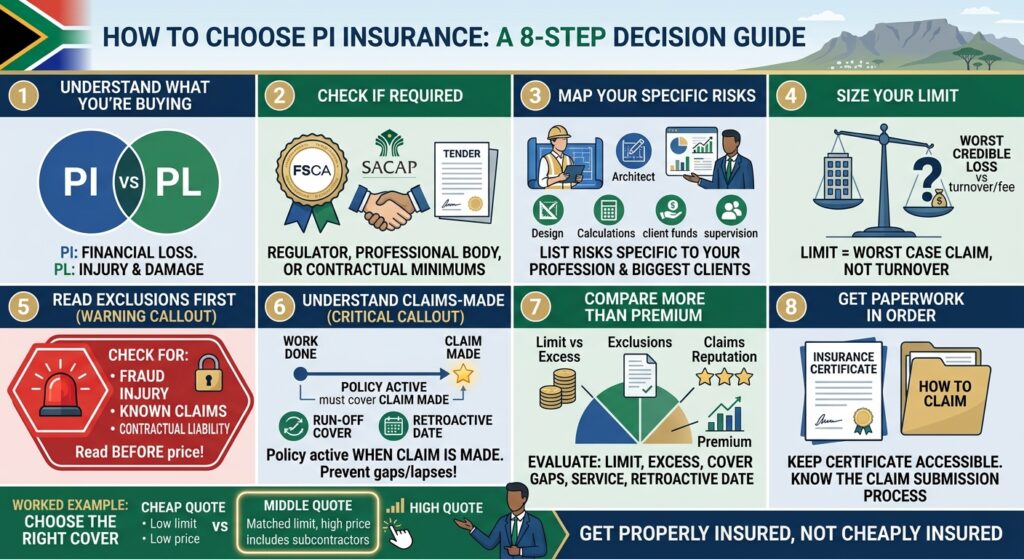
Step 1: Understand what you’re actually buying
Professional indemnity insurance covers claims that your advice, design or service caused a client financial loss, plus the cost of defending the claim. It is different from public liability insurance, which covers injury and property damage. If you’re not clear on the distinction, start with What Is Professional Indemnity Insurance? and Public Liability vs Professional Indemnity
Step 2: Check whether you’re required to have it
Some professions face a legal or regulatory minimum. Others need it because a client, employer or tender demands it. Either way, this sets your floor. See Is Professional Indemnity Insurance Compulsory?
Step 3: Map the risks specific to your profession
Generic cover misses specific risk. An architect’s exposure looks nothing like a consultant’s. Before you compare quotes, list:
- The type of work you do (advice, design, calculations, transactions)
- Your biggest clients or contracts
- Whether you supervise sites, hold client funds, or sign off on other people’s work
- Any past complaints or near-misses, even ones that didn’t become claims
Profession-specific guidance: architects, engineers, quantity surveyors, consultants.
Step 4: Size your limit of indemnity
Match your limit to the worst credible loss on a single job, not to your turnover. See How Much Professional Indemnity Insurance Do I Need? for the full method, including how to weigh contract minimums, aggregate limits and defence costs.
Step 5: Read the exclusions before the benefits
Every policy has gaps. Some are standard across the industry (fraud, injury, known claims); others vary by insurer. Check:
- Whether defence costs sit inside or outside your limit
- How the policy treats contractual liability and guarantees
- Whether your retroactive date covers your past work
- What happens if you change or add services
Full list: What Does Professional Indemnity Insurance Not Cover?
Step 6: Understand the claims-made basis
PI is almost always written on a claims-made basis: your policy has to be active when a claim is made, not just when the work was done. This affects how you think about lapses, switching insurers and eventually stopping work. See What Is a Retroactive Date in Professional Indemnity Insurance? and The Risks of Cancelling Your Professional Indemnity Insurance
Step 7: Compare more than the premium
Once you know what you need, compare quotes on:
- Limit of indemnity and excess
- What’s excluded, not just what’s included
- Whether defence costs erode the limit
- Claims handling reputation. A cheap policy that fights every claim costs you more in time and stress than it saves in premium.
- Retroactive date, especially if you’re switching from another insurer
Step 8: Get your paperwork in order
Once you’ve chosen a policy, you’ll likely need to prove cover to clients, employers or tenders. Keep your certificate of insurance accessible, and know how to submit a claim before you ever need to.
A worked example
This is a hypothetical scenario, not a real claim.
An IT consultant compares three PI quotes. The cheapest has the lowest limit and excludes claims arising from subcontracted work, which is most of what she does. The middle option costs slightly more, matches her contract’s minimum limit, and covers subcontracted work. She chooses the middle option, not the cheapest one, because the cheap policy wouldn’t have paid out on her actual work.
Common mistakes when choosing professional indemnity insurance
- Buying on price alone, without checking exclusions
- Underestimating the limit needed for your largest contract
- Assuming public liability covers professional advice (it generally doesn’t)
- Losing your retroactive date when switching insurers
- Not declaring a new service you’ve started offering
Frequently asked questions
How long does it take to get professional indemnity insurance?
Often the same day online, once you know your profession, services and required limit. Complex practices may take longer if an insurer needs more information.
Can I change my cover later?
Yes. Tell your insurer when your work, revenue or client base changes materially, so your cover keeps matching your risk.
Should I use a broker or buy directly?
Either can work. A broker adds value when your risk is complex or your profession has unusual requirements. For straightforward cover, comparing quotes directly is often enough.
What if my profession isn’t listed on a comparison site?
Ask. Most insurers can quote outside a standard list if you describe your actual services.
Compare cover built for your profession
Tell us what you do, and we’ll help you compare limits, exclusions and price side by side.