
An excess is the amount your business pays first when you claim. If that amount is too high for your cash flow, a cheap insurance quote can become an expensive problem very quickly.
For South African SMEs, the excess on a policy is not a side note. It affects whether you can repair a work bakkie, replace stolen tools, or recover from a covered loss without disrupting payroll, supplier payments, or SARS obligations. That is why understanding excess on insurance matters just as much as understanding the premium.
What Excess on Insurance Means for Your Business
When you review a quote for public liability, contractors all risk, business vehicle insurance, or professional indemnity cover, the premium usually gets all the attention. The excess deserves the same attention because it shows what part of the loss stays with your business.
In simple terms, excess means the first amount you pay yourself before the insurer pays the balance of a valid claim, up to the policy limit. On South African policies, this is usually shown as a rand amount on the schedule.
If your policy excess is R2,500 and your covered loss is R20,000, your business pays the first R2,500 and the insurer pays the remaining R17,500, subject to the policy wording, conditions, and limits.
That is why the real question is not only, "What is my premium?" It is also, "Could I pay this excess tomorrow if something went wrong?"
Read the Excess as Part of the Quote, Not as Fine Print
A lot of SME owners compare quotes by monthly premium only. That is risky. Two policies can look similar on price and still behave very differently at claim stage because one has a much higher excess.
Treat the excess as part of the total cost of cover, not as legal fine print.
Ask these questions when comparing quotes:
What is the exact excess in rand?
Is it the same for every type of claim?
Would this amount put pressure on cash flow if I had to pay it this week?
Is there a compulsory and voluntary portion?
Under local regulatory frameworks overseen by the Financial Sector Conduct Authority (FSCA), important policy terms should be disclosed clearly before cover is bound.
Practical rule: if you can only afford the premium, but not the excess, the cover may not suit your business properly.
A broader explainer like this guide to decoding short-term insurance policy wording can help you read the rest of the document with less guesswork.
Why the Number Is Shown in Rand Terms
Insurers use excess to decide how much of the first loss you keep. The higher the excess, the more risk stays with your business at the start of a claim.
For many South African SME policies, you may see excess amounts such as:
| Cover type | Typical SME-style excess range |
|---|---|
| Basic business contents | R500 to R2,500 |
| Business vehicle or bakkie cover | R1,500 to R5,000 |
| Contractors all risk | R2,500 to R20,000 |
| Professional indemnity | R2,500 to R25,000 |
These amounts vary widely depending on the insurer, risk profile, claims history, vehicle use, industry, location, and cover structure.
The key point is simple. The excess is not an admin charge. It is the part of the loss your business agreed to carry first.
How Excess Works at Claim Time
Excess becomes real when a claim happens.
If the loss is less than the excess, your insurer will usually not contribute because the claim does not rise above your retained amount. If the loss is more than the excess, the insurer usually pays the balance after deducting the excess, subject to the policy terms.
Think of it as a threshold.
If the covered loss is R1,800 and the excess is R2,500, your business carries the full R1,800.
If the covered loss is R30,000 and the excess is R2,500, your business carries R2,500 and the insurer may pay R27,500.
That is why the excess should always be read together with the policy limit. A high limit is useful, but you still need enough working capital to fund the first part of the loss.
A useful place to see how claims are handled in practice is the claims section on Bi-me, because the logic is the same even when the wording varies across products.
Think of It as a Threshold, Not an Added Fee
Many first-time buyers misunderstand excess and assume it is an extra fee charged on top of the premium at claim stage. That is not how it works.
The premium is what you pay to keep the policy active. The excess is the amount you keep for your own account when a valid claim happens.
This distinction matters because it changes how you budget for insurance. Premiums are predictable monthly costs. Excesses are irregular but important cash events that can hit at exactly the wrong time.
The policy schedule should always be read as a pair, the limit and the excess together.
Do Not Confuse Excess with Excess Insurance
There is another term that causes confusion. Excess insurance can refer to a higher layer of insurance that responds above a primary policy limit. That is different from the excess you pay from your own pocket on a claim.
For SME owners, the practical test is simple:
If the wording refers to your contribution first, it means claim excess.
If the wording refers to cover above another layer, it means excess insurance as a coverage structure.
That distinction matters in broker discussions, policy schedules, and commercial liability wording.
Compulsory Versus Voluntary Excess
In South African short-term insurance, excess is often split into two parts.
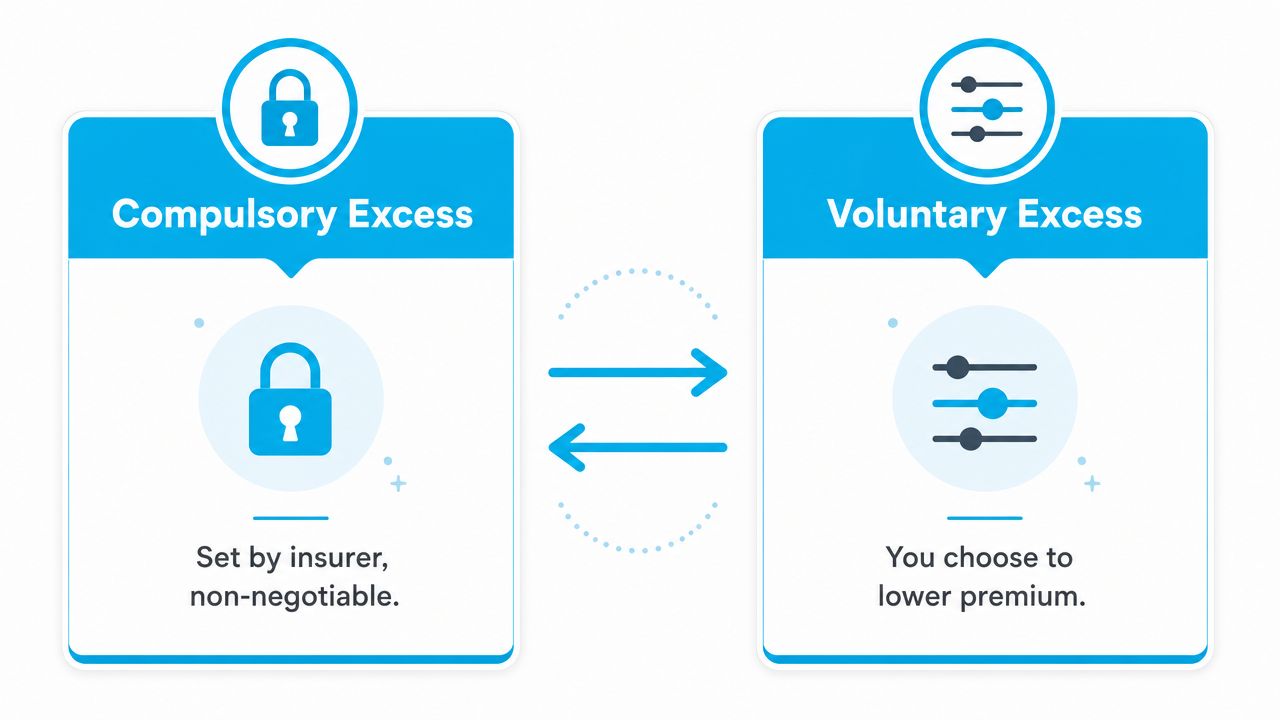
Compulsory excess is the amount the insurer sets. You normally cannot remove it.
Voluntary excess is the extra amount you choose to add yourself, usually to reduce the premium. The FSCA Treating Customers Fairly framework supports the principle that product features like this should be explained clearly and sold appropriately.
The Total Excess Is What Matters at Claim Time
If your insurer applies a compulsory excess of R1,500 and you choose a voluntary excess of R1,000, your total excess is R2,500.
That total is what matters when a claim is settled.
| Excess structure | Amount |
|---|---|
| Compulsory excess | R1,500 |
| Voluntary excess | R1,000 |
| Total payable excess | R2,500 |
For many SMEs, this is where quote comparisons go wrong. The premium may look competitive, but the total excess may be far higher than expected.
Ask for Both Figures on Every Quote
A proper comparison should show:
Monthly premium
Compulsory excess
Voluntary excess
Total excess payable at claim stage
Any special excess for theft, own damage, windscreen, or high-risk drivers
Useful habit: compare the premium and the full excess structure as one package.
That is especially important for businesses with multiple vehicles, tools in transit, contracting risks, or frequent small losses.
How Excess Affects Your Premium
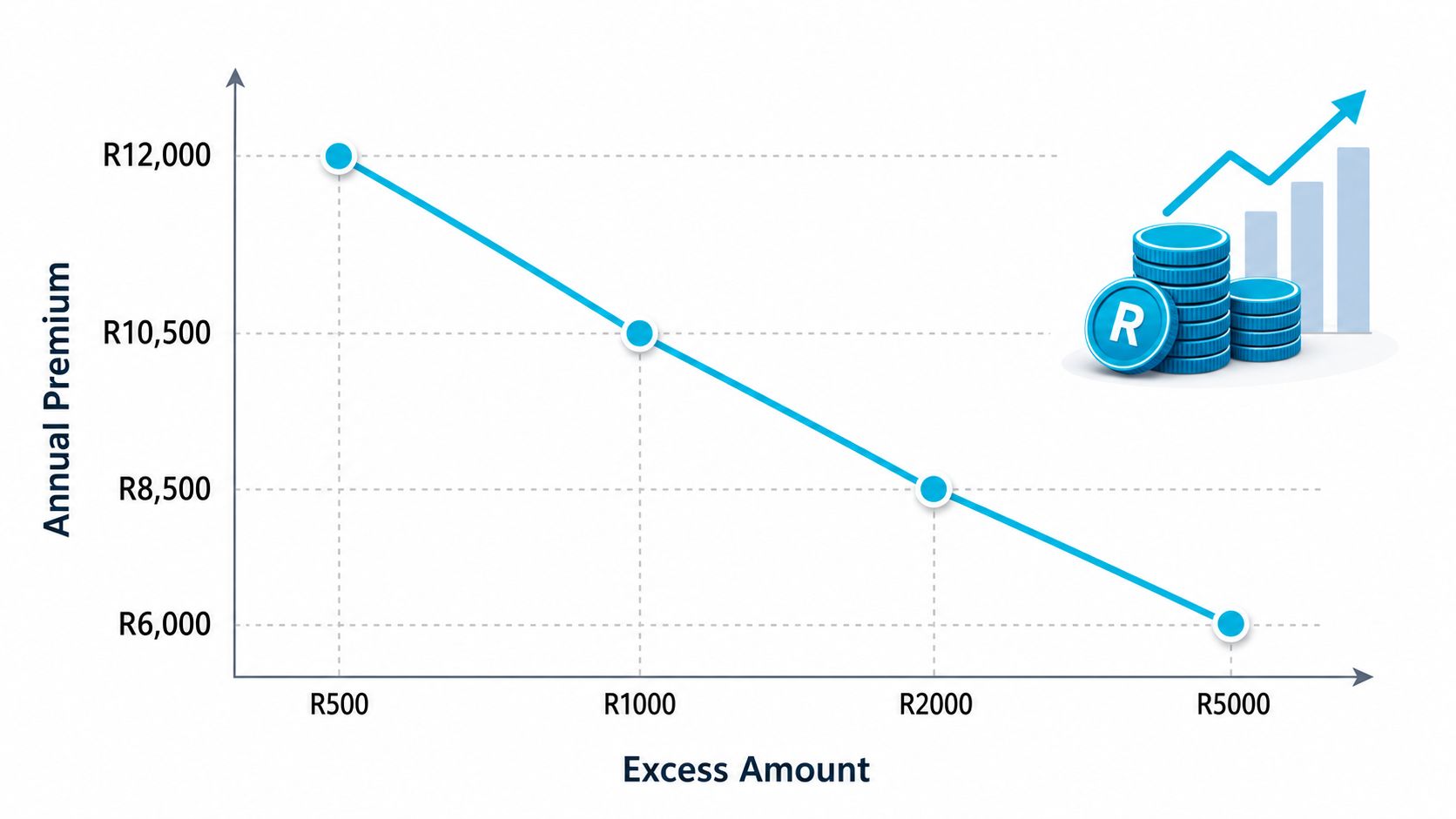
Excess and premium usually move in opposite directions.
If you agree to carry more of the first loss, the insurer will often charge a lower premium. If you want a lower excess, the insurer will usually charge more because it is taking on more claim risk from the start.
The Premium Is the Price of Risk Transfer
A lower premium is not automatically a better deal.
If the lower premium comes with a very high excess, your business may save money each month but struggle badly when a claim happens. That can be a serious issue for SMEs running tight margins, seasonal turnover, or heavy supplier commitments.
This is particularly relevant for business vehicles and bakkies. South Africa has a very high level of uninsured driving, with estimates often putting uninsured vehicles on local roads at roughly 60% to 70%. That increases practical claims pressure for insured businesses because collisions often involve uninsured third parties, which can slow recovery and leave the insured business relying heavily on its own policy structure.
Guidance from the National Financial Ombud Scheme South Africa reinforces the importance of policy clarity and fair complaint resolution where cover, excess, and disclosure are in dispute. That is why Bi-me also surfaces excess choices during public liability insurance cost comparison, so you can judge the premium and the claim-day exposure together.
Check the Quote for the Right Question
The best question is not, "What is the cheapest quote?"
It is, "What would my business need to pay first if a claim happens?"
That one question quickly reveals whether the cover is actually affordable in real life.
Worked Examples for South African SMEs
Once you see the numbers in rand, excess becomes much easier to evaluate.
| Scenario | Claim size | Excess paid by business | Insurer payout | Practical impact |
|---|---|---|---|---|
| Small consulting firm, professional indemnity claim | R50,000 | R2,500 | R47,500 | Usually manageable if the firm has working capital available |
| Plumbing contractor, stolen tools claim | R18,000 | R5,000 | R13,000 | Cash pressure is immediate because tools may need replacement before jobs continue |
| Construction SME, contractors all risk loss | R200,000 | R20,000 | R180,000 | Large first-loss amount can disrupt operations if reserves are tight |
| Delivery business, insured bakkie accident | R75,000 | R7,500 | R67,500 | Fleet downtime and excess hit cash flow at the same time |
A Small Firm With Room to Absorb the Excess
For a business with stable monthly income and a decent reserve, a moderate excess can make sense. It keeps the premium under control while leaving the business able to absorb smaller claims without panic.
The issue is not whether excess exists. Every short-term insurance buyer should expect some form of retained risk. The issue is whether the amount matches the business's real cash position.
A Contractor Where the Cash Hit Is Immediate
For contractors, tradespeople, and mobile service businesses, an excess can hurt twice.
First, you need cash for the excess. Second, you may need to replace equipment, hire temporary vehicles, or keep jobs moving while the claim is processed. That is why a higher excess can be far more painful in practice than it looks on a quote.
Practical reading: the excess is part of the loss you agreed to keep, so budget for it like an emergency operating cost.
How to Use the Table for Your Own Business
Use your own likely claim scenarios.
For example:
A small office-based business might worry about laptop theft, accidental damage, or liability claims.
A contractor might worry about tools, materials on site, and vehicle accidents.
A delivery business might focus on vehicle own damage, third-party claims, and goods in transit.
Then test the excess against your cash flow. If paying it would delay wages, rent, suppliers, or tax payments, the quote may be too aggressive.
Choosing the Right Excess for Your Business
The right excess sits where the premium remains sensible and the first-loss amount remains affordable.
That answer differs from one SME to another.
Start With How Often Claims Could Happen
If your business is exposed to frequent smaller losses, a high excess may become frustrating because you keep paying out of pocket and seldom get value from the policy on smaller incidents.
If claims are rare but potentially severe, a higher excess may be more workable because you are protecting against larger shocks rather than everyday losses.
Match the Excess to the Balance Sheet
This is where many buying decisions should start.
Ask yourself:
Do we have spare cash available right now?
Could we absorb this amount without using expensive credit?
Would we still be able to pay salaries and suppliers on time?
If several insured items are exposed, could multiple excesses apply?
A business with a strong balance sheet can normally retain more risk. A startup or small operator with thin margins may need a lower excess even if the premium is a bit higher.
Ask These Questions Before Binding Cover
Before accepting any quote, ask:
Does the excess change by claim type?
Are there special excesses for theft, high-risk areas, younger drivers, or night driving?
How much does the premium drop if I increase the excess?
Can my business comfortably fund this amount on short notice?
What other terms in the policy schedule affect the claim payout?
For broader local context on policyholder rights and complaint channels, it can also help to review the Ombud for Financial Services Providers, especially where advice, disclosure, or intermediary conduct is in question.
How Bi-me Presents Excess When You Compare Quotes
A common problem in insurance buying is that the premium stands out, while the excess is hidden in detailed wording or a long PDF schedule.
A better comparison experience shows the important numbers side by side:
Premium
Compulsory excess
Total excess exposure
Limits and key exclusions
Compare the Claim Cost, Not Just the Monthly Price
When you can see how the premium changes as the voluntary excess changes, the trade-off becomes easier to understand. That helps business owners make a real commercial decision instead of chasing the cheapest-looking quote.
A lower premium can make sense. A higher excess can also make sense. What matters is whether the combination fits your business risk and your available cash.
Keep the Schedule and the Quote Together
Once cover is bound, keep the quote, schedule, and excess details together.
That helps when:
You need to brief a co-director or finance manager
A claim happens and you want to confirm the excess quickly
Renewal comes around and you want to compare like for like
You need to check whether changing the excess still makes sense
Good comparison habit: save the premium, limits, schedule, and excess details together for future review.
Key Takeaways and Practical Next Steps
If you remember only a few things, remember these:
Excess is the first amount your business pays on a claim.
Compulsory and voluntary excess can combine into one total figure.
A lower premium often means a higher first-loss amount.
The right excess depends on your cash flow, not just your appetite for a cheap quote.
Business vehicle, contractor, and liability claims can all feel very different depending on the excess structure.
Before your next renewal or new purchase, use this simple checklist:
| Quote check | Why it matters |
|---|---|
| Check the total excess | It tells you the real first-loss amount your business keeps |
| Check special excesses | Some claims have different excess rules |
| Compare premium changes | It shows whether the saving is actually worth the extra risk |
| Test against cash flow | If you cannot pay it quickly, the cover may not be practical |
| Read the schedule with the wording | Limits, exclusions, and excess all work together |
Keep the quote, the schedule, and the excess figure together. It will save time and confusion later.
If you want to compare business insurance options with the excess shown clearly alongside premium, limits, and key wording differences, visit Bi-me and compare your options in one place.
This article is general information only and does not take into account your business's financial situation, insurance needs, or objectives. Cover is always subject to the insurer's policy wording, terms, conditions, limits, and exclusions.