
Your bakkie is back on the road. Maybe it carries tools to a client in Pretoria. Maybe it drops stock at a shop in Durban. Maybe it collects materials for a job in Cape Town. If that vehicle earns money for your business, your insurance must match the way you use it, not just the badge on the bonnet.
Many SMEs (Small and Medium-sized Enterprises) get caught here. A private motor policy feels cheaper and simpler. Once the vehicle starts doing business work, the risk changes. In South Africa, that change matters even more. Our roads carry heavy uninsured-vehicle exposure. Insurers also assess business use more carefully than ordinary commuting. Business vehicle insurance is an exposure decision. You need to consider what the vehicle does each day, who drives it, what it carries, and what happens if it goes off the road.
What Business Vehicle Insurance Actually Means for an SME
A plumber parks his bakkie outside a client’s house. Pipe cutters, fittings, and a ladder rack sit inside and on the load bed. That vehicle is no longer just transport. It is part of the business’s revenue engine.
That is where business vehicle insurance starts to differ from private cover. If you use the vehicle for deliveries, service calls, transporting tools, or moving goods between sites, the policy must reflect that role. It cannot reflect a personal commuting pattern. International commercial-auto guidance draws the same line. Vehicles that haul tools, tow business trailers, or carry employees count as commercial risks, not private ones. For South African SMEs, that distinction matters. An insurer can dispute a claim if the owner misclassified the use. The real issue is not only vehicle damage. You also need to know whether the insurer will respond while the vehicle earns income.
Think in three loss buckets
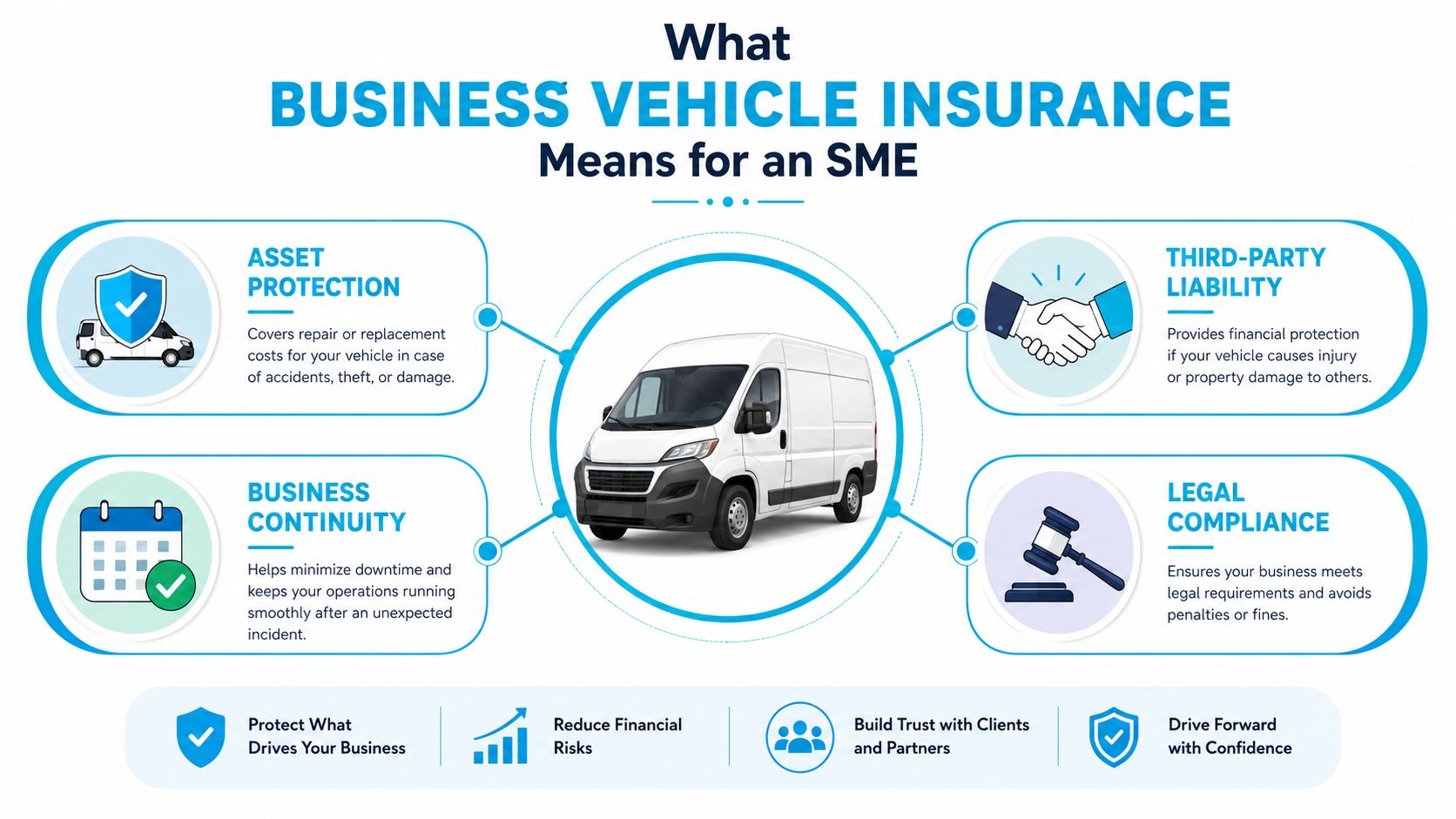
The easiest way to understand the cover is to split it into asset protection, third-party liability, and business continuity. Asset protection helps pay for damage to your own vehicle. Liability helps when you damage someone else’s car or property. In serious cases, it can also respond to injury claims. Business continuity matters because downtime can stop deliveries, delay jobs, and force you to hire a substitute vehicle.
Practical rule: If the vehicle makes money, the insurance has to protect the revenue engine, not only the metal.
Ownership and driver access matter too. A privately insured car that handles the occasional business errand is one thing. A bakkie that carries staff, tools, or stock every day is something else. Once the use becomes commercial, the insurance should follow suit.
The Three Core Cover Types Explained Simply
Think of the cover tiers like floors in a building. Third-party is the basement. It gives you the minimum structure for damage you cause to someone else. Third-party fire and theft is the middle floor. It adds protection if someone steals your vehicle or fire damages it. Full coverage is the top floor. It gives you the widest protection for your own vehicle and usually includes third-party liability too.
The simple trade-off
A courier van that racks up high mileage in traffic needs a different discussion from a single work bakkie in a locked yard. The right tier depends on how painful a loss would be. If replacing the vehicle would strain cash flow, a broader policy usually makes sense. The same applies when the vehicle carries business-critical kit.
A cheap premium can still be expensive if the policy won’t carry the real loss.
Here is a quick reference for comparing quotes.
| Cover Tier | Pays For | Typical SME Use Case |
|---|---|---|
| Third-party | Damage you cause to other people's property or vehicles | Very basic risk transfer where the vehicle's own value is less important than liability control |
| Third-party fire and theft | Third-party damage, plus fire and theft of your own vehicle | A business vehicle that is exposed to theft risk but where full physical cover isn't needed |
| Comprehensive | Your own vehicle damage, plus broader third-party protection | A working bakkie, van, or light truck that carries tools, stock, or staff and must stay on the road |
For many SMEs, the question is not whether to buy cover. The real question is which tier matches the vehicle's job. If you are still comparing policy wording and not just price, the motor cover page is a helpful place to see how commercial options are usually framed.
Do not confuse a private motor mindset with a business one. A private car can sit unused for days without affecting income. A delivery vehicle cannot. That is why the same loss becomes much bigger once revenue depends on the vehicle.
Fleet Policies Versus Single-Vehicle Commercial Cover
Many owners hear “fleet policy” and picture a large logistics company with rows of trucks. In practice, a fleet policy simply covers multiple vehicles under one commercial structure. Once your business runs more than one working vehicle, the question changes. You stop asking, “Can I insure this bakkie?” You start asking, “How should I organise cover so admin, drivers, and claims stay under control?”
When one policy stops being enough
Single-vehicle commercial cover works well when a business has one dedicated work vehicle. It can also work for one main vehicle and one backup. That setup makes it easier to control the vehicle, the driver, and the use pattern. A fleet structure makes more sense once several vehicles go out on the road. It becomes even more useful when the business rotates drivers or moves vehicles between sites.
What insurers look at in a fleet setup
At that point, underwriting becomes more operational. Insurers want the vehicle list, driver details, and current values. They also want a clear picture of how the business uses each vehicle. If one bakkie leaves and another comes in, the business must update the policy properly. If that update never happens, the business may think it has cover while the schedule says something else.
Practical rule: The more vehicles you have, the more your insurance becomes an admin system as well as a risk policy.
A fleet setup can also simplify daily changes. Trades, courier businesses, and contractor fleets often find one list easier to manage than several separate policies. The downside is discipline. Your team must keep tighter records, control driver access, and process mid-term changes properly. Good admin handles that well. Weak admin turns it into a risk.
Businesses that move stock between sites should also look at the goods in transit insurance page. The vehicle and the cargo often need different protection.
The smartest choice is not always the broadest one. A single service vehicle with one named driver may suit a focused commercial policy. A business with multiple bakkies and rotating crews usually needs a structure that can move with the operation.
Common Exclusions and Underwriting Factors SMEs Miss
Most claim problems start long before the accident. They start when someone sets up the policy with the wrong use class, the wrong drivers, or incomplete vehicle details. Many SMEs compare premiums first. They only read the wording after something goes wrong.
What insurers need to know
Underwriters ask about annual mileage, overnight storage, driver history, security features, load-carrying, and modifications. Each of those details changes the exposure. Ladder racks, service bodies, lift gates, and branded fit-outs can affect repair severity. They can also change how the insurer views the risk. Staff-driven vehicles raise similar issues because multiple drivers can increase uncertainty.
The personal-versus-commercial gap catches people most often. A vehicle that handles client visits, deliveries, or tool transport does not present the same risk as a commuter car. If the owner bought the policy as private use but the vehicle spends most of its time working, the claim can turn into a disclosure dispute.
Practical rule: If the vehicle earns money, assume the insurer will want to price the work, not the commute.
What businesses often overlook
Here is what SMEs usually miss:
-
Driver disclosure: If everyone with a licence can drive the vehicle in practice, the policy needs to say that clearly.
-
Business use class: Client visits, deliveries, and field service work are not the same as ordinary private travel.
-
Modifications: Racks, bodies, and special equipment can change how a repair is handled.
-
Storage and security: Where the vehicle sleeps matters because theft risk is not the same in every yard or driveway.
-
Mileage honesty: If the actual distance is much higher than declared, the price and the risk stop matching.
A contrarian point can save money and frustration. The cheapest policy is often the wrong choice when the vehicle spends more time earning revenue than commuting. Downtime, substitute transport, and delayed jobs can cost more than the premium difference.
South African roads make this issue even sharper. Industry groups like the Automobile Association (AA) and the South African Insurance Association regularly point out that roughly 60% to 70% of vehicles on our roads have zero insurance. That means only a small 30% to 35% share actually carries cover. When so many drivers are uninsured, recovering third-party damages becomes difficult. If someone hits your work bakkie and carries no policy, you cannot rely on them to pay out of pocket. That is why the right commercial cover matters from day one.
A Step-by-Step Buying Checklist for South African SMEs
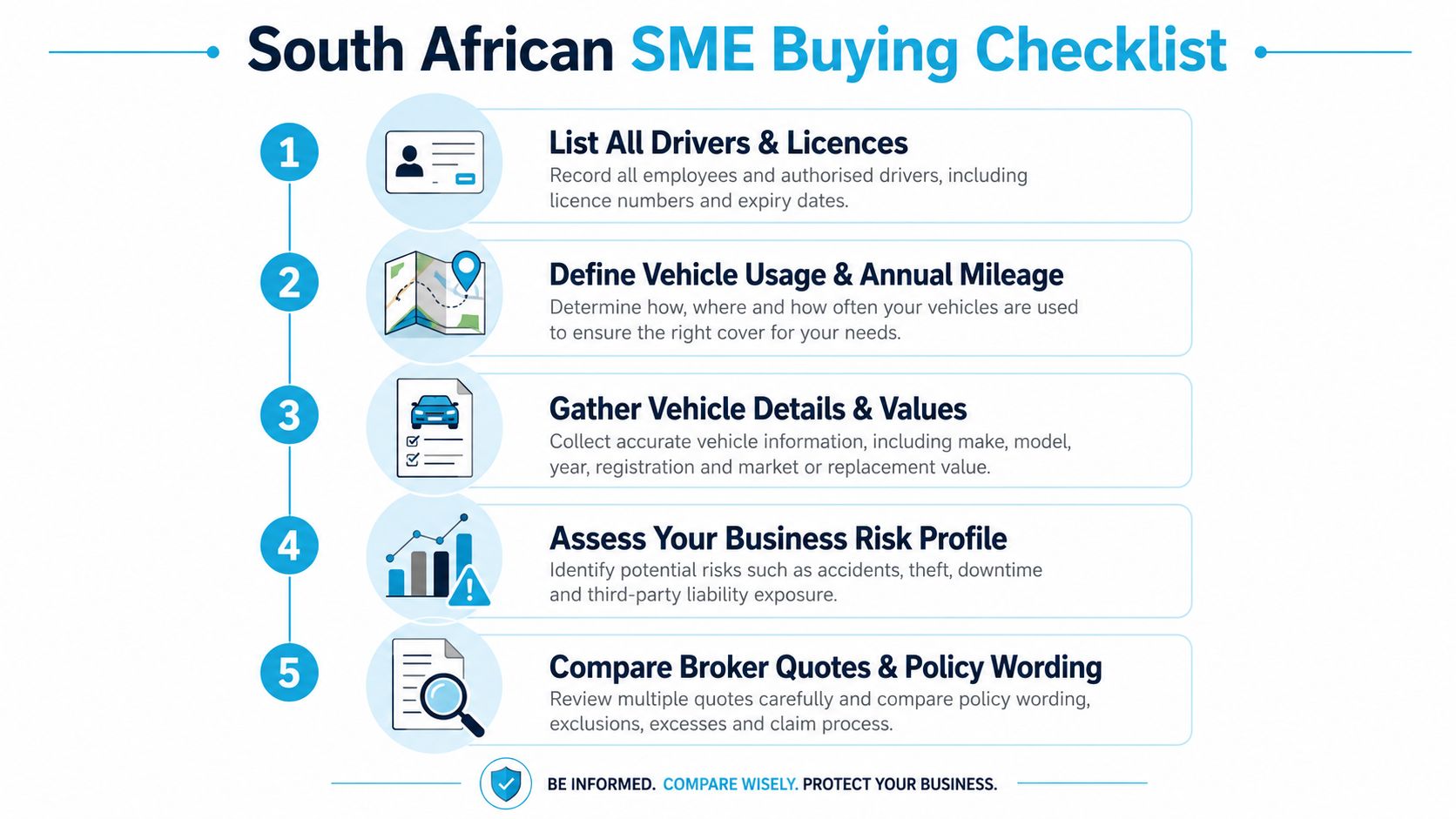
Start with the people who drive the vehicle. Write down every driver. Record the licence each one holds. Then decide whether the business wants one named driver, a few named drivers, or broader access. If a staff member uses their own car for work, treat that as a separate issue from insuring a company-owned bakkie.
Build the risk picture before you ask for quotes
Next, pin down how the vehicle earns revenue. Does it handle customer visits, transport goods, run tools to site, or move between branches? Declare the annual mileage accurately. Also record where the vehicle stays at night. A vehicle in a locked yard presents a different risk from one parked on the street outside a flat.
When you work out how much cover you need, do not look only at your own vehicle's value. Look at the damage your business could cause to someone else. South African roads include a large share of uninsured vehicles. If one of your drivers hits a luxury SUV or causes a pile-up, your business may face major costs. That is why commercial policies locally typically start third-party liability limits around R5 million to R20 million. Those limits give your business a meaningful safety net.
Then check whether tools, stock, or equipment need separate protection. A policy can cover the bakkie properly and still leave the contents exposed. Trades and contractors often discover that too late.
A practical pre-purchase list
-
Drivers and licences: Confirm who drives, how often, and with what licence.
-
Vehicle use: State whether it's for deliveries, site work, sales calls, or mixed use.
-
Storage: Confirm where the vehicle spends the night.
-
Security: List alarms, immobilisers, tracking, and physical controls.
-
Contents: Decide whether tools, equipment, or goods need their own cover.
-
Liability limits: Choose limits that fit the size of the claims you could face.
A good quote is not just the cheapest one. It is the one that still makes sense when a real loss happens and someone checks the wording line by line.
What Actually Drives the Cost of Your Premium
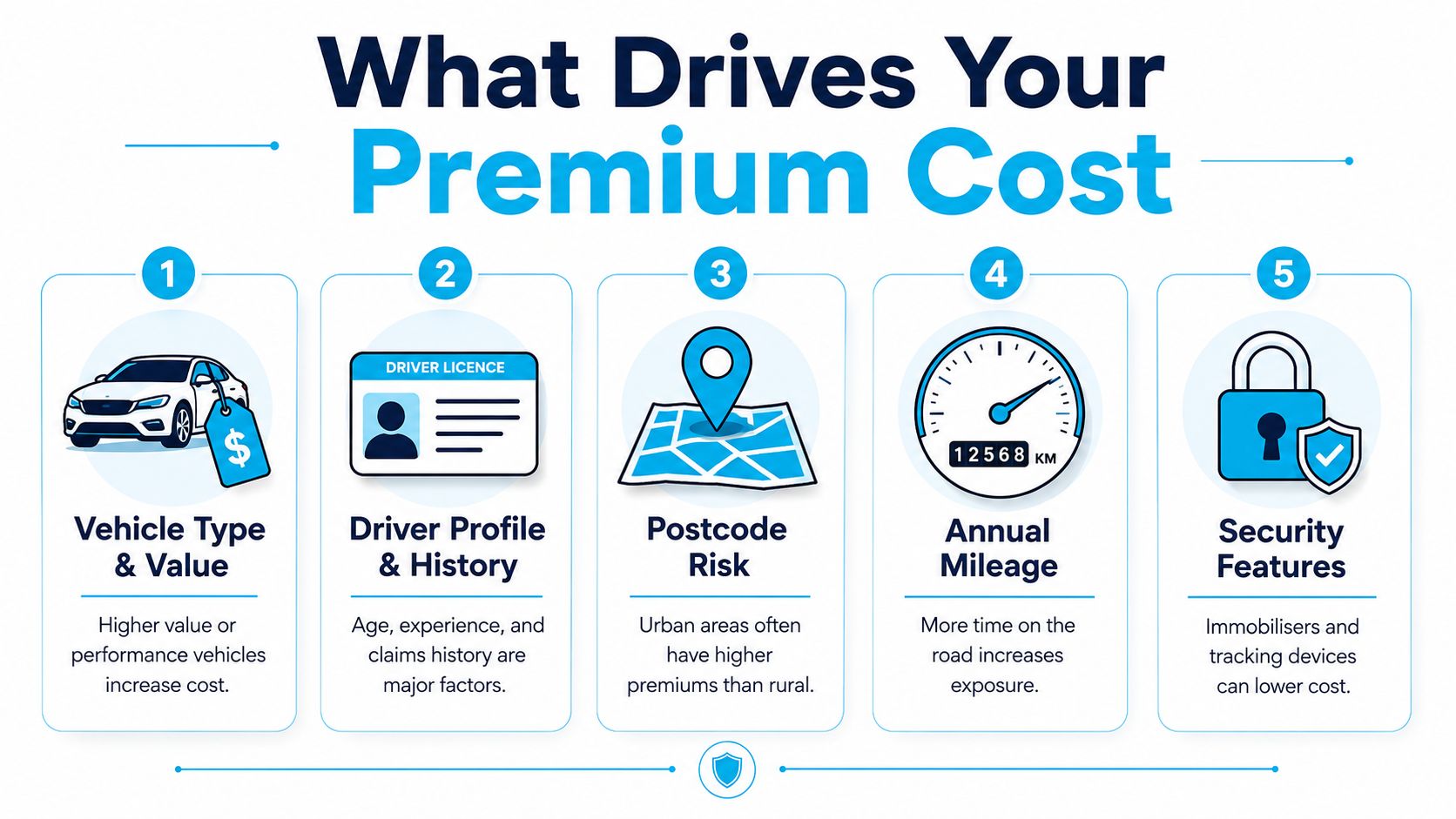
Premiums follow exposure. A large delivery van, a lightly used service bakkie, and a high-value light truck do not cost the same to insure. They do not create the same level of risk. Vehicle type and value matter. Driver profile, storage area, and workload matter too.
The levers you can move
Some pricing factors are fixed. A younger driver, a certain vehicle category, or a riskier operating pattern does not disappear by wishful thinking. Other factors sit under your control. You can restrict drivers, fit security devices, tighten storage rules, and declare mileage honestly.
That is where many SMEs can improve their position without weakening cover. If one driver uses the vehicle most of the time, say so. If the vehicle stays in a locked yard, record it. If you install a tracker or immobiliser, tell the insurer. These are simple risk controls, not tricks.
What to prioritise first
-
Driver restriction: Fewer approved drivers usually means a cleaner risk story.
-
Security improvements: Tracking and immobilisers are worth discussing before you chase a small premium difference.
-
Mileage discipline: Don't overstate or understate the distance. Either one creates problems.
-
Vehicle use clarity: A clean use description reduces disputes later.
-
Claims record: Good claims behaviour matters because insurers price the past into the future.
Why South African road use affects pricing
The South African market has another factor in the background. The road network carries the overwhelming majority of domestic freight by volume. That means commercial vehicles face constant road use, stop-start traffic, and distance-related loss. Heavy road dependence, combined with the uninsured-vehicle share noted earlier, helps explain why insurers underwrite business vehicles more carefully than private cars.
A broker's job often involves helping you choose the right lever. One business may need stronger security. Another may need tighter driver control. A third may simply need to rate the vehicle as commercial in the first place. The cheapest quote only helps if the policy still fits the way the vehicle works every day.
Managing Claims and Documents Through a Digital Broker
When a vehicle goes off the road, speed matters. A tender may be due. A client may be waiting. Your team may need proof of cover or a claims reference immediately. A digital broker can reduce admin pressure if the platform works properly.
What should be easy to do
You should be able to pull up your policy schedule and certificate of insurance quickly when a customer asks for proof. You should also be able to make routine changes, such as updating a vehicle or adding a driver, without rebuilding a paper trail from scratch. In a good digital setup, you can log claims online and track them without endless phone calls.
That is the basic value of a platform like Bi-me. It lets SMEs compare quotes, buy online, manage documents, and handle routine policy changes through a client portal. Partnered insurers still handle underwriting, and the policy documents name them clearly. In practice, that setup means less waiting for certificates, endorsements, and claims admin. It is especially useful when a business needs proof of cover for a contract or wants all policy records in one place.
Where human support still matters
Digital tools work well for routine changes. They help less when the risk is unusual. Contractor fleets, specialised fit-outs, and mixed vehicle use often fall into that category. In those cases, a broker needs to read the wording carefully. The broker should also check how the insurer defines use, driver access, and equipment.
If you ever need to manage the back end of a policy, the claims page shows the kind of self-service process that can save time during a stressful loss. The point is not technology for its own sake. The point is quick access to documents, endorsements, and claims support when the vehicle is out of service.
A slow broker can cost a business more than a slightly higher premium. If you cannot prove cover, cannot update the schedule, or cannot start a claim quickly, the delay becomes part of the loss.
Questions South African SMEs Ask Most Often
A common question is whether a personal policy ever covers light business use. Many people assume a few client visits or an occasional delivery will not matter. The real issue is whether the policy matches the actual use pattern. If the vehicle works as part of the business, the wording needs to treat it that way.
Another question involves staff who use their own cars for work. That situation needs separate attention because ownership, driver identity, and business use do not line up in the same way as a company vehicle. If an employee drives their own car for business tasks, the business should check whether the employee's policy allows that use. The business should also check whether any business liability sits elsewhere.
The uninsured third-party problem also comes up often in South Africa. Since the Automobile Association (AA) cited estimates that about 60% to 70% of vehicles were uninsured, the risk of not recovering losses from another driver is real. It is not theoretical.
Practical rule: If someone else hits your business vehicle, your policy still has to do the heavy lifting while recovery is sorted out.
The last question usually concerns speed. How fast can a digital broker issue cover for a new bakkie? That depends on the risk details. Digital platforms matter because they cut the waiting time between quote, purchase, and proof of cover.
If your vehicle earns revenue, your insurance should reflect that reality. It should not revolve around the cheapest monthly figure on a quote sheet. Bi-me helps South African SMEs compare business cover, manage policy documents, and keep the moving parts of vehicle insurance in one place. If you want to check whether your current cover still matches how your vehicles are used, visit Bi-me and review the options against your business activity.
This is general information only and does not take into account your financial situation, needs, or specific objectives. As with any insurance, the cover will be subject to the terms, conditions, and exclusions contained in the policy wording.