Professional indemnity exclusions are the situations your policy won’t pay for: injury and property damage, dishonest acts, claims you already knew about, work outside your declared business, and liability you took on by contract beyond the ordinary duty of care. Most declined claims come from a few predictable gaps, and all of them can be spotted before you buy.
This article covers the standard exclusions and how to reduce your exposure. Exact terms depend on your policy wording, so always check yours.
Core professional indemnity insurance cover: liability for mistakes
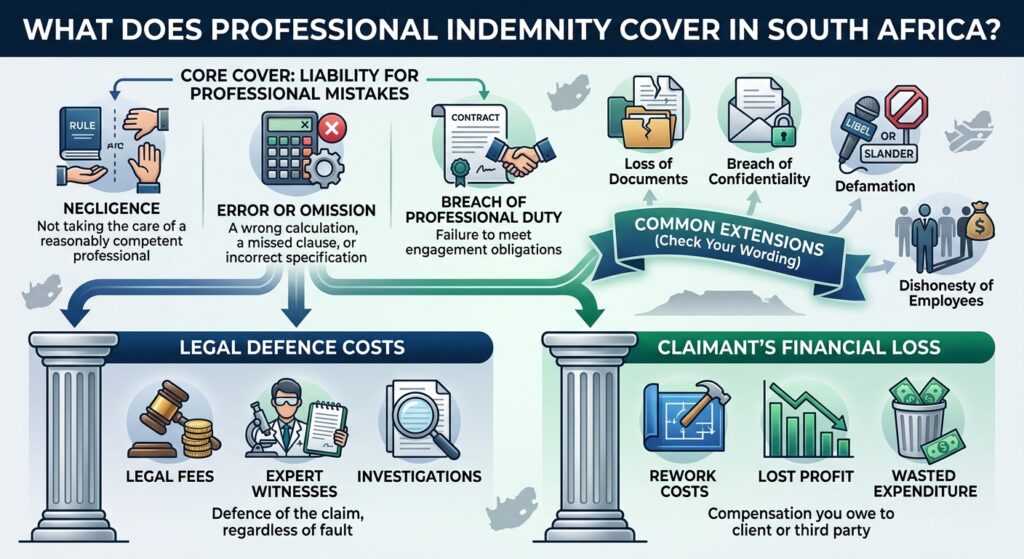
Most PI policies respond when a client claims that:
- You were negligent. You didn’t take the care a reasonably competent professional in your field would have.
- You made an error or omission. A wrong calculation, a missed clause, a specification that didn’t match the brief.
- You breached your professional duty. You failed to do what your engagement required.
The loss claimed is normally financial: rework costs, lost profit, wasted expenditure, or a payment made on your advice.
Legal defence costs
For many professionals this is the most valuable part of cover. Even a weak claim costs money to defend. Your policy typically covers:
- Legal fees for defending the claim
- Costs of expert witnesses and investigations
- Costs of negotiating a settlement
Check whether defence costs sit inside your limit of indemnity (eroding the amount left for compensation) or on top of it. It’s a small detail with a big effect on a large claim.
Common extensions to professional indemnity insurance cover
Many policies include, or offer as options, cover for:
- Loss of or damage to documents: the cost of reconstituting client documents you’re holding
- Breach of confidentiality: accidentally disclosing client information
- Defamation: unintentional libel or slander in your professional work
- Intellectual property infringement: unintentional breach of copyright or similar rights in your work
- Dishonesty of employees: loss caused by a staff member’s dishonesty, where you weren’t complicit
- Retroactive cover: claims arising from earlier work, back to the retroactive date on your policy
Not every policy includes all of these, and sub-limits often apply. Ask your broker to walk you through them, and read the wording on the Bi-me policy wording page.
Professional indemnity insurance cover by profession
Risks vary a lot depending on what you do. Typical claim triggers, written as illustrations, and the statutory body to check where one applies:
| Profession | Typical claim trigger | Regulator to check |
|---|---|---|
| Architect | Design or specification error; inadequate site inspection | SACAP |
| Engineer | Calculation or specification error; design coordination failures | ECSA |
| Quantity surveyor | Cost estimate far off actual cost; valuation errors | SACQSP |
| Consultant | Advice or analysis that proves wrong | Varies by field |
| IT professional | System design flaw; failed implementation | Usually none; check any professional body you belong to |
| Property practitioner (estate agent) | Misrepresentation or non-disclosure | PPRA |
| Project manager | Missed critical path; poor cost control | SACPCMP, for construction project managers |
If your profession requires statutory registration, keep it current. Insurers can ask about it, and practising unregistered can put a claim at risk.
For profession-specific detail, see our pages for architects, engineers, quantity surveyors and consultants.
A worked example
This is a hypothetical scenario, not a real claim.
A quantity surveyor prepares a cost estimate for a client’s new building. The estimate omits a major cost item. Tenders come in well above budget and the client can’t proceed, so they claim for the pre-construction costs they wasted.
Under typical professional indemnity insurance cover:
- The insurer appoints lawyers and investigates.
- If the claim is defended, the defence costs are paid.
- If liability is established or a settlement is reached, the insurer pays it, up to the limit and less your excess.
What affects how much cover you actually get
The level of professional indemnity insurance cover you receive depends on:
- Limit of indemnity: the ceiling on what’s paid
- Excess: what you pay first
- Retroactive date: how far back your work is covered
- Sub-limits: lower caps on particular extensions
- Business description: cover applies to the work you declared, not everything you might do
That last point catches people out. If you start offering a new service, tell your insurer or broker.
What isn’t covered
Professional indemnity insurance cover has clear boundaries. It doesn’t cover physical injury or property damage, fraud by you, or known problems from before the policy started. The full list is in Professional Indemnity Exclusions: What PI Doesn’t Cover.
Frequently asked questions
The insurer still pays to defend the claim. That’s a large part of the value.
Only if the work falls after your retroactive date and the claim is first made while your policy is active.
No. It covers claims made against you by others, not your own business losses.
It depends on the wording. Ask specifically.
Protect your practice
Professional indemnity insurance cover is only useful if it matches the work you actually do. Tell us about your profession and we’ll help you get the right cover.