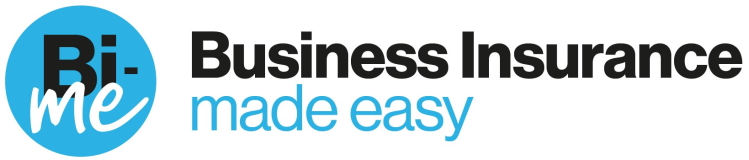

You're probably doing what most sole traders do. Chasing invoices, answering WhatsApps, buying stock, loading tools, and trying to keep customers happy. Whether you're a plumber heading to a call-out, a freelance consultant joining a client meeting, or a market trader opening your stall before sunrise, insurance usually sits in the “I'll sort it out later” pile.
That works until something small turns expensive.
A client trips over your extension lead. You scratch a customer's counter while fitting a sink. A delivery you're handling damages a third party's property. The problem isn't only the accident itself. The problem is that, as a sole trader, the claim can land on you personally.
That's why business insurance as sole trader matters so much in South Africa. It isn't just paperwork for tenders or a box to tick for a landlord. It's part of protecting your income, your tools, and in some cases your personal assets when a normal working day goes wrong.
Your Business Your Risk an Introduction
A sole trader's day often starts before the customer sees any work. You load equipment, confirm directions, answer one urgent message, and try to arrive on time. If you're a plumber, you're under a sink fixing a leak. If you're a consultant, you're carrying a laptop into a client's office. If you sell at a market, you're setting up while everyone else is still parking.
Then something ordinary happens. Water spills onto a polished floor. A customer steps back, slips, and gets hurt. Or your ladder clips a glass panel at a client's premises. Suddenly the conversation changes from “How much will this cost?” to “Who is paying for the damage?”
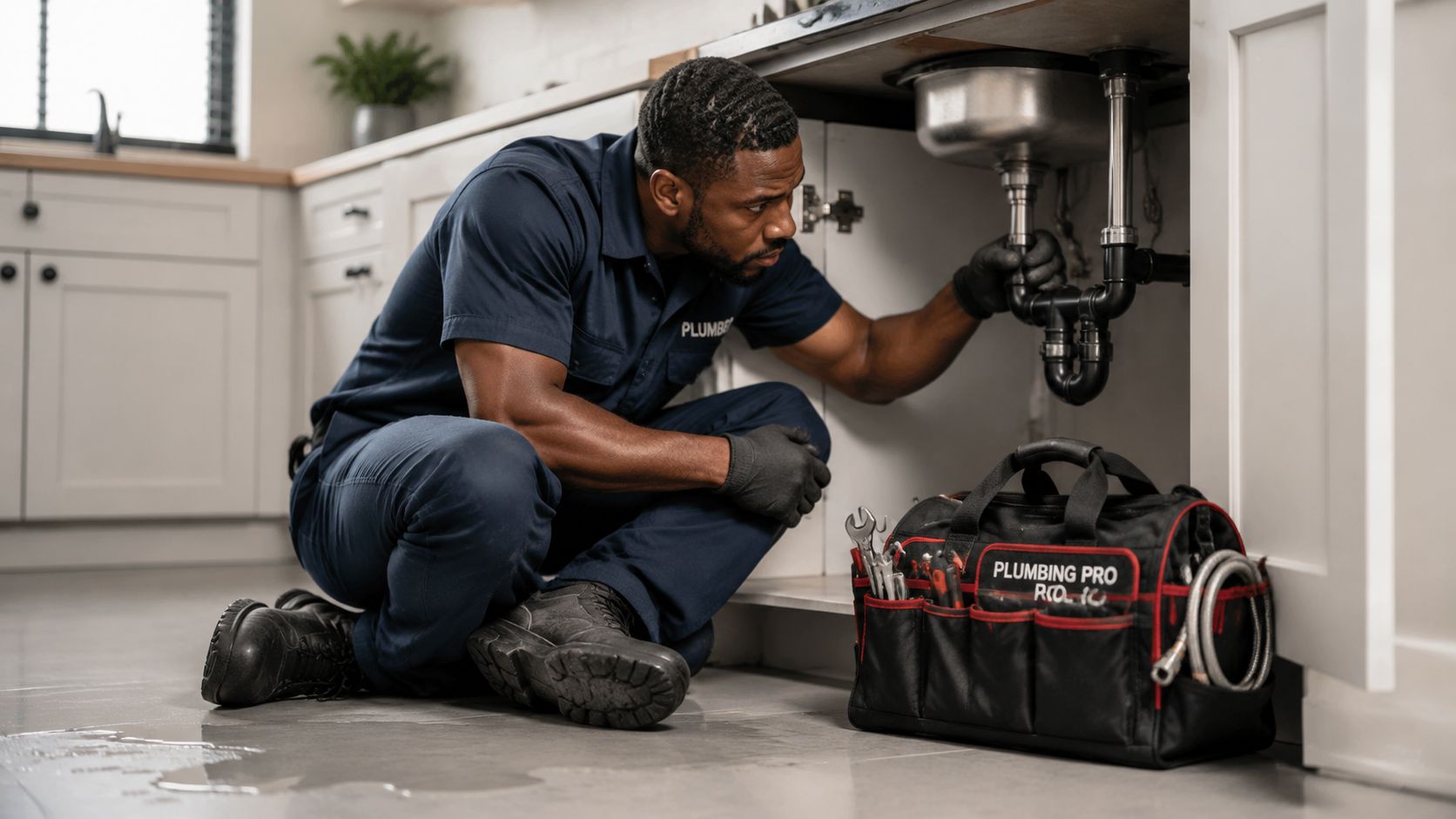
That's where public liability insurance comes in. In plain language, it's there for situations where your business activity causes injury to someone else or damage to their property, and they hold you responsible.
Why this matters in South Africa
Public liability isn't operating in a vacuum. In South Africa, the short-term insurance market, including business insurance for sole traders, is governed by the Short-Term Insurance Act 53 of 1998, and that legal framework sets standards for consumer protection around policies such as public liability, as outlined in the Short-Term Insurance Act reference.
Practical rule: If your work brings you onto client premises, into public spaces, or into contact with customer property, liability risk is already part of your business.
A lot of new sole traders think insurance is mainly for large companies with offices, fleets, and payroll departments. It isn't. The smaller your business is, the less room you usually have to absorb one bad claim out of cash flow.
That's why business insurance as sole trader is less about complexity and more about resilience. It gives you a safety net for real-world mishaps, so one incident doesn't undo years of hard work.
What Public Liability Insurance Actually Covers
Public liability can sound technical, but the core idea is simple. It deals with harm caused to other people or other people's property because of your business activities.
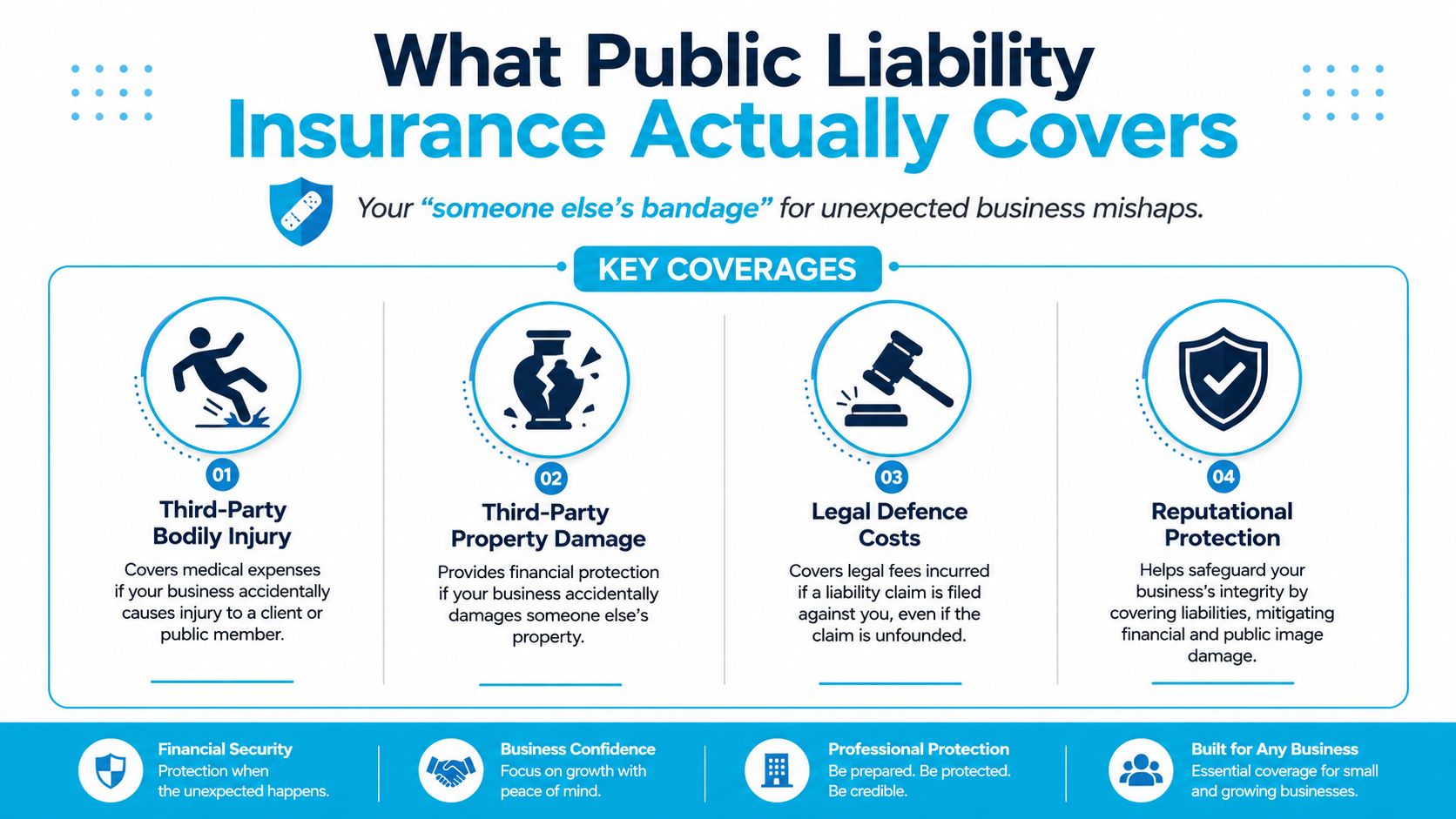
Think of it as someone elses bandage
If your own drill is stolen, that's not public liability. If your own laptop breaks, that's not public liability either. Public liability is for the outside impact of your work.
A simple way to remember it is this. It's someone else's bandage. Someone else's medical expense, someone else's damaged counter, someone else's legal claim against you.
If you want to see how this cover is typically described in a South African small business setting, the public liability cover overview is a useful starting point.
The main events it usually responds to
Third-party bodily injury
A client slips on a wet patch after you've cleaned or repaired an area. They need treatment and say your work setup caused the accident.Third-party property damage
You're installing shelving, moving equipment, or photographing at a customer's home and accidentally damage something valuable that belongs to them.Legal defence costs
A person doesn't need to be right to bring a claim. If they accuse you of causing the loss, legal costs can start before fault is fully decided.Pressure on your reputation
Liability matters aren't only about the invoice at the end. They can also affect how clients talk about your business and whether site managers, landlords, or event organisers want to work with you again.
A good first question is not “Do I need public liability?” It's “Who could suffer loss if something goes wrong while I'm working?”
A few examples that make it clearer
A freelance trainer visiting a client's office knocks over expensive equipment while setting up. A caterer damages flooring during an event setup. A handyman leaves tools where a member of the public can trip over them.
The cover doesn't make every business mistake disappear. It also doesn't replace skill, safe working habits, or careful setup. What it does is create financial backup for a category of claims that can otherwise hit fast and hit hard.
That distinction matters. Many sole traders buy insurance without being sure what problem each policy is meant to solve. Public liability is one piece of the broader business insurance as sole trader picture, and it's the piece built around third-party injury, third-party property damage, and the defence costs that often follow.
Why Sole Traders Face Unique Financial Risks
A registered company and a sole trader may both do the same work, serve the same client, and face the same accident. The difference sits in where the financial damage can land.
There is no legal wall between you and the business
As a sole trader, there isn't a corporate veil between your business obligations and your personal finances. If a liability claim lands and you're responsible, the pressure doesn't stop neatly at “the business”. It can affect your own solvency, because legally the business and the owner aren't separate in the same way a company is.
That's why public liability feels more urgent for sole traders than many people realise. A claim isn't just an operational setback. It can become a personal financial problem.
A common oversight among new business owners is thinking that being small means they have less exposure. In reality, being small often means you have fewer buffers. You may not have retained profits, a finance department, or spare reserves to absorb legal costs and compensation demands.
The policy wording must match your business structure
Another risk is quieter and easier to miss. The “sole trader vs. SME” policy exclusion gap can cause serious trouble if the policy isn't aligned to your actual structure. As noted in this guide to small business insurance in South Africa, it's important to understand what category of business the policy is written for.
The broader issue is also highlighted by Specialised Broker Services on small business insurance, which notes that many standard SME insurance products may not adequately cover unincorporated entities, creating the risk of a rejected claim if the business structure isn't explicitly declared.
If your schedule says one thing and your business operates another way, the trouble often only appears when you claim.
There's another practical point. If you employ one or more people, you're legally required to register with the Compensation Fund under COIDA, and failing to do that can lead to penalties and personal liability for workplace injury claims, as explained in this South African business insurance overview.
That doesn't make public liability less important. It means different risks sit in different places. Injury to a member of the public is one issue. Injury to your employee is another. Mixing them up is one of the most common reasons sole traders buy the wrong protection.
How to Choose the Right Liability Cover Limit
Choosing a liability limit feels abstract until you translate it into your daily work. The right amount depends less on what you'd like to pay and more on the level of harm your business could realistically cause.
What a limit of indemnity means
The limit of indemnity is the maximum amount the insurer will pay for a covered liability claim, subject to the policy wording. Think of it as the ceiling of your protection.
If that ceiling is too low, you could still face a shortfall. That matters more for sole traders because any amount above the insured limit can become your problem directly.
A simple way to choose
Start with three questions:
Where do you work?
Home office work usually creates less third-party exposure than regular work on customer premises, construction sites, retail areas, or public venues.What can your work physically affect?
Advice-only work and hands-on installation work don't carry the same liability profile. The more your work can injure a person or damage valuable property, the more limit you usually need.Do your clients require a minimum limit?
Some landlords, principal contractors, event venues, and commercial clients won't let you start without proof of a specific liability amount.
For South African sole traders, public liability limits are commonly tiered by risk exposure. R5 million is a common minimum for low-risk businesses, R10 million to R20 million is standard for professions like retail and contractors working on third-party sites, and hazardous industries may require R50 million or more, according to Rateweb's guide to small business insurance in South Africa.
| Occupation Type | Risk Level | Typical Cover Limit (ZAR) |
|---|---|---|
| Freelance consultant working mainly from office settings | Low | R5 million |
| Photographer visiting client premises | Moderate | R5 million |
| Retail trader with public foot traffic | Medium to high | R10 million to R20 million |
| Plumber or electrician working on third-party sites | Medium to high | R10 million to R20 million |
| Contractor in hazardous environments | High | R50 million or more |
How to sense-check your number
A low-risk solo consultant may choose a lower benchmark because there's limited physical interaction with the public. A plumber working in homes, complexes, or commercial sites usually needs to think differently because water damage, slips, and property damage are easier to imagine. A contractor entering high-risk or controlled sites may not have much choice if the contract specifies the minimum.
Choose the limit based on the size of the possible claim, not the size of your business.
That's the part many people miss. Your turnover doesn't cap the value of a liability loss. One serious accident can exceed what a small operation could ever pay from savings.
Understanding Costs and Common Policy Exclusions
Price matters. For most sole traders, it matters immediately. But the monthly premium only makes sense once you know what drives it and what the policy leaves out.
What affects the price
Most South African SMEs, including sole traders, can expect to spend between R500 and R5,000 per month on core business insurance policies, with the final cost depending heavily on cover type, risk profile, and business size, according to Ready Accounting's overview of business insurance for South African SMEs.
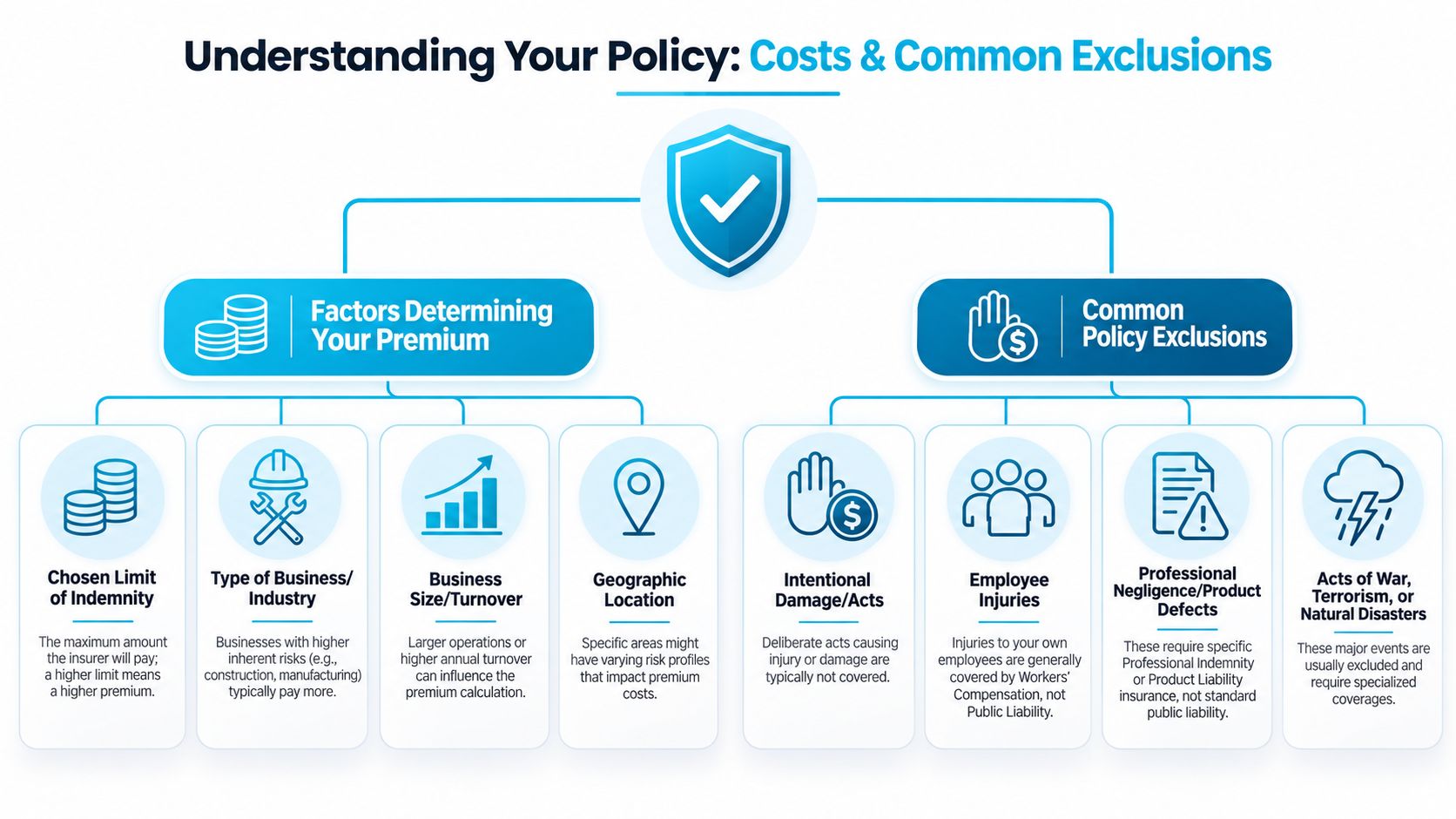
That range is broad because insurers look at several practical details:
Your chosen limit
Higher liability limits usually cost more because the insurer may have to respond to a larger claim.Your actual activities
A consultant, a caterer, and a contractor don't present the same level of third-party risk.Business size and turnover
More jobs, more clients, and more site activity can mean more opportunities for incidents.Where and how you operate
Working in public areas, customer homes, shopping centres, or controlled sites usually changes the risk picture.
What public liability usually does not cover
Realistic expectations are necessary. Public liability is important, but it isn't a catch-all policy.
Professional negligence
If your advice, design, diagnosis, or specialised service causes financial loss, that usually sits under Professional Indemnity rather than public liability.Faulty workmanship itself
If your work has to be redone because it was done badly, the cost of correcting that work is often treated differently from damage caused to third parties.Employee injuries
Your staff's workplace injuries don't usually sit under public liability. They connect to your COIDA responsibilities instead.Vehicles and road incidents
If the loss arises from using a motor vehicle, that is usually handled under motor cover, not public liability.
Read the exclusions with the same care you give the premium. The gap between those two is where claim surprises usually live.
A sensible buying approach is to ask two separate questions. First, what am I covered for? Second, what common losses in my business are handled by another policy altogether?
Getting Covered Instantly with a Digital Platform
Traditional business insurance often frustrates sole traders for one reason. It asks for time you don't have. You're on-site, in traffic, or with a client when someone says, “Please send the form back with supporting documents.” That process can drag on, especially if you need proof of cover urgently.
A digital platform changes the flow. Instead of waiting for back-and-forth calls, you can enter your business details online, compare options, select cover, and access documents in one place.
What the online process looks like
For many sole traders, the useful part of digital buying isn't just speed. It's clarity.
You enter your occupation and business details
That matters because cover should reflect what you do, not a vague business label.You compare quotes side by side
Seeing more than one option helps you look beyond premium alone and check limits, wording, and fit.You customise the cover
The point isn't to buy the biggest policy. It's to choose cover that matches your daily work, the places you operate, and any client requirements.You pay online and receive documents digitally
For sole traders who need to send proof of cover to a customer, landlord, or site manager, instant access matters.
Why digital buying suits sole traders
A modern platform is especially useful when your business doesn't operate on office hours. If you remember at night that a client wants a certificate tomorrow morning, you need a process that doesn't depend on waiting for someone to call you back.
One option in South Africa is Bi-me's online quote flow for small business public liability insurance. It's a digital brokerage platform that lets businesses compare quotes from multiple local insurers, customise cover by occupation, buy online, and manage policies through a client portal. That setup fits sole traders well because it reduces paperwork and gives quicker access to schedules and certificates.
A self-service portal also helps after purchase. You may need to download documents, request changes, review your schedule, or start the claims process without searching through old emails.
The easier it is to review and manage your cover, the less likely you are to leave a mistake sitting in the policy for months.
For business insurance as sole trader, convenience isn't a luxury. It's part of getting the basics done properly before a client asks for proof or a claim forces you to read the wording under pressure.
Managing Your Policy for Long-Term Protection
Buying the policy is only the start. Good insurance works best when it keeps pace with the way your business changes.
Keep your cover aligned with your work
Review your policy at least whenever your activities change. If you move from home-based consulting into regular site visits, start selling products, hire staff, or take on larger contracts, your original setup may no longer reflect the actual risk.
Keep your records clean as well. Save contracts, job sheets, incident notes, invoices, maintenance logs, and client communications. If something goes wrong, clear records make it easier to explain what happened and when.
Update your occupation details if your work broadens beyond the original description.
Tell your broker or platform about new locations if you start working at more sites or in higher-risk environments.
Check client contract requirements before accepting work that demands a higher liability limit or extra cover.
Review your schedule and certificate so your business structure and activities are described correctly.
Lower friction when a claim happens
If an incident occurs, act early. Gather photos, note names, keep damaged items where possible, and report the event promptly. Don't admit liability casually on-site just to calm things down. Give factual information, then follow the policy process.
Good risk habits can also support premium stability over time. Safer setups, tidy work areas, staff training where relevant, and clear customer communication all help reduce avoidable incidents.
The aim isn't to become an insurance expert. It's to treat insurance as part of how you run the business, the same way you treat quotes, tools, stock, or tax.
If you want a simpler way to arrange and manage cover online, Bi-me lets South African businesses compare options, buy cover, and access policy documents without the usual paperwork.
This is general information only and does not take into account your financial situation, needs, or specific objectives. As with any insurance, the cover will be subject to the terms, conditions, and exclusions contained in the policy wording.