
How much professional indemnity insurance you need depends on the worst credible loss you could cause on a single job, not on your annual income. Start with any minimum set by a regulator or contract, then size your limit to your largest realistic claim, including legal costs. There’s no standard number for your profession, and anyone quoting one without asking about your contracts is guessing.
Three numbers on every PI policy
- Limit of indemnity: the most the insurer will pay for a claim. If a claim exceeds it, your own assets are exposed above that amount.
- Aggregate limit: the most the policy pays across all claims in a policy period.
- Excess: what you pay first on each claim.
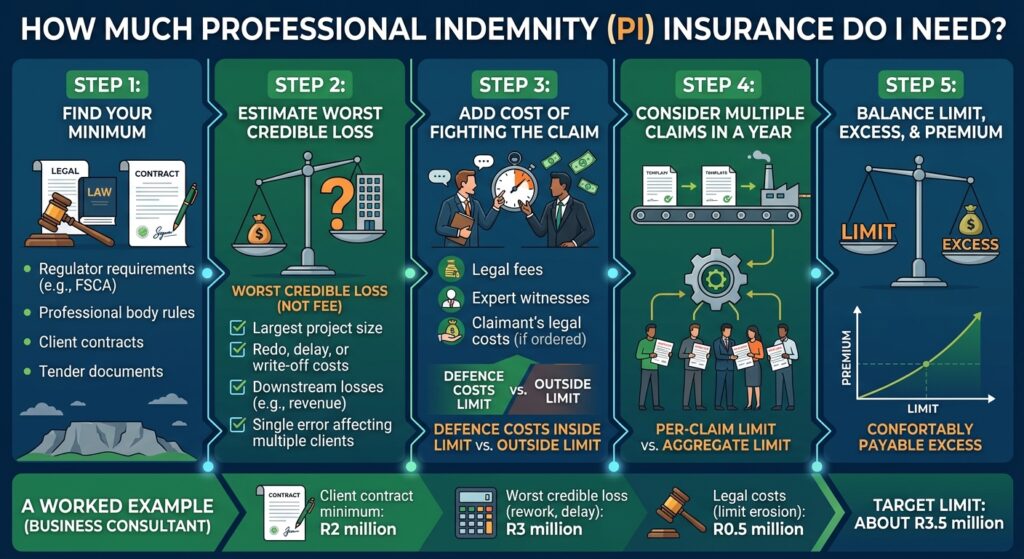
Step 1: Find your minimum
Your limit can’t go below what you’re required to hold. Check:
- Your regulator. FSPs, for example, face a legal minimum set through the FSCA. See Is Professional Indemnity Insurance Compulsory?
- Your professional body’s rules
- Every current client contract, especially the insurance clause
- Tender documents you plan to bid on
Take the highest of these as your floor. If a contract needs a higher limit, you need it before you sign.
Step 2: Estimate your worst credible loss on one job
This is the step most people skip, and it’s the one that matters. Ask yourself:
- What is the largest project or engagement I take on?
- If my work is wrong, what would the client have to redo, delay or write off?
- What could they lose downstream, such as lost revenue or wasted spend based on my advice?
- Could one error affect several clients at once?
Base it on what you could realistically cause, not on your fee. A small fee can sit on top of a very large client decision. A low-value engagement can still produce a large claim.
Step 3: Add the cost of fighting the claim
Legal costs can be large, and where they sit changes your real protection:
- Defence costs inside the limit reduce the amount available to pay compensation. Outside the limit, they don’t.
- If you lose, you may also be ordered to pay the claimant’s legal costs. Check whether those fall within your limit.
- Related claims may be treated as one. Several claims from the same error can be aggregated under a single limit.
Step 4: Think about how many claims you could face in a year
A single limit protects you against one bad job. If you do repeatable work for many clients, such as templates, standard designs or software, one flaw can trigger several claims. In that case the aggregate limit matters as much as the per-claim limit.
Step 5: Balance the limit against excess and premium
A higher limit usually costs more. A higher excess usually lowers the premium, but only if you can comfortably pay it on the day. Don’t lower the limit to save on premium if your contracts or worst-case loss need more.
A worked example
This is a hypothetical scenario with invented figures. It illustrates the method and is not a benchmark for any profession.
A business consultant advises on a client’s ERP rollout.
| Step | Figure |
|---|---|
| Client contract minimum | R2 million |
| Worst credible loss (rework R1.8m + delay losses R1.2m) | R3 million |
| Legal costs that could erode the limit | R0.5 million |
| Target limit | About R3.5 million |
The contract minimum of R2 million would be too low. She’d ask for quotes at the next standard limit above R3.5 million and one step higher, then compare what each extra layer of protection costs.
Review your limit at renewal
Your limit isn’t set once and forgotten:
- Grow it as your work grows. Bigger contracts, larger clients and new services all raise exposure.
- Be careful when reducing it. PI is usually claims-made, so the limit on your current policy applies to claims made now about past work. Cutting your limit to save money also cuts protection for work you did years ago.
- Declare changes. A new service or client type can change both your exposure and your cover.
Common mistakes when choosing a limit
- Basing it on turnover rather than worst credible loss
- Copying a peer’s limit without checking your own contracts
- Missing a contractual minimum buried in a client’s terms
- Ignoring whether defence costs erode the limit
- Reducing the limit at renewal without thinking about past work
Frequently asked questions
Is R1 million enough?
It depends on your contracts and worst credible loss. It may be a legal minimum for some regulated professions. For many professionals it’s simply a starting point, not proof of adequacy.
Does a higher limit cost double?
Not usually. Premium doesn’t rise in a straight line with limit, but the effect varies by profession and insurer. Get quotes at more than one limit and compare.
Can I increase my limit for one big project?
Often yes. Ask your broker about a temporary increase, and keep it in place until the period in which claims could arise has passed.
What if a claim exceeds my limit?
The insurer pays up to the limit. Anything above it is your responsibility, which is why worst-case sizing matters.
Get a limit that fits your work
Give us your largest contract, your client contract requirements and the services you offer, and we’ll help you compare limits and excesses side by side.