Professional indemnity exclusions are the situations your policy won’t pay for: injury and property damage, dishonest acts, claims you already knew about, work outside your declared business, and liability you took on by contract beyond the ordinary duty of care. Most declined claims come from a few predictable gaps, and all of them can be spotted before you buy.
This article covers the standard exclusions and how to reduce your exposure. Exact terms depend on your policy wording, so always check yours.
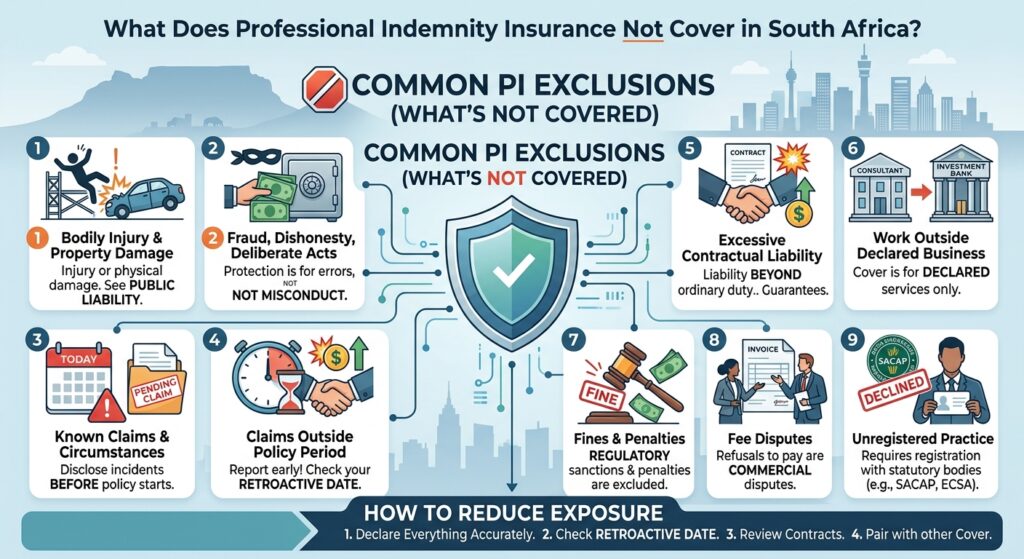
Common professional indemnity exclusions
1. Bodily injury and property damage
If your work causes someone to be physically hurt, or damages their property, that’s normally a public liability claim, not PI. PI deals with financial loss from professional advice and services.
An architect’s design error that leads to the cost of redesign is PI. A site visitor injured by falling debris is not. See The Difference Between Public Liability and Professional Indemnity.
2. Fraud, dishonesty and deliberate acts
Insurance protects you from mistakes, not misconduct. Deliberate wrongdoing, fraud and dishonesty by you are excluded. Many policies protect an innocent business owner against a dishonest employee, but not against their own dishonesty.
3. Claims and circumstances you already knew about
If you know of a claim, or of circumstances likely to lead to one, before your policy starts or renews, it’s generally excluded. It’s the most misunderstood of all professional indemnity exclusions, and the most costly.
How to avoid it:
- Disclose known incidents, complaints and disputes when you apply
- Notify your insurer of potential claims as soon as you become aware of them, within the policy period
- Never assume “it probably won’t go anywhere”
4. Claims made outside the policy period
PI is usually claims-made. If a claim arrives after your policy has ended, and you have no run-off or continuing cover, it may not be covered even if the work was done while you were insured.
Also check your retroactive date. Work done before that date is typically excluded. See What Is a Retroactive Date?
5. Contractual liability beyond the ordinary duty
Contracts sometimes push liability further than the law would. Common examples:
- Guarantees that a project will finish on time or a design will achieve a specific result
- Warranties about outcomes rather than about reasonable care
- Indemnities that make you responsible for someone else’s losses
- Liability caps that don’t match your policy limit
PI is designed to cover legal liability arising from negligence, not promises you made in a contract. Have someone review client contracts before you sign them, especially tender documents.
6. Work outside your declared business
Your policy covers the professional services you described to the insurer. If you add a service, or your work changes significantly, you may be operating outside your cover.
Example: a business consultant who begins offering financial planning advice may need that activity declared, and possibly a different type of cover.
7. Fines, penalties and regulatory sanctions
Fines and penalties imposed by regulators or courts are generally excluded. Some policies include limited cover for defence costs in regulatory investigations. Check whether yours does.
8. Fee disputes
If a client refuses to pay or asks for a refund of your fees, that’s a commercial dispute, not a negligence claim. Refunding or reducing fees generally isn’t covered.
9. Practising without the required registration
If your profession requires registration with a statutory body and you practise without it, your insurer may decline a claim. Check the body for your field and keep your registration current:
Other professional indemnity exclusions you may see
Depending on the policy, you may also find exclusions for:
- Employer’s liability and employment disputes
- Pollution or environmental damage
- Client money and trust funds: often excluded or sub-limited, which matters for property practitioners
- Cyber events and data breaches: these may need separate cover. Under POPIA, a security compromise involving personal information generally has to be reported to the Information Regulator, and the cost of doing that properly is not something PI will necessarily fund. See our cyber insurance cover.
- War, terrorism or nuclear risks
- Insolvency of the insured
An illustrative example
This is a hypothetical scenario, not a real claim.
A project manager signs a contract guaranteeing that a building will be completed by a fixed date. The project runs late because of avoidable coordination failures, and the client claims the penalty set out in the contract.
The insurer may decline part or all of the claim. Negligent project management could be covered, but a contractual guarantee of a completion date goes beyond the duty of care, and penalties may be excluded. Same event, very different outcomes, depending on how the contract was worded.
How to reduce your exposure to professional indemnity exclusions
- Read the exclusions first, before the benefits.
- Declare everything accurately: your services, your revenue, your past claims.
- Check your retroactive date and keep it when switching insurers.
- Review contracts for guarantees and unlimited liability.
- Pair PI with other cover: public liability for injury and damage, cyber insurance for data risks.
- Report early. Notify your insurer at the first sign of a problem.
Frequently asked questions
Can an insurer decline my claim after accepting my premium?
Yes, if the claim falls under an exclusion or you failed to disclose something material. That’s why accurate disclosure at the outset matters.
Are exclusions the same across all insurers?
No. Wording varies, so compare exclusions, not just premiums.
Does PI cover data breaches?
Not necessarily. It may respond where a breach results from a professional error, but dedicated cyber cover is the more reliable option. Ask your broker.
What should I do if I think a claim might be excluded?
Report it anyway. Let the insurer decide, and get advice from your broker.
Know what you’re buying
Cheap cover that excludes the risks you actually face isn’t cheap. Talk to us about your profession, your contracts and your risk profile.