

You’ve found a municipal tender that fits your business. A Tender Documents Checklist South Africa approach helps you see, early, which forms, certificates and declarations can determine whether your bid is even evaluated. The price is competitive. The technical team is ready. The deadline looks manageable. Then you open the bid pack. You see CIPC documents, SARS tax compliance, CSD records, B-BBEE evidence, SBD forms, declarations, sector certificates, pricing schedules and submission rules. One missing signature can matter as much as the quality of your work.
A strong Tender Documents Checklist South Africa guide must do more than list paperwork. It should help you decide which documents apply to your organ of state, sector and bid value. It should also help you test the final pack for errors that make a bid non-responsive.
This version is built for South African SMEs that want a practical, legally accurate way to prepare an organ of state tender compliance pack.
Why Your Business Needs a Tender Documents Checklist in South Africa
Consider Sipho, a Durban-based SME owner preparing his first plumbing submission for a municipal request for quotation. He knows how to install piping, manage a site and price labour. At first, he does not realise that a bid committee can reject his offer before considering those capabilities. An incomplete declaration or a company document mismatch can be enough.
That result feels harsh to a first-time bidder. However, procurement committees must assess each submission against the published requirements. South Africa’s procurement environment is shaped by frameworks including the PFMA, MFMA, the Preferential Procurement Policy Framework Act and the Preferential Procurement Regulations. In addition, Treasury guidance and the tender document issued by the procuring entity also matter.
Each returnable gives the Bid Evaluation Committee and Bid Adjudication Committee evidence about identity, tax status, authority, preference claims, independence and eligibility.
Practical rule: Treat every compulsory returnable as evidence, not as an attachment.
The cost of getting it wrong
The cost of a failed submission is not limited to the missed opportunity. Your team may lose time preparing a replacement bid. You may pay again for certification or courier services. Worse, repeated administrative errors can damage confidence and waste capacity.
Start with the official tender pack. A preparation resource such as this South African government tender opportunities database can help you identify opportunities. However, the issuing organ of state remains the authority on its own forms, dates, submission method and compulsory documents.
The Tender Documents Checklist South Africa below works best as a decision tool. First, identify the organ of state. Next, identify the sector. Then, check the bid value and the relevant preference point rules. This sequence separates the universal compliance baseline from returnables that apply only to construction, security, healthcare, professional services, joint ventures or a specific procurement.
Universal Baseline for Your Tender Documents Checklist in South Africa
Most public tender packs start with the same identity and compliance foundation. Exact wording varies, so the tender document always wins. Even so, South African tender packs repeatedly ask for CIPC registration, SARS tax compliance, active CSD registration, B-BBEE evidence, banking confirmation, director identification and completed bidding forms.
The South African tender documents checklist guide also highlights municipal rates clearance where relevant and current company records.
Primary Registration & Identity Documents
Central Supplier Database (CSD): CSD registration confirms active listing on the government supplier database. Furthermore, suppliers must keep their profiles updated, including MAAA numbers, legal names, addresses, banking, and tax details.
CIPC Registration: CIPC registration documents establish the legal identity of the bidding entity. Therefore, check that the registered name, registration number, and directors match every other document. Responses under a trading name must still identify the registered entity.
SARS Tax Status: SARS Tax Compliance Status proof shows valid tax standing via an active PIN. Consequently, you should avoid saved PDFs if the organ of state requires live verification on eFiling.
Preference & Financial Returnables
SBD 1 & SBD 4 Forms: SBD 1 records the invitation to bid, while SBD 4 handles declarations of interest and independent bid determination. Therefore, both forms must be completed, signed by an authorized person, and submitted in full.
B-BBEE & Specific Goals: A B-BBEE certificate or EME/QSE affidavit supports preference point claims under Preferential Procurement Regulations 2022. As a result, these claims must align with the tender’s stated specific goals, such as ownership or locality.
Banking Confirmation: Bank letters verify the account where payments will be made. However, ensure the letter is printed on official bank letterhead and matches the bidding entity’s name exactly.
Director Identification: Certified director IDs help procuring entities verify company leadership. In addition, ensure certification dates satisfy the tender’s recency requirements.
| Document | What It Confirms | Validity Rule |
|---|---|---|
| CIPC registration documents | Legal identity, registration details and directors | Use current company information and check it against the tender response |
| SARS tax compliance PIN or status proof | Tax compliance evidence | Verify it in line with the tender’s closing-date instructions, then monitor it through evaluation |
| CSD registration and report | Government supplier registration and supplier details | Confirm active status and matching information before submission |
| B-BBEE certificate or affidavit, where relevant to the stated specific goals | Basis for the stated preference-related claim | Use the evidence and validity period specified in the tender |
| Bank confirmation | Banking details of the bidding entity | Obtain the requested letter or confirmation close enough to the tender process |
| Certified director IDs | Identity of directors or required representatives | Follow the tender’s certification and date requirements |
| SBD 1 | Formal invitation and bid offer | Complete the issued version and sign every required field |
| SBD 4 | Declaration of interest, bidders past SCM practices and independent bid determination | Complete and sign it as instructed |
| Municipal rates clearance, where relevant | That the municipal account is not in the prohibited arrears position | Submit current proof in the format requested |
The official bid checklist shows why this baseline acts as a gate. Signed invitation, declaration and preference-related forms are not decorative. Missing or unsigned compulsory returnables can stop a bid from moving to technical or price evaluation.
Essential CSD baseline checks for South African tenders
For many SMEs, the CSD registration baseline is where tender readiness begins. In any Tender Documents Checklist South Africa workflow, an outdated CSD profile often causes problems across the rest of the submission.
Check these items before every bid:
- Legal entity name matches CIPC records
- MAAA number is visible and active
- Tax details align with SARS records
- Banking details match the account named in your tender response
- Contact details match the authorised representative handling clarifications
- Commodity and service information is up to date where relevant
Tip: If your CSD report, bank letter and pricing schedule identify the business differently, fix the mismatch before you submit. Evaluators notice inconsistency fast.
SARS tax checks in your tender compliance workflow
Many SMEs treat the SARS Tax Compliance Status PIN as a once-off download. That is risky. In practice, suppliers should monitor their TCS PIN on eFiling before submission and during the evaluation period. This matters most where the organ of state verifies tax status more than once.
A PIN that is active on the closing date but becomes inactive, suspended or non-compliant during evaluation can create a serious responsiveness problem. This risk is even higher where the tender requires ongoing tax compliance. Businesses should therefore keep their underlying tax affairs current and resolve outstanding returns early.
Practical steps for SMEs:
- Confirm the PIN is active shortly before submission
- Check whether all returns and payments are up to date on eFiling
- Avoid relying on an old stored tax status document
- Recheck tax status if clarification or best and final offer stages delay adjudication
- Assign one staff member or adviser to monitor SARS compliance until award
Important CSD tax sync warning: Resolving a tax issue on SARS eFiling does not always update your CSD profile immediately. In practice, evaluators often rely on the tax status reflected on the CSD summary report. After resolving the issue on eFiling, log into the CSD portal and manually click Request Tax Details from SARS, or use the available tax refresh function, so the CSD record pulls the latest status.
SBD and MBD Forms Explained Without the Jargon
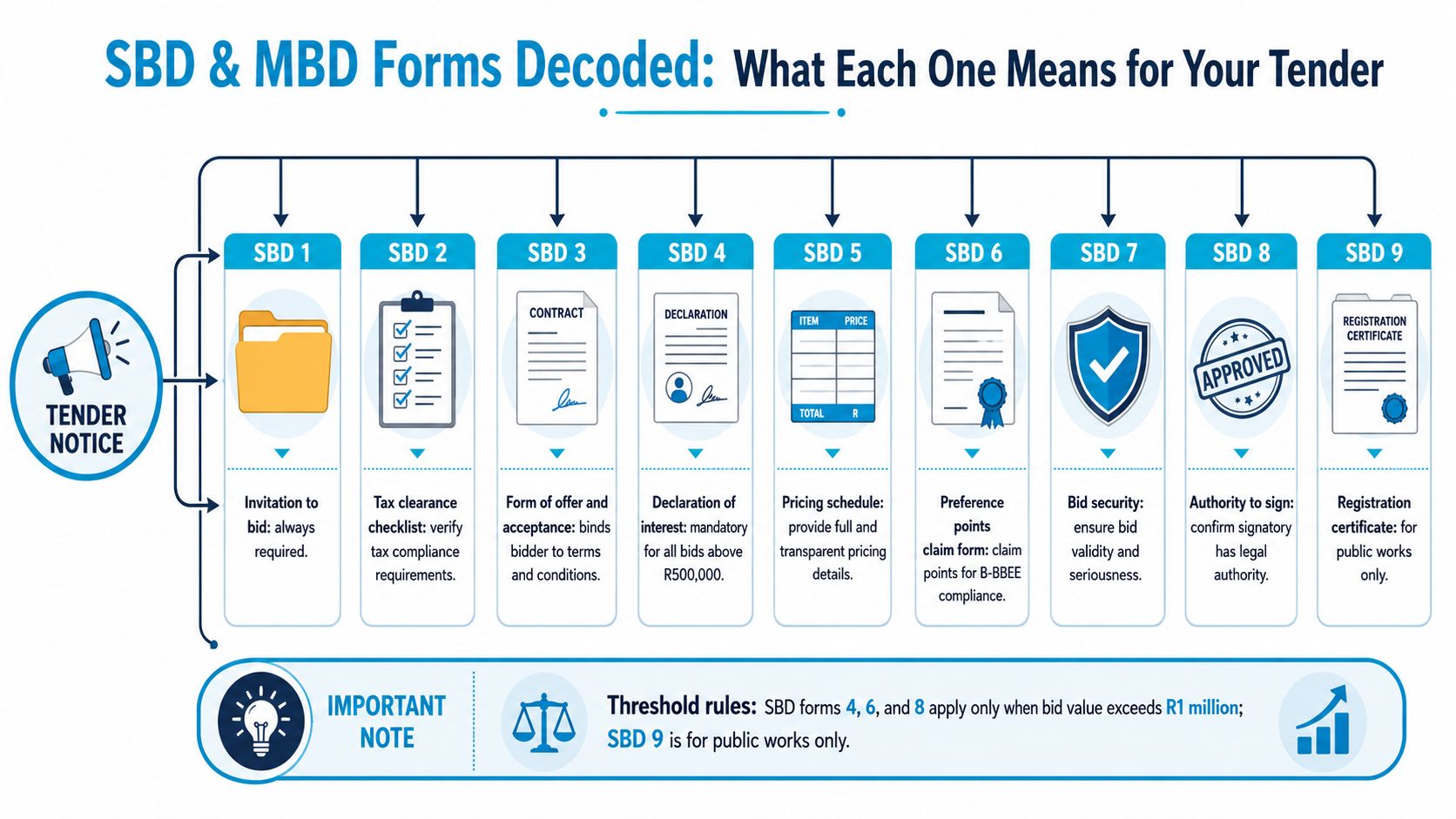
SBD and MBD forms perform similar administrative work across different procurement environments. National and provincial departments commonly use Standard Bidding Documents. Municipalities often use Municipal Bidding Documents. The form number matters. However, the tender pack’s own version and completion instruction matter more.
SBD 4 form explained
If bidders search for SBD 4 form explained, the simplest answer is this: SBD 4 is one of the most important integrity declarations in the bid pack.
National Treasury Instruction No. 03 of 2021/2022 consolidated earlier declaration requirements into an updated SBD 4, titled Declaration of Interest and Bidders Past SCM Practices and Independent Bid Determination. In practice, bidders should follow the current tender pack instead of looking for separate older forms such as standalone SBD 8 and SBD 9.
Read SBD 4 as a set of compliance questions:
- Who owns or controls the bidding entity?
- Which conflict of interest needs to be declared?
- Whether the bidder has been involved in disallowed past SCM practices
- How the bid was independently prepared
- Which authorised signatory is clearly identified
A missing answer, omitted signature or outdated template can create a responsiveness problem.
MBD forms vs SBD forms in South African tenders
A common bidder question is MBD forms vs SBD forms. In a Tender Documents Checklist South Africa review, the easiest way to understand the difference is to ask which sphere of government issued the pack.
| Form Family | Commonly Used By | What to Watch |
|---|---|---|
| SBD forms | National and provincial organs of state | Use the exact version issued with the tender |
| MBD forms | Municipalities and municipal entities | Numbering and wording may differ from SBD packs |
You may still see familiar functions across both form families:
- Invitation to bid
- Pricing schedule
- Declaration of interest
- Preference or specific-goal claim forms
- Contract or special-condition schedules
- Returnable document checklists
The government tender document illustrates the repeated use of returnable schedules, preference declarations and supply-chain forms in South African procurement.
How to avoid form-version mistakes
Download the forms from the tender notice or the issuing department’s official pack. Do not copy a completed form from a previous bid and replace only the title. A changed declaration, revised pricing schedule or different instruction can make an old version unsuitable.
Before submission, check every page for required initials, signatures, dates and attachments. Where the tender requires an original and copies, follow that packaging instruction precisely. Some official bid documents specify an original tender plus two copies. That requirement appears in the cited government tender pack. Therefore, treat it as tender-specific, not universal.
Preference Points, Specific Goals and B-BBEE
This is one of the areas where bidders make the most avoidable mistakes.
Under the Preferential Procurement Regulations 2022, the preference point system is linked to bid value:
- 80/20 preference points South Africa rules apply to bids with a value of up to R50 million, inclusive of VAT
- 90/10 applies to bids above R50 million, inclusive of VAT
That threshold matters because the wrong form, wrong declaration or wrong assumption about preference scoring can weaken an otherwise competitive bid.
Preference points are also no longer described accurately if they are treated as B-BBEE only. The tender must state its Specific Goals. These may include:
- B-BBEE status level of contributor
- Ownership by black people
- Ownership by women
- Ownership by youth
- Ownership by persons with disabilities
- Locality, where defined in the tender
- Other lawful goal criteria clearly stated by the organ of state
Practical rule: Do not assume that a B-BBEE certificate alone proves every preference claim. Read the specific-goal schedule and attach the exact supporting evidence it requests.
| Bid Value | Preference System | What the Bidder Must Check |
|---|---|---|
| Up to R50 million, inclusive of VAT | 80/20 | Correct preference form, specific-goal evidence, complete declarations |
| Above R50 million, inclusive of VAT | 90/10 | Correct preference form, specific-goal evidence, complete declarations |
If the pack awards preference points for B-BBEE level, your certificate or affidavit remains critical. If it awards points for women ownership, youth ownership, disability ownership or locality, you may need extra supporting documents. Therefore, always let the published tender criteria decide what goes into the pack.
Sector-Specific Rules for Your South African Tender Documents Checklist
The baseline is only the first layer. A Tender Documents Checklist South Africa process for a construction contractor, security provider and professional services firm will differ because each may need very different evidence of eligibility.
Construction, security and healthcare tender document requirements
For construction work, inspect the required CIDB registration and grading, category and tender scope. The pack may also ask for CIDB register evidence, COID or a Letter of Good Standing, health and safety evidence, municipal-account or lease evidence, guarantees and project-specific technical schedules. Do not assume that holding a CIDB registration automatically satisfies the grade, class or scope stated in the tender.
Security tenders may require PSIRA registration, business compliance evidence and training records for guarding personnel. Check which directors, managers and employees must be listed. Also, confirm whether the tender requires certificates for the exact service being offered.
Healthcare and pharmaceutical procurements can add SAHPRA licences, section 22C permits for scheduled substances and relevant professional registrations. A general company compliance folder will not replace a licence connected to the product or activity.
Professional and general services tender document requirements
General services tenders may request professional body membership, trade test certificates, personnel CVs, method statements, references or specialist permits. Use the tender’s commodity description to decide which proof belongs in the pack.
| Sector | Key Conditional Returnables | Issuing Body |
|---|---|---|
| Construction | CIDB grading and registration evidence, COID or Letter of Good Standing, health and safety documents, guarantees where required | CIDB, Compensation Fund or relevant authority |
| Security | PSIRA registration, business compliance evidence, accredited training records | PSIRA and recognised training providers |
| Healthcare and pharmaceuticals | SAHPRA licence, section 22C permit where applicable, professional registration | SAHPRA and relevant professional councils |
| Professional services | Professional membership, trade test or competence certificates, CVs and technical schedules | Relevant professional body or training authority |
| General services | Commodity-specific permits, supplier confirmations, method statements or specialist evidence | Relevant sector authority or issuing organ of state |
The construction and trade services insurance resource is useful when a tender asks for evidence of business protection or contractual cover. Insurance certificates do not cure a missing regulatory registration. However, they can form part of the conditional pack where the tender requires them.
Why sector licences matter early
The highest-risk documents are usually those tied directly to eligibility. A bidder may overlook a sector licence because the company documents are perfect. Even so, an organ of state can reject the submission before technical scoring if that licence is compulsory.
Joint Ventures, Consortiums and Subcontracting Rules
Joint venture and consortium submissions often fail because bidders assume one lead entity can carry the compliance burden for everyone else. In most cases, that assumption is wrong. Where the tender allows an unincorporated JV or consortium, the evaluation committee usually needs evidence for the JV arrangement itself and for each participating member.
Tender document requirements for JVs and consortiums
Unincorporated JV & Consortium Requirements
An unincorporated JV is a contractual collaboration between separate legal entities, requiring individual compliance proof for every member alongside the main agreement.
Core JV Returnables Checklist:
- JV Agreement: Signed agreement defining member roles, work split, lead partner authority, and liability allocation.
- Authority Proof: Board resolutions or letters of authority allowing signatories to act for each member entity.
- Identity & Tax Proof: Individual CSD summary reports, CIPC records, and active SARS TCS PINs for every member.
- Preference & Licensing: JV-specific or consolidated B-BBEE evidence, plus individual director IDs and required sector licences.
- Schedules: Joint pricing and apportionment schedules reflecting agreed work shares.
Critical Note: A lead partner’s clean status cannot fix a missing or non-compliant document from another member. If one partner fails tax or CSD compliance, the entire bid risks disqualification.
Use this quick JV control table before submission:
| JV Requirement | What to Check |
|---|---|
| JV agreement | Signed by all parties, scope and responsibilities clearly allocated |
| Lead partner authority | Written proof of who signs and who answers clarifications |
| CSD | Separate summary report for each member |
| CIPC | Current company documents for each registered member |
| SARS | Separate active TCS PIN or tender-specific tax proof for each member |
| B-BBEE or specific-goal evidence | Submitted in the exact format the tender prescribes for JVs |
| Sector licences | Each member covers the portion of work it will actually perform |
| Pricing and schedules | Figures reconcile across member split and consolidated bid price |
Mandatory Subcontracting Rules & Allocations
When a tender requires subcontracting (e.g., over 30% to targeted EMEs or QSEs), treat it as a mandatory pre-award qualification requirement.
Required Subcontracting Proof:
- Signed subcontracting commitment or formal declaration.
- Targeted subcontractor details, including CSD registration, tax proof, and B-BBEE affidavit.
- Workshare breakdown confirming the exact percentage allocation and real, measurable scope descriptions.
- Signed letters of intent or draft subcontracting agreements where requested.
Common Pitfalls: Bidders often fail by omitting percentage proof or nominating subcontractors with inactive CSD or tax status. Vague promises without verification will result in rejection.
Final Review: Your Tender Documents Checklist South Africa Guide
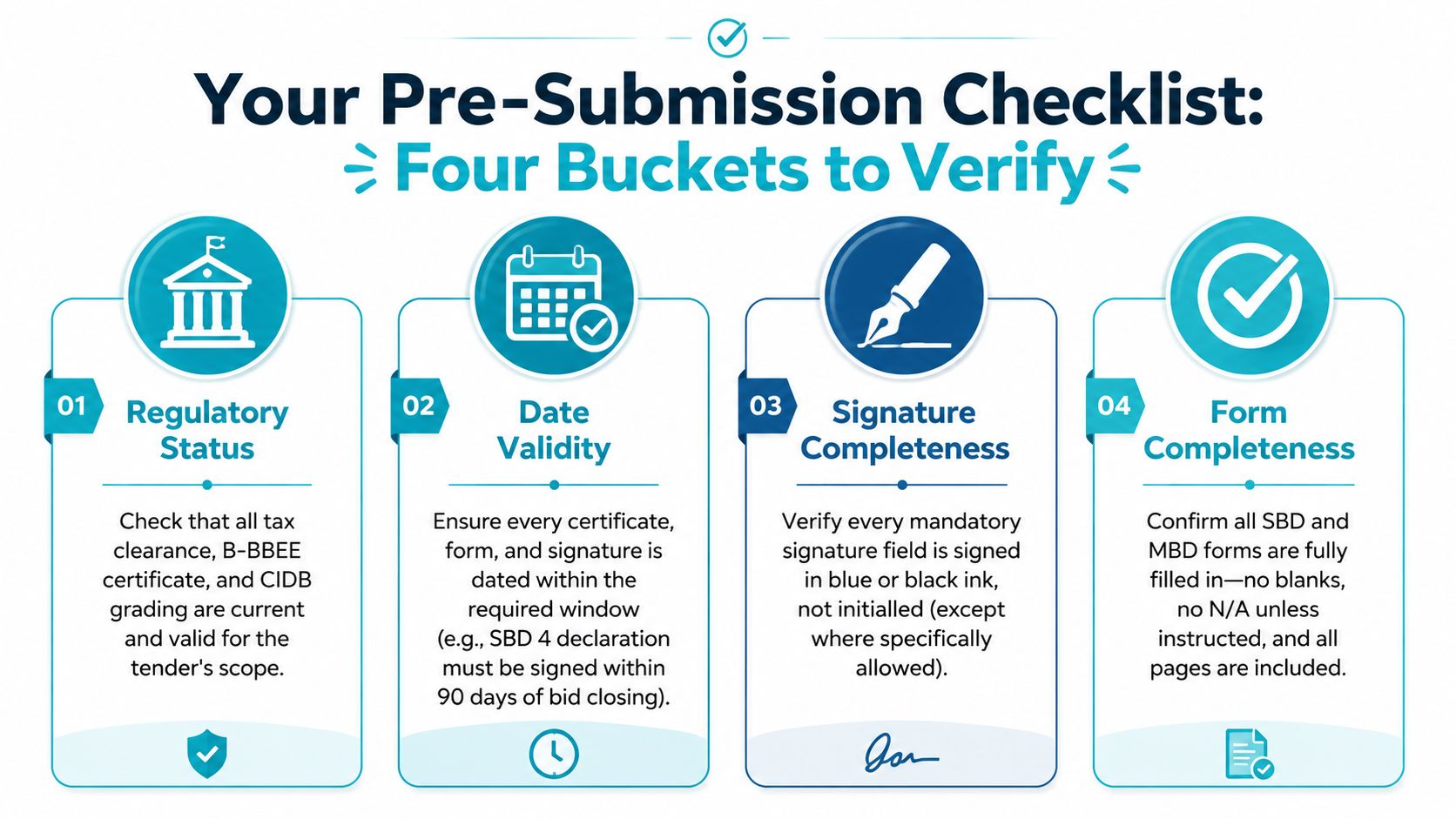
Turn the tender pack into four verification buckets. This prevents the final review from becoming a rushed search through folders and emails.
Four checks before sealing the bid
- Regulatory status: Confirm CSD, SARS, B-BBEE and any sector registration. For construction, check CIDB. For security, check PSIRA. For healthcare, check the relevant licence and professional registrations.
- Date validity: Compare every certificate, affidavit, letter and declaration with the closing date and the tender’s stated validity rule. A document that is current today may not satisfy a requirement tied to closing.
- Signature completeness: Inspect SBD 1, SBD 4, preference forms, declarations, pricing schedules and resolutions. An authorised signatory must complete the fields the tender identifies.
- Cross-reference consistency: Match the legal name, registration number, tax reference, address and banking information across CIPC, SARS, CSD and the bid response. Resolve discrepancies before upload or delivery.
A clean pack tells the evaluator one consistent story about who is bidding, who signed, what is being offered and whether the bidder is eligible.
How to organise the review sheet
Create a one-page working sheet with four columns: document, tender instruction, evidence location and final check. Mark each item as mandatory, conditional or not applicable only when the tender allows that treatment. Keep the official tender checklist beside your internal version so your team can trace each tick to a page or file.
If the tender requires proof of insurance, store the current certificate with the administrative pack. A platform such as Bi-me’s online insurance certificate service can provide a central place to access and share certificates, subject to the relevant policy terms and requirements. Where the tender calls for professional indemnity, public liability or contract works cover, prepare that proof early rather than treating it as a last-minute attachment.
Disqualifiers That Catch Otherwise Strong Bids
A strong price and capable team do not protect a bidder from an administrative rejection. The official returnable-document checklist makes the underlying problem clear. Public entities need complete, auditable evidence before they can assess the offer.
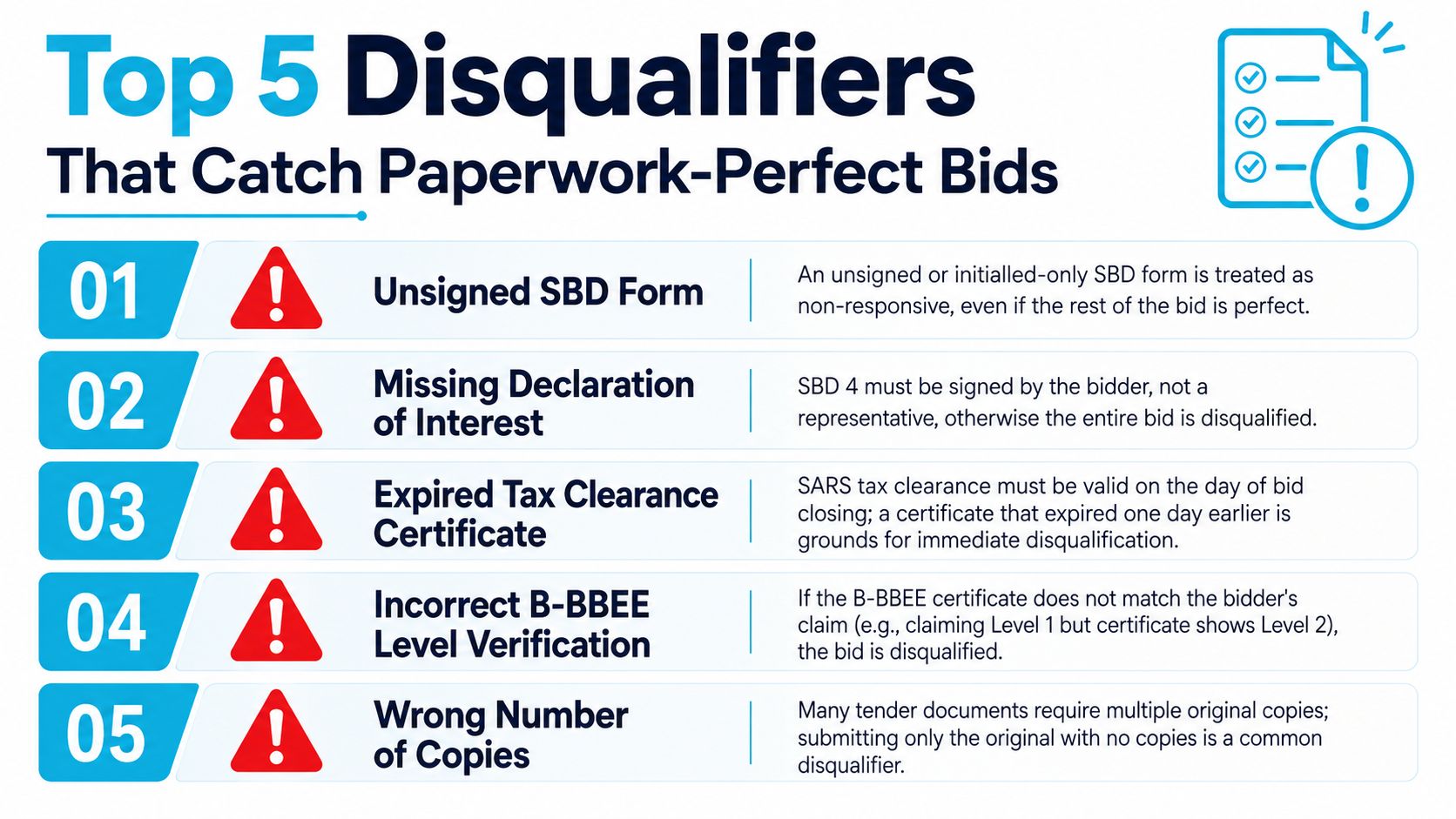
Common tender document disqualifiers in South Africa
Check these traps before your courier arrives or your portal upload begins:
Administrative & Identity Triggers
- Unsigned Forms: Unsigned SBD or MBD forms trigger non-responsiveness. Initialling a page is not a substitute unless expressly permitted.
- Mismatched Identity: Entity names on CSD, CIPC, and SARS records must match the bid exactly.
- Expired Evidence: Tax PINs, B-BBEE, COID, and sector certificates must remain active throughout evaluation.
Qualification & Eligibility Failures
- Wrong Preference Support: B-BBEE certificates must align directly with the tender’s stated specific goals.
- Insufficient CIDB Grading: Lower grades or incorrect classes result in automatic disqualification regardless of price.
- Late or Incorrect Delivery: Submissions received after the deadline or via unapproved channels are excluded without review.
Mandatory Declarations & Restrictions
- Undeclared Conflicts: Failure to declare state-employed directors or connected persons on SBD 4 causes rejection.
- State Employee Restrictions: Unauthorised contracting with persons in state service triggers immediate disqualification.
- Treasury Listing: Bidders on the Register for Tender Defaulters or Restricted Suppliers face automatic exclusion.
- Missed Briefings: Failing to attend a compulsory briefing or sign the register renders the bid non-responsive.
The cited official documents also show that tenders may require a signed invitation, declarations of interest and past supply-chain practices, preference-point forms and independent bid declarations within the updated SBD 4 framework. Missing one of these can affect responsiveness before the committee considers price.
Why these disqualifiers matter
From a PFMA and MFMA compliance perspective, these disqualifiers matter because the procuring entity must show that it evaluated bids against published requirements, supplier eligibility rules and supply chain management controls. A bid can be commercially excellent and still fail on legality, auditability or integrity grounds.
Run a final self-audit with someone who did not prepare the pack. Ask that person to verify the closing date, submission channel, signatures, page count, file names, copies, compulsory briefing evidence and every mandatory tick-box. Where professional advice or contractual insurance is relevant, businesses can also review professional indemnity insurance options alongside the tender’s requirements.
Applying the Decision-Tree Workflow to Any Tender
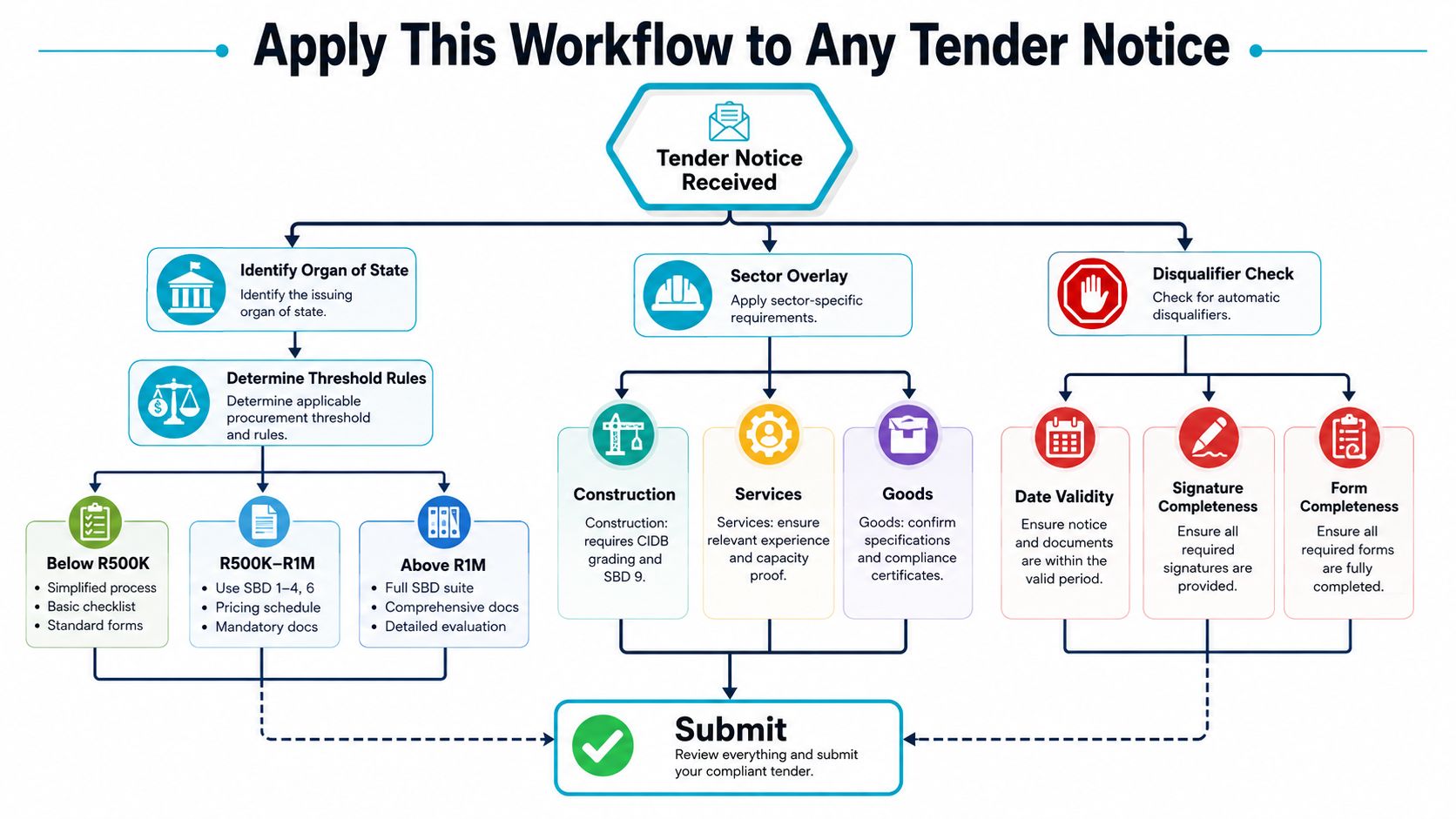
Use the same sequence every time, but let the tender details decide the branches. A repeatable Tender Documents Checklist South Africa workflow helps SMEs reduce avoidable compliance mistakes from one bid to the next.
Start with the notice
Identify the organ of state and read its tender conditions, returnable schedule, pricing instructions, addenda and submission method. Confirm whether the procurement is national, provincial or municipal, because the form family and terminology may differ.
Next, confirm the business baseline. Check CIPC, SARS, CSD, B-BBEE, banking evidence, director IDs and the required SBD or MBD forms. Then, identify the bid value and apply the correct preference system.
For 80/20 preference points South Africa analysis, ask whether the total tender value is at or below R50 million inclusive of VAT. If it is above R50 million inclusive of VAT, move to the 90/10 framework and the tender’s stated specific goals. The supply chain management guidance confirms that the procuring entity should compile its own bidding checklist and tailor it to the commodity and special conditions.
Add the sector and delivery overlays
Add the sector overlay. Construction may require CIDB, COID and safety evidence. Security may require PSIRA documentation. Professional or healthcare work may require registrations, licences and competence evidence.
Then, add the delivery structure overlay. Single-entity bids should follow the standard compliance path. For joint ventures or consortiums, verify the signed agreement, lead-partner authority, and individual compliance evidence for every member. When a tender requires targeted subcontracting, confirm the subcontractor’s status and percentage allocation prior to submission rather than after the award.
For example, an Eastern Cape cleaning tender at R800,000 should be checked against its own listed baseline and service-specific documents. A R12 million Gauteng construction bid should also be checked against the 80/20 preference framework because it remains below the R50 million threshold, while still requiring a deeper review of the stated CIDB grade, contractor registration evidence, COID and any bid guarantee or other financial security demanded by the pack.
Those examples illustrate the decision process, not a universal document rule.
Final stress test before submission
Finally, stress-test the completed pack for dates, signatures, identity matching, required copies, pricing arithmetic and delivery confirmation. Joint ventures need their own branch, including the signed JV agreement, lead-partner authority, each participant’s required compliance evidence and any consolidated B-BBEE or specific-goal document requested. Subcontracting arrangements should be checked against the tender’s stated declarations and supporting confirmations.
Common Questions Bidders Ask Before Submitting
Common Tender Compliance Questions
Should I refresh my CSD report before every bid?
Refresh it close to submission. If the issuing entity requests a current report, generate a new version rather than reusing an old file.
What does a joint venture need?
Submit the signed JV agreement, lead partner authority, each member’s tax and registration proof, and required B-BBEE documentation.
How do 80/20 and 90/10 preference points work?
In general, 80/20 applies to tenders up to R50 million (inclusive of VAT), and 90/10 applies above R50 million. Always verify specific goals before claiming points.
Document Management & Submission Rules
Can I reuse B-BBEE, CIPC, and COID documents?
Yes, provided you verify validity, entity details, and certification dates for each new submission.
What counts as mandatory?
Any document marked compulsory, returnable, or pre-qualifying is mandatory. Optional profiles cannot replace required forms.
What if an addendum arrives after compilation?
Download the addendum, replace affected schedules, sign the required acknowledgement, and update your submission pack accordingly.
Bi-me helps South African SMEs compare business insurance quotes, tailor cover by industry or occupation, buy eligible cover online and access policy documents in a self-service portal. Review the cover your tender requires, then visit Bi-me to compare options and retrieve certificates.
This is general information only and does not take into account your financial situation, needs, or specific objectives. As with any insurance, the cover will be subject to the terms, conditions, and exclusions contained in the policy wording.